
1. Introduction: Performance Boundary of Sodium Allyl Sulfonate in High-Salinity Drilling Fluids
Sodium allyl sulfonate, commonly abbreviated as SAS or ALS, CAS NO.:2495-39-8, is a widely used anionic functional monomer for synthesizing water-based drilling fluid additives including fluid loss reducers, clay dispersants and shale stabilizers. Its sulfonate groups provide hydration and electrostatic repulsion to stabilize bentonite colloids under moderate temperature and salinity conditions, making it a cost-effective choice for shallow and medium-depth wells.
However, in saturated brine drilling systems — such as salt-gypsum formations, high-density completion brines and saturated NaCl/CaCl₂ workover fluids — sodium allyl sulfonate based polymers suffer obvious performance degradation. Saturated salt environments compress the electric double layer of polymer chains, shield anionic charges and even cause polymer precipitation, leading to sharp drops in viscosity retention, out-of-control HTHP fluid loss and wellbore instability risks. Solving the salt resistance limitation of SAS requires systematic optimization from molecular structure design, polymerization process and field application engineering, rather than simply increasing polymer dosage.
2. Root Mechanism of Insufficient Salt Resistance of Sodium Allyl Sulfonate (SAS/ALS)
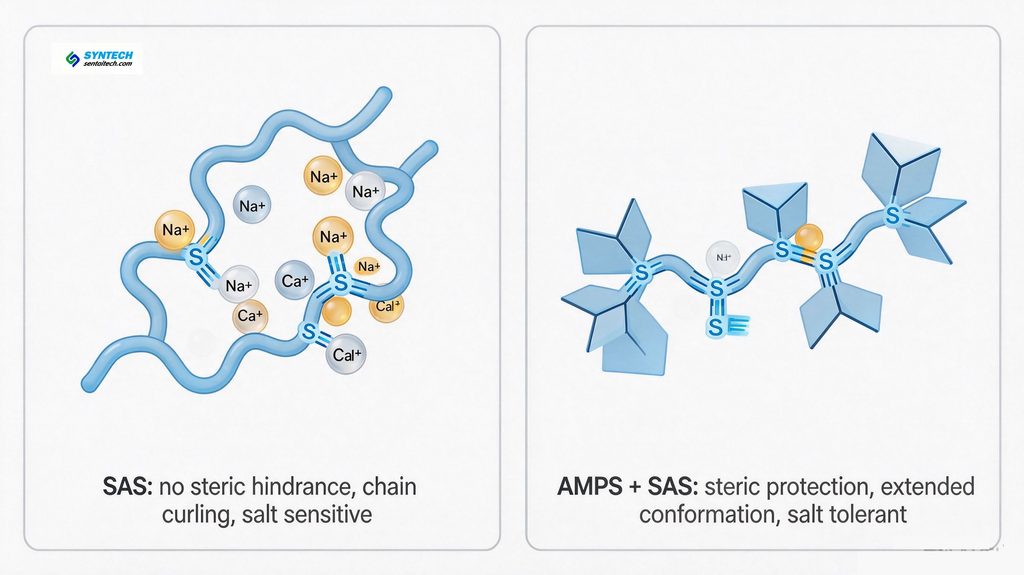
The inherent molecular structure of sodium allyl sulfonate determines its upper limit of salt tolerance, which cannot be eliminated by simple formulation adjustment. First, SAS has a short flexible allyl backbone (CH₂=CH–CH₂–SO₃Na) with no bulky side groups to provide steric hindrance. In saturated brine with high ionic strength, Na⁺, Ca²⁺ and Mg²⁺ directly approach the sulfonate groups, compress the hydration shell and neutralize negative charges. The polymer chains curl from an extended conformation into tight coils, losing hydrodynamic volume and dispersion capacity rapidly. Second, divalent cations such as Ca²⁺ can form ionic bridges between two sulfonate groups on different chains, causing intermolecular cross-linking, flocculation and even precipitation. This effect is far more severe for SAS than for sterically hindered sulfonate monomers, because the exposed sulfonate groups on SAS have no spatial barrier against cation attack. Third, the allylic C–H bond on the SAS backbone is chemically active. Under the combined action of high temperature and high salt, chain scission and oxidative degradation are accelerated, further reducing the effective polymer concentration in the drilling fluid.
3. Solution 1 — Copolymerization with Sterically Hindered Sulfonate Monomers (AMPS as Core Strategy)
The most industrially validated solution is to copolymerize sodium allyl sulfonate with 2-acrylamido-2-methylpropane sulfonic acid (AMPS), and use AMPS as the main salt-tolerant functional unit while retaining SAS as an auxiliary monomer for molecular weight regulation and cost control. AMPS carries a bulky tert-butyl side group next to the sulfonate group, which creates strong steric hindrance. This spatial barrier prevents salt cations from approaching and shielding the sulfonate groups, so the polymer can maintain an extended chain conformation even in saturated brine. Meanwhile, the amide bond on AMPS has better hydrolysis resistance and thermal stability than the allyl structure of SAS.
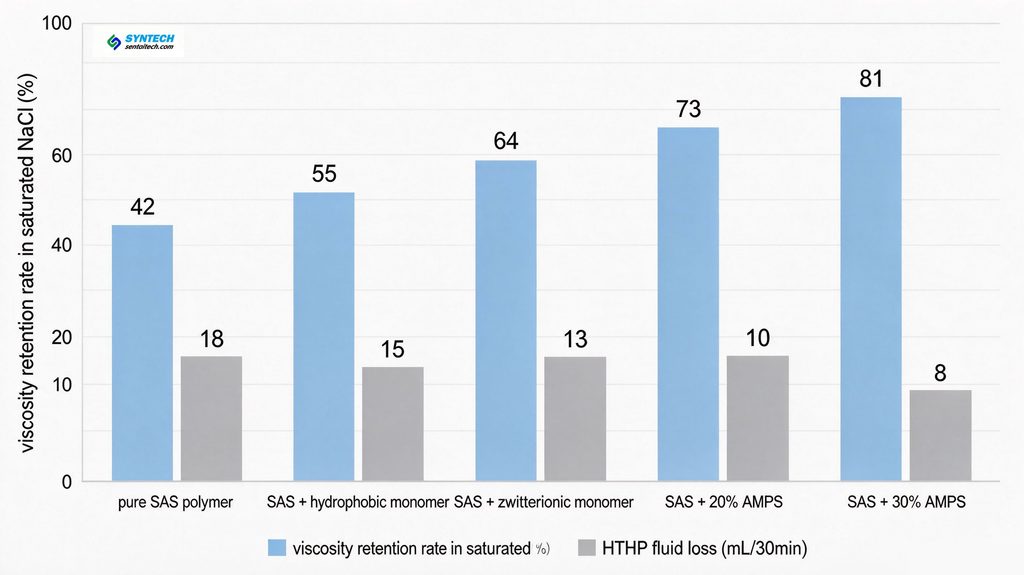
Field performance data shows that when AMPS accounts for more than 20 mol% of total monomers, the viscosity retention rate of the copolymer in saturated NaCl brine rises from less than 30% (pure SAS polymer) to over 70%, and HTHP fluid loss can be reduced by more than 40% after thermal aging at 180 °C. For saturated CaCl₂ brine systems with higher divalent ion content, the AMPS proportion should be further increased to 30–40 mol%, and the SAS proportion should be controlled at 10–25% to avoid salt sensitivity.
4. Solution 2 — Introduce Hydrophobic or Zwitterionic Functional Units
4.1 Hydrophobic association modification
Incorporating a small amount (2–5 mol%) of hydrophobic monomers such as long-chain alkyl acrylamide or styrene into the SAS copolymer system builds a hydrophobic association network. In high-salinity environments, the hydrophobic groups aggregate spontaneously to form physical cross-linking points, which compensates for the viscosity loss caused by charge shielding. This mechanism has been widely verified in high-salinity fracturing fluid and drilling fluid polymer designsPMC.
4.2 Zwitterionic modification
Copolymerizing SAS with zwitterionic monomers such as sulfobetaine-type vinyl monomers introduces the anti-polyelectrolyte effect. Unlike ordinary anionic polymers that shrink in salt, zwitterionic polymers expand more as salinity rises, because external salt ions break the intramolecular charge pairs and stretch the molecular chainsSemantic S…. This design can maintain stable filtration control even in saturated CaBr₂ heavy brine systems at 190–200 °CACS Public….
5. Solution 3 — Optimize Polymerization Process to Regulate Chain Structure
Poor salt resistance of many SAS-based products does not come from the monomer itself, but from unreasonable polymerization process that produces uneven composition and wide molecular weight distribution.
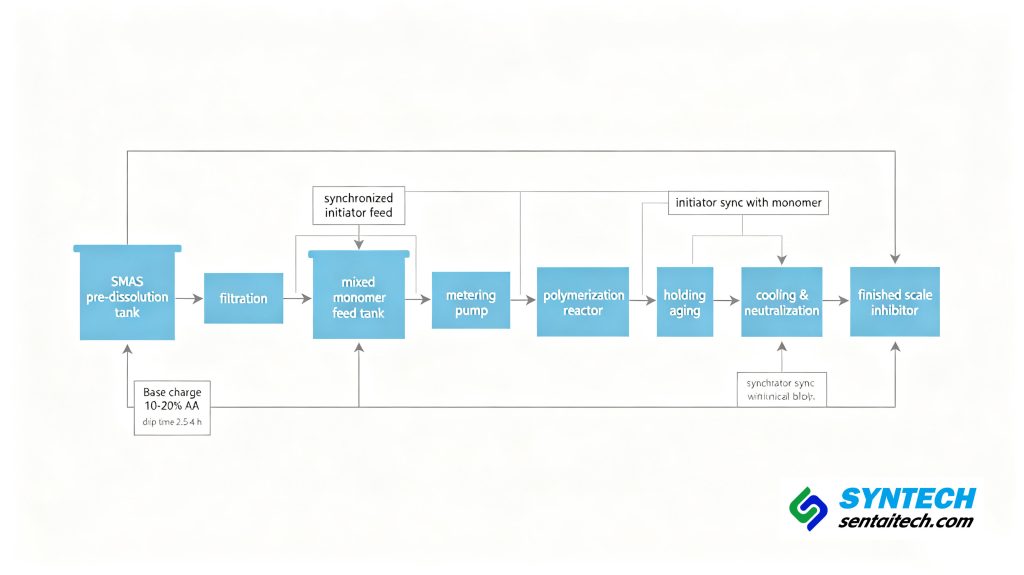
- Staged feeding strategy: Add the salt-tolerant main monomers first, then drip sodium allyl sulfonate and other functional monomers synchronously with the initiator. This avoids SAS homopolymer segments and makes sulfonate groups evenly distributed along the chain, improving overall salt tolerance.
- Controlled molecular weight window: For saturated brine drilling fluid fluid loss additives, the optimal weight-average molecular weight is controlled at 30,000–80,000 Da. Too high molecular weight causes salt-induced precipitation; too low fails to form an effective filter cake.
- Narrow polydispersity: Use redox initiation systems with stable decomposition rate to obtain narrow molecular weight distribution, which reduces the high-MW precipitation fraction and low-MW invalid fraction simultaneously.
6. Solution 4 — Compound with Salt-Tolerant Synergistic Additives
For on-site applications where polymer structure cannot be changed temporarily, compounding synergistic additives can effectively improve the salt resistance performance of SAS-based drilling fluid systems.
- Nanomaterial enhancers: Nano-silica, laponite or modified carbon nanotubes fill the micropores of the filter cake, forming a denser low-permeability barrier. They also adsorb polymer chains to form a composite network, reducing the impact of salt-induced polymer curling on filtration controlPMC.
- Rigid resin synergists: Compound with sulfonated phenolic resin or sulfonated lignite. These macromolecular rigid materials have inherent high salt tolerance and can work synergistically with SAS-based polymers to improve high-temperature high-salt filtration performance.
- Clay stabilizers: Add appropriate potassium chloride or polyamine shale inhibitors to reduce clay hydration and dispersion, lowering the requirement for polymer dispersion capacity under high salt.
7. Solution 5 — Optimize Field Mixing and Application Procedures
Even with the same polymer product, different on-site mixing procedures lead to very different salt resistance performance.
- Pre-hydration in fresh water first: Fully hydrate the sodium allyl sulfonate based polymer in fresh water before gradually adding salt to increase salinity. Directly adding polymer into saturated brine will cause instantaneous surface coagulation and internal unwrapping, forming “fish-eye” gel particles that cannot function effectively.
- Stepwise dosing of polymer and salt: Add polymer in batches, and increase salinity step by step, so that the polymer chain can gradually adapt to the high-salt environment and maintain a more stretched conformation.
- pH control: Maintain the drilling fluid pH at 9.0–10.5. Too low pH accelerates amide hydrolysis; too high pH promotes magnesium hydroxide precipitation, both of which aggravate performance degradation of SAS-based systems.
8. Solution 6 — Clarify Application Boundaries and Position SAS as Auxiliary Monomer
It must be emphasized that due to structural limitations, sodium allyl sulfonate is never suitable as the sole main sulfonate monomer for saturated brine drilling systems. The most cost-effective positioning is to use SAS as an auxiliary functional monomer accounting for 10–30% of total monomers, which plays the role of adjusting molecular weight, improving early dispersion and reducing raw material cost, while the core salt-tolerant function is borne by AMPS, zwitterionic units or other high-performance monomers. For ultra-deep wells above 200 °C and heavy brine completion systems above 1.8 g/cm³ density, SAS should only be used as a trace co-monomer, and the main formula should rely on high-performance salt-tolerant monomers to meet downhole requirements.
Frequently Asked Questions (FAQ)
Q1: Why does sodium allyl sulfonate (SAS/ALS, CAS NO.:2495-39-8) have poor salt resistance in saturated brine?
A1: SAS has a short flexible allyl backbone with exposed sulfonate groups and no steric hindrance. In saturated brine, salt cations compress the electric double layer, shield negative charges and cause chain curling; divalent ions also cause intermolecular cross-linking and precipitation, leading to loss of fluid loss control and rheology stability.
Q2: Can pure sodium allyl sulfonate homopolymer be used as the main fluid loss additive in saturated brine drilling fluid?
A2: No. Pure SAS homopolymer has very limited salt tolerance and will lose most of its effectiveness in saturated NaCl or calcium-containing brine. SAS should be used as an auxiliary co-monomer copolymerized with salt-tolerant monomers such as AMPS.
Q3: What is the most effective technical route to improve the salt resistance of SAS-based drilling fluid polymers?
A3: Copolymerization with AMPS (2-acrylamido-2-methylpropane sulfonic acid) is the most mature and cost-effective solution. The steric hindrance of AMPS protects sulfonate groups from cation shielding, and can increase viscosity retention in saturated brine from <30% to over 70%.
Q4: What is the appropriate proportion of sodium allyl sulfonate in saturated brine drilling fluid polymer formulas?
A4: Generally 10–25% of total monomer mass is recommended. Within this range, SAS can regulate molecular weight and control cost without obviously reducing the overall salt tolerance of the product. Exceeding 30% will cause significant salt sensitivity.
Q5: Can increasing the dosage of SAS polymer compensate for insufficient salt resistance on site?
A5: No. Excessive polymer dosage under high salt will aggravate intermolecular cross-linking and flocculation, which may instead increase fluid loss and deteriorate rheology. The correct approach is to optimize polymer structure or compound salt-tolerant synergists.
Q6: Can on-site mixing process adjustment improve the salt resistance of SAS-based drilling fluid?
A6: Yes. Pre-hydrating polymer in fresh water first, then increasing salinity step by step can avoid instantaneous polymer coagulation and significantly improve the actual salt resistance performance. Maintaining pH at 9.0–10.5 also helps stabilize performance.
References
[1] Ningbo Innopharm. Sodium Allylsulfonate: A Versatile Component for Oilfield Drilling Fluids [EB/OL]. https://www.nbinno.com/article/other-organic-chemicals/sodium-allylsulfonate-oilfield-drilling-fluids-additive-ce
[2] Xie J, et al. Multi-Scale Regulation of High-Temperature and High-Salinity Water-Based Drilling Fluids [J]. Petroleum Science and Technology, 2024.
[3] Sun Y, et al. Salt-responsive zwitterionic polymer for saturated brine drilling fluid rheology enhancement [J]. Colloids and Surfaces A: Physicochemical and Engineering Aspects, 2023.
[4] Alhamzah A A, Fellows C M, Hamed O A. Methallylsulfonate Polymeric Antiscalants for Application in Thermal Desalination Processes [J]. Polymers, 2023.
[5] Wang G, Li J. Preparation and Properties of AMPS-Modified Fluid Loss Additive for High-Salinity Drilling Fluids [J]. Drilling Fluid & Completion Fluid, 2022, 39(2): 187–193.
[6] ACS Omega. Perspective Review of Polymers as Additives in Water-Based Fracturing Fluids — sulfonated polymer salt tolerance mechanism [J]. ACS Omega, 2022, 7(8): 6912–6925.
[7] Huang X, Sun J, et al. A high-temperature resistant and high-density polymeric saturated brine-based drilling fluid [J]. Petroleum Exploration and Development, 2023, 50(3): 612–620.
[8] API Recommended Practice 13B-1: Recommended Practice for Field Testing Water-Based Drilling Fluids [S]. American Petroleum Institute, 2019.