
1. Why High Ca²⁺/Mg²⁺ Formations Stress SAS/ALS-Based Drilling Fluids
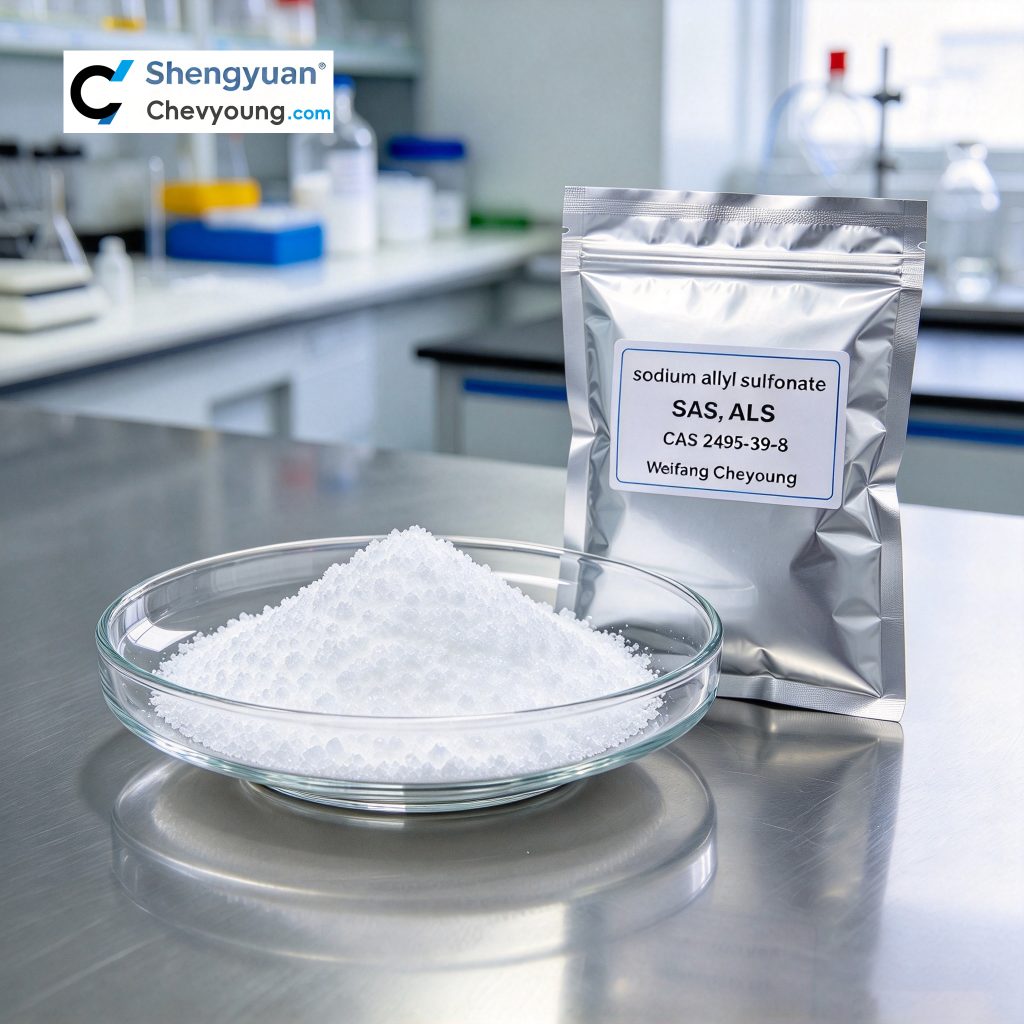
Sodium allyl sulfonate, abbreviated SAS or ALS, CAS NO.:2495-39-8, is a common anionic functional monomer copolymerized into water-based drilling fluid polymers — fluid-loss reducers, shale stabilizers and dispersants. The polymer carries negatively charged –SO₃⁻Na⁺ groups that hydrate, disperse bentonite and build a thin, low-permeability filter cake. When drilling through gypsum, anhydrite, salt-dome sequences, seawater-contaminated mud or calcium-rich carbonate reservoirs, Ca²⁺ and Mg²⁺ invade the mud continuously. Dissolving anhydrite cuttings can raise filtrate Ca²⁺ by 200–500 mg/L per circulation cycle. Divalent cations compress the electric double layer around both bentonite platelets and SAS/ALS-bearing polymer chains, neutralize negative charge, and break the dispersion that SAS-modified polymers are designed to provide. The failure modes below are the predictable, field-observed consequences.
2. Failure Mode 1 — Double-Layer Compression and Zeta-Potential Collapse
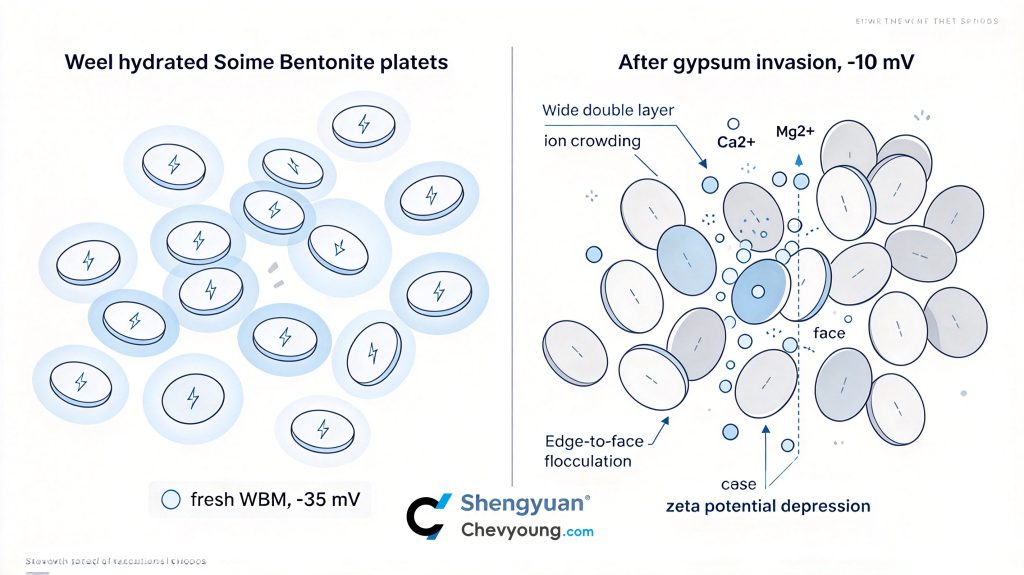
SAS/ALS copolymer works by adsorbing onto bentonite and leaving a negatively charged, hydrated shell that keeps platelets apart. In high Ca²⁺/Mg²⁺ mud, divalent cations screen the –SO₃⁻ charges. Measured Zeta potential drops sharply from the normal −30 to −40 mV toward −10 mV or closer to zero. Once repulsion falls below the van der Waals attraction, bentonite platelets aggregate. The thin, hydrated colloidal network that gives the mud its rheology and filtration control disintegrates. Adding more SAS/ALS-based polymer does not restore stability, because the extra –SO₃⁻ is immediately screened by incoming Ca²⁺.
3. Failure Mode 2 — Bentonite Flocculation and Rheology Blow-Out
Two microstructural changes occur simultaneously:
- Edge-to-face flocculation (“card-house”): Ca²⁺ bridges positively charged clay edges to negative faces, raising yield point (YP) and gel strength sharply. The mud becomes highly thixotropic and gelled at rest, which causes high pump pressure, surge pressures on restart and lost-circulation risk.
- Face-to-face aggregation: platelets stack tightly, lose hydration water, and the effective yield of bentonite collapses. The mud goes watery despite high solids content. Field symptoms: PV/YP ratio distorted, 10 s and 10 min gel strength rising cycle by cycle, Marsh funnel time swinging erratically. Operators often mistake this for insufficient polymer and over-dose SAS/ALS thinner, which worsens salt load and accelerates the next cycle.
4. Failure Mode 3 — Ca-Bentonite Conversion and Filter-Cake Degradation
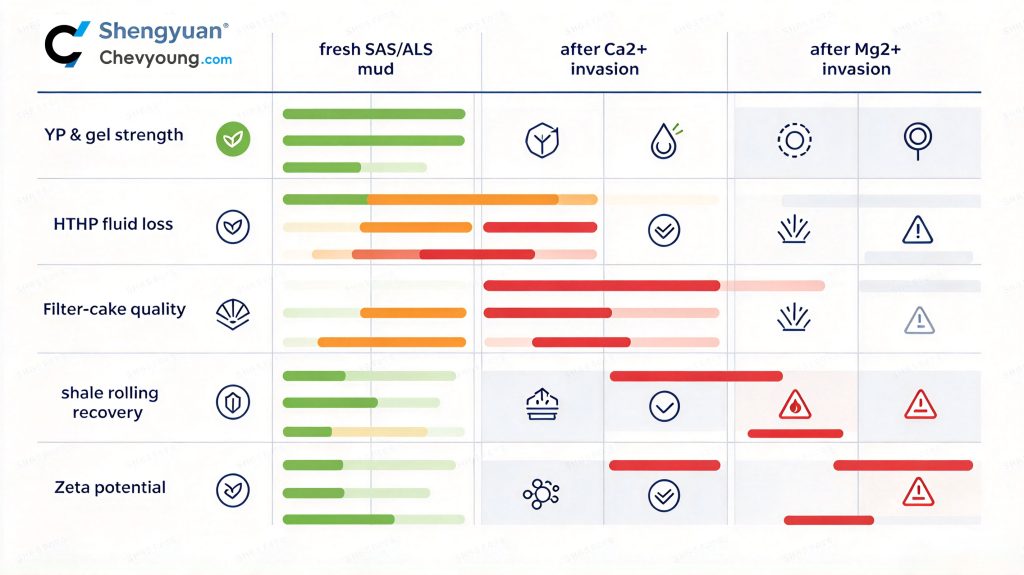
Na-bentonite hydrates to ~1000–1200 times its dry volume; Ca-bentonite hydrates to only ~30 times. When Ca²⁺ exchanges with Na⁺ on the clay exchange complex, the active bentonite yield drops dramatically. The remaining filter cake becomes thick, spongy, high-permeability and sticky. HHTP (high-temperature high-pressure) fluid loss surges from a design target of 8–12 mL to 25–40 mL or more. The cake no longer seals the permeable formation, filtrate invades shale, and differential sticking risk rises. Adding more SAS/ALS polymer cannot compensate because the underlying clay mineral has been chemically converted.
5. Failure Mode 4 — Precipitation of Anionic Polymer and Sulfonate Salts
Although calcium sulfonate is more soluble than calcium carbonate or phosphate, locally high Ca²⁺ plus alkaline pH still precipitates the anionic polymer as calcium-crosslinked microgels. These microgels:
- appear as tacky slugs on the shaker screens;
- plug shale-shaker screens and downhole pore throats;
- reduce the active polymer concentration in the liquid phase;
- form a “false” viscosity that disappears after hot rolling. Magnesium adds a second issue: at pH above ~10.5, Mg²⁺ precipitates as Mg(OH)₂. This fluffy white precipitate floats in the mud, increases total solids, raises density unpredictably and gives a false high gel.
6. Failure Mode 5 — Loss of Shale Inhibition and Wellbore Instability
SAS/ALS-modified polymers rely on electrostatic repulsion to keep reactive shale cuttings dispersed and limpet-free. Under Ca²⁺/Mg²⁺ screening, the polymer cannot adsorb uniformly on shale. Cuttings hydrate, swell and disperse into the mud, increasing low-gravity solids (LGS). Rolling recovery of shale cuttings drops, the shale shakers see gumbo balls, and hole diameter enlarges. The combination of thick filter cake + poor inhibition causes stuck pipe, bit balling and slow ROP.
7. Failure Mode 6 — False Treatments and Runaway Chemical Cost
The most expensive field failure is the treatment loop. Seeing rising fluid loss and YP, the mud engineer adds more SAS/ALS polymer, more thinner and more alkali. Each addition:
- increases anionic load that Ca²⁺ precipitates;
- raises pH and accelerates Mg(OH)₂ precipitation;
- adds salts that further compress the double layer. Without pre-treatment — soda ash (Na₂CO₃) to precipitate Ca²⁺ as CaCO₃, or caustic/soda ash sequencing to remove Mg²⁺ — every chemical dose is partially wasted. Mud cost per meter climbs while rheology and filtration keep drifting.
8. Corrective Chemical Sequence (Mechanistic Basis)
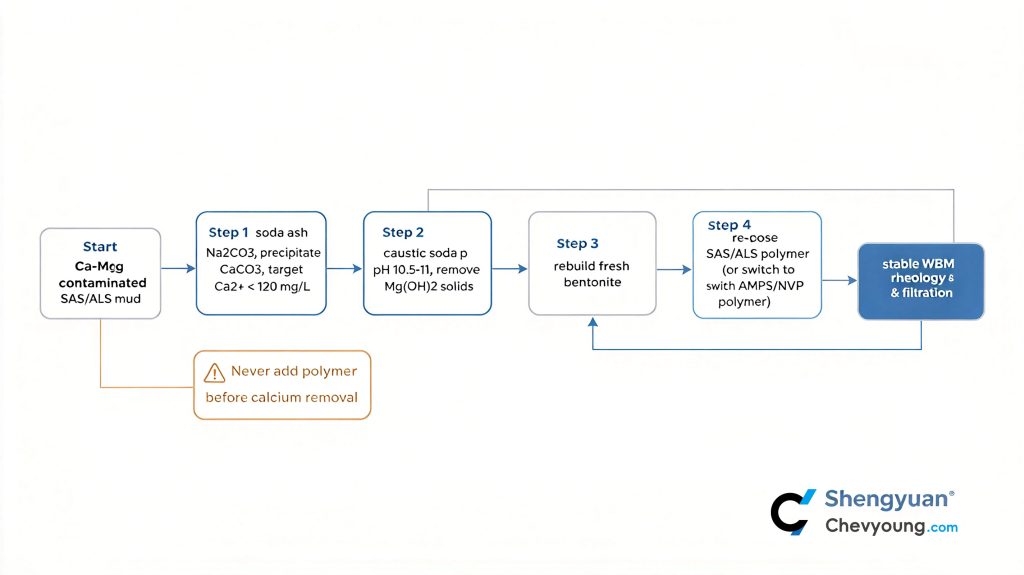
Field-proven sequence in Ca²⁺/Mg²⁺ invasion:
- Precipitate Ca²⁺ first with soda ash (Na₂CO₃), target filtrate Ca²⁺ < 120 mg/L.
- Precipitate Mg²⁺ with caustic soda to pH 10.5–11.0, flocculate and remove Mg(OH)₂ solids.
- Rebuild colloidal fraction with fresh bentonite.
- Only then re-dose SAS/ALS-based polymer (or switch to AMPS/NVP-based polymers for extended salt/heat tolerance). Adding SAS/ALS polymer before calcium removal is the root cause of most failure modes above.
Frequently Asked Questions
Q1: Why does SAS/ALS (sodium allyl sulfonate, CAS NO.:2495-39-8) polymer fail in gypsum formations?
A1: Gypsum releases Ca²⁺, which compresses the clay double layer, converts Na-bentonite to Ca-bentonite and screens the –SO₃⁻ charges on the SAS polymer. The polymer loses dispersion, fluid loss rises and rheology blows out.
Q2: What is the typical filtrate Ca²⁺ level that triggers visible failure of SAS-based mud?
A1: Trouble usually begins above ~120–200 mg/L Ca²⁺. Anhydrite dissolution adds 200–500 mg/L Ca²⁺ per circulation cycle if not treated, so untreated Ca²⁺ quickly reaches the failure threshold.
Q3: Does magnesium cause a different failure pattern than calcium?
A3: Yes. Mg²⁺ mostly precipitates as Mg(OH)₂ at high pH, adding fluffy solids and false gel strength. Ca²⁺ drives clay flocculation, bentonite conversion and filter-cake degradation. Both must be removed in sequence.
Q4: Can we compensate by simply adding more SAS/ALS-based thinner?
A4: No. Extra anionic polymer is precipitated by Ca²⁺ and raises salt load further. Calcium must be precipitated first (soda ash) before polymer re-dosing works.
Q5: Is SAS/ALS-based polymer suitable for seawater or saturated brine mud?
A5: SAS-based polymers are acceptable for moderate salinity. For high-salinity, high-Ca²⁺/Mg²⁺ and HTHP wells, AMPS- or NVP-based polymers with rigid amide backbones outperform SAS-based ones because they resist cation screening better.
Q6: How can field engineers diagnose Ca²⁺/Mg²⁺ failure of SAS/ALS mud quickly?
A6: Check filtrate Ca²⁺ and Mg²⁺ by titration, Zeta potential, HTHP fluid loss, 10-min gel strength and shale rolling recovery. Rising Ca²⁺ + dropping Zeta + rising fluid loss + rising gel = calcium-contamination signature.
References
[1] Drilling Fluids Explored. How to Treat Calcium and Magnesium Contamination, 2020. https://drillingfluidexplore.wordpress.com/2020/10/18/how-to-treat-calcium-and-magnesium-contamination/
[2] Oil Authority. Calcium Contamination in WBM — anhydrite dissolution raises filtrate Ca²⁺ by 200–500 mg/L per cycle. https://oilauthority.com/glossary/calcium-contamination
[3] Oil Authority. Aggregation — face-to-face stacking of clay by Ca²⁺/Mg²⁺ double-layer compression. https://oilauthority.com/glossary/aggregation
[4] Oil Authority. Deflocculated Mud — calcium precipitates lignosulfonate deflocculants and causes flocculation. https://oilauthority.com/glossary/deflocculated-mud
[5] MDPI Processes. A Low-Molecular-Weight Polymer Fluid-Loss Additive for WBM Under High-Salinity, High-Temperature, High-Density Conditions, 2026, 14(13): 2192. https://www.mdpi.com/2227-9717/14/13/2192
[6] PMC. Nano-Modified Polymer Gels as Temperature- and Salt-Resistant Fluid-Loss Additive — Zeta potential drop under salt-gypsum invasion. PMC9498723. https://pmc.ncbi.nlm.nih.gov/articles/PMC9498723/
[7] Li et al. Overcoming Salt Contamination of Bentonite WBM with Dual-Functionalized Cellulose Nanocrystals. (Ca²⁺/Na⁺ attachment to bentonite face surfaces and flocculation mechanism.)
[8] SYNTECH. Sodium Allyl Sulfonate (SAS, CAS 2495-39-8) — core monomer for drilling fluid fluid-loss and clay-stabilization polymers. https://www.sentaitech.com/related-research/other-industrial-applications-of-sodium-allyl-sulfonate-sas-cas-2495-39-8/