
1. Why Feeding Sequence Matters for SMAS–Acrylic Acid Scale Inhibitor Synthesis
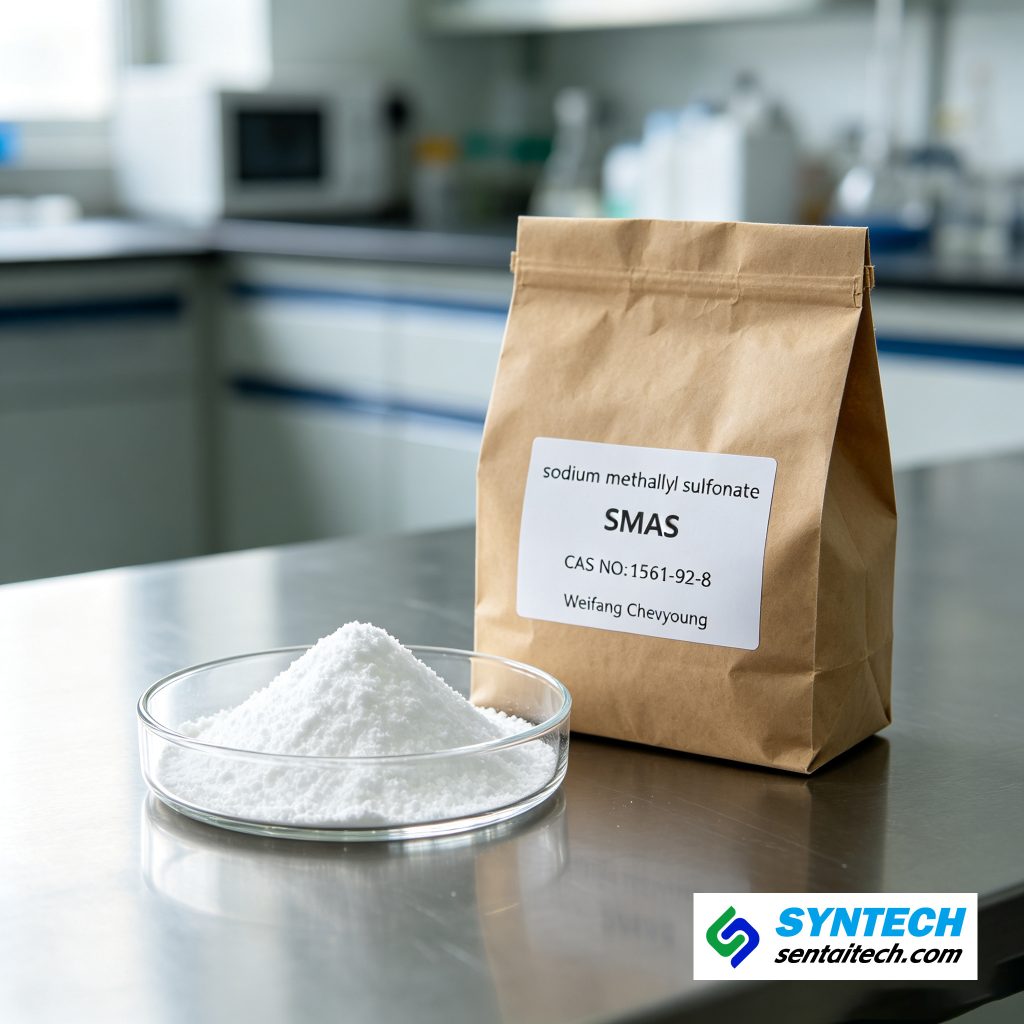
Sodium methallyl sulfonate, widely known as SMAS, CAS NO.:1561-92-8, is a core sulfonated functional monomer for manufacturing phosphorus-free water treatment scale inhibitors. When copolymerized with acrylic acid (AA) via aqueous free-radical polymerization, SMAS introduces negatively charged –SO₃⁻ groups into the polycarboxylate backbone, improving salt tolerance, thermal stability and iron oxide dispersion capacity of the final antiscalant product.
However, sodium methallyl sulfonate and acrylic acid have distinctly different reactivity ratios and polymerization kinetics. Unlike styrene–maleic anhydride systems that tend toward alternating copolymerization, the AA–SMAS pair shows large reactivity mismatch: acrylic acid polymerizes much faster, while the allylic structure of SMAS exhibits stronger chain-transfer behavior and slower propagation rate. If the feeding sequence is not properly designed, the resulting copolymer will have highly uneven monomer sequence distribution, wide molecular weight distribution and high residual monomer, all of which directly degrade scale inhibition performance.
For scale inhibitors, uniform distribution of carboxyl and sulfonate groups along the polymer chain, together with a narrow molecular weight window of 2000–2500 Da, are prerequisites for strong threshold effect and crystal lattice distortion. Feeding sequence is the single most impactful process variable that controls these structural parameters in a standard aqueous copolymerization line.
2. Reactivity Mismatch: The Root Cause of Feeding Sensitivity
The allylic C–H bond in sodium methallyl sulfonate is highly susceptible to chain transfer to monomer, which terminates growing polymer radicals and generates new allylic radicals of low reactivity. This inherent property makes SMAS both a functional monomer and an implicit chain transfer agent during copolymerization.
When all monomers are charged into the reactor in one shot (one-shot batch process):
- Fast-reacting acrylic acid polymerizes first, forming long poly(acrylic acid) homopolymer segments in the early stage.
- SMAS concentration gradually rises in the residual liquid phase, but its low propagation rate leaves large amounts of unreacted SMAS at the end of reaction.
- The final product is a mixture of AA-rich high-molecular-weight chains, SMAS-rich oligomers and residual free SMAS monomer.
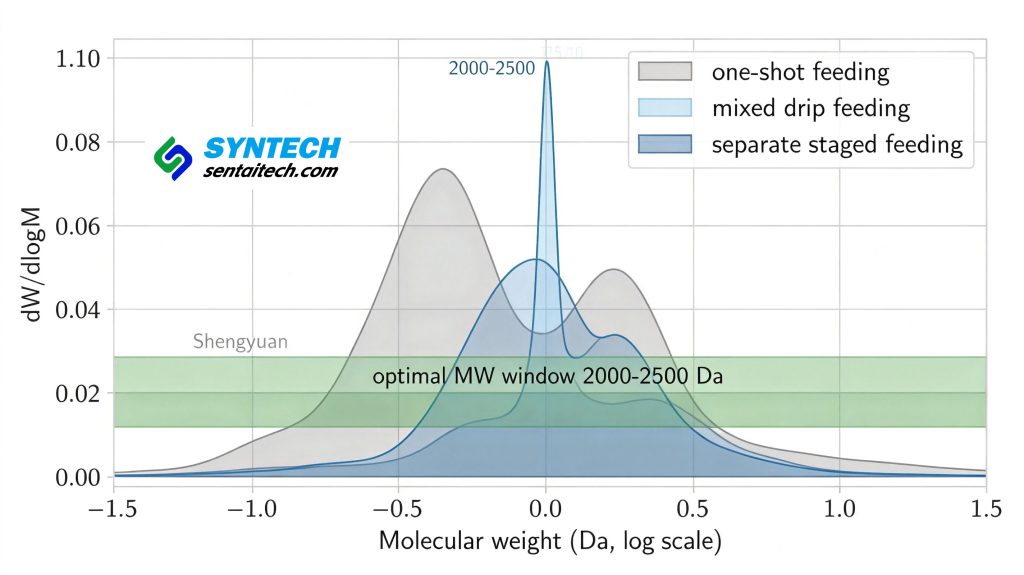
Published work on methallylsulfonate antiscalants for thermal desalination confirms that molecular weight, not just sulfonation degree, determines calcium sulfate inhibition performance, with the best results at 2000–2500 Da. A one-shot feeding process cannot reliably hit this target because the reactivity gap creates a broad, bimodal molecular weight distribution.
3. Comparison of Common Feeding Modes for AA–SMAS Scale Inhibitor
3.1 One-shot full charging
All SMAS, acrylic acid and water are loaded into the reactor before heating and initiator addition. This method is simple but produces the widest composition and molecular weight distribution. It is only acceptable for low-end, low-performance dispersant products, not for precision scale inhibitors.
3.2 Pre-mixed monomer continuous dropwise feeding
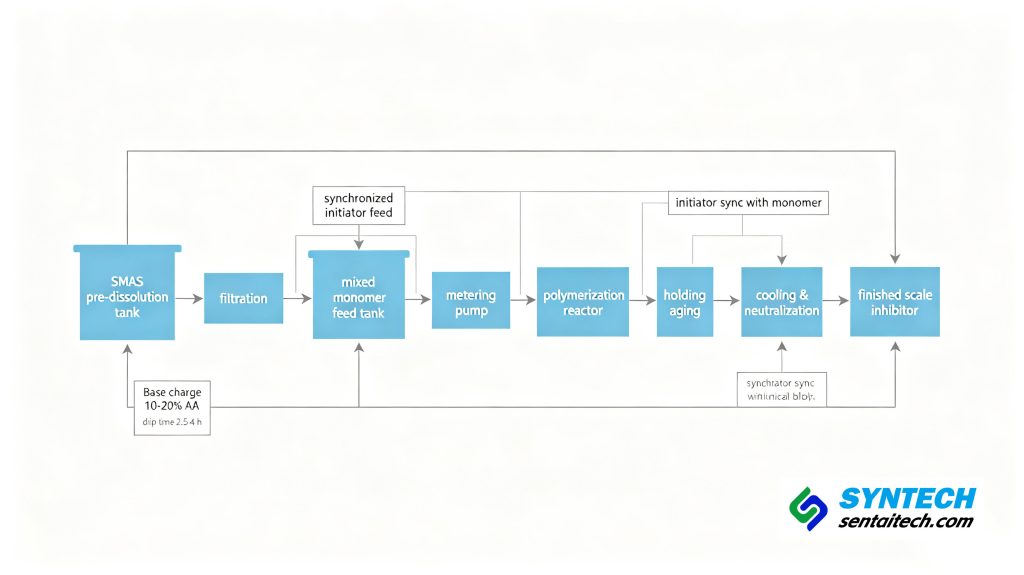
Sodium methallyl sulfonate and acrylic acid are pre-mixed in the target ratio in a feed tank, then dripped into the reactor at a constant rate simultaneously with the initiator solution. This is the most widely recommended industrial process for AA–SMAS scale inhibitors. Because the monomer ratio in the feed remains constant throughout the reaction, each growing polymer chain encounters nearly the same monomer environment, producing a relatively uniform copolymer composition and narrow molecular weight distribution.
3.3 Separate parallel feeding of SMAS and AA
SMAS solution and acrylic acid solution are fed through two independent metering pumps, with adjustable individual flow rates. This allows process engineers to tune feed ratio dynamically during reaction, for example to compensate for reactivity drift at high conversion. It is used for high-grade custom formulations but adds metering and control complexity.
3.4 Stepwise / staged feeding
A portion of acrylic acid is charged as base solution in the reactor, then the remaining AA and all SMAS are dripped in stages. This creates a controlled gradient structure and is sometimes used to tailor polymer charge density for specific scales such as calcium phosphate or barium sulfate.
4. Critical Precaution 1: Pre-dissolve SMAS Fully Before Feeding
Sodium methallyl sulfonate is a crystalline solid with good but not instant water solubility. A frequent operational mistake is feeding solid SMAS directly into the hot reactor or pumping a partially dissolved slurry.
- Undissolved SMAS particles dissolve gradually during polymerization, creating local monomer ratio fluctuations and composition drift.
- Undissolved solids can settle on the reactor bottom and degrade under prolonged heating, increasing colored impurities and residual monomer.
- Incomplete dissolution also causes metering pump deviation and inaccurate monomer ratio.
Best practice: Prepare a homogeneous SMAS aqueous solution of known concentration in a dedicated preparation tank, filter it through a 5–10 µm cartridge filter, and only then connect it to the feed line. This step is especially important for bulk solid SMAS that may have caked during storage.
5. Critical Precaution 2: Synchronize Initiator Feeding with Monomer Feeding
Initiator feeding schedule must be aligned with monomer feeding to maintain stable radical concentration and chain-growth rate.
- Do not add all initiator at once at the beginning. A high initial radical concentration in the presence of excess acrylic acid produces very short chains early and very long chains later, widening PDI.
- Do not delay initiator feeding relative to monomer feeding. Insufficient radicals cause low conversion and high residual SMAS monomer.
- Standard practice: drip initiator solution continuously, starting 5–10 minutes before monomer feeding and ending 10–15 minutes after monomer feeding finishes, to ensure full conversion in the final holding stage.
For redox initiation systems commonly used at lower temperatures, the reducing agent should also be fed synchronously, not charged entirely as base solution. This avoids a burst of radicals at the start that amplifies the reactivity difference between AA and SMAS.
6. Critical Precaution 3: Control Drip Rate to Match Heat Removal and Residence Time
Acrylic acid polymerization is strongly exothermic. Too fast a feeding rate causes temperature runaway, which:
- accelerates initiator decomposition;
- boosts chain transfer to SMAS;
- shifts molecular weight downward and broadens distribution.
For a typical 105 °C atmospheric reflux process, total monomer drip time of 2.5–4 h is standard, followed by 0.5–1 h of holding aging. Faster feeding may be acceptable on larger reactors with better heat-exchange capacity, but the rate must be validated with GPC molecular weight data and scale-inhibition performance data, not only by temperature control.
An often-overlooked point: feeding rate directly affects the instantaneous monomer ratio in the reactor. At high drip rate, unreacted SMAS accumulates; at low drip rate, acrylic acid is consumed as fast as it enters, and the liquid phase becomes SMAS-rich. Both extremes distort copolymer composition.
7. Critical Precaution 4: Design the Base Charge Properly
Most industrial recipes charge a fraction of total monomers (usually part of acrylic acid and sometimes a small amount of SMAS) as initial base solution in the reactor before heating. The base charge sets the initial monomer concentration and seed polymer environment.
- Too high a base charge of acrylic acid leads to a large early homopolymer fraction and broad PDI.
- Too low a base charge leads to low initial radical efficiency and long induction period.
A typical robust design uses 10–20% of total acrylic acid in the base charge, with all or most of the sodium methallyl sulfonate introduced via continuous drip. This configuration avoids a large burst of pure acrylic acid polymerization at the start and helps keep copolymer composition uniform.
8. How Feeding Sequence Translates to Scale Inhibitor Performance
Feeding-induced structural differences show up clearly in application testing:
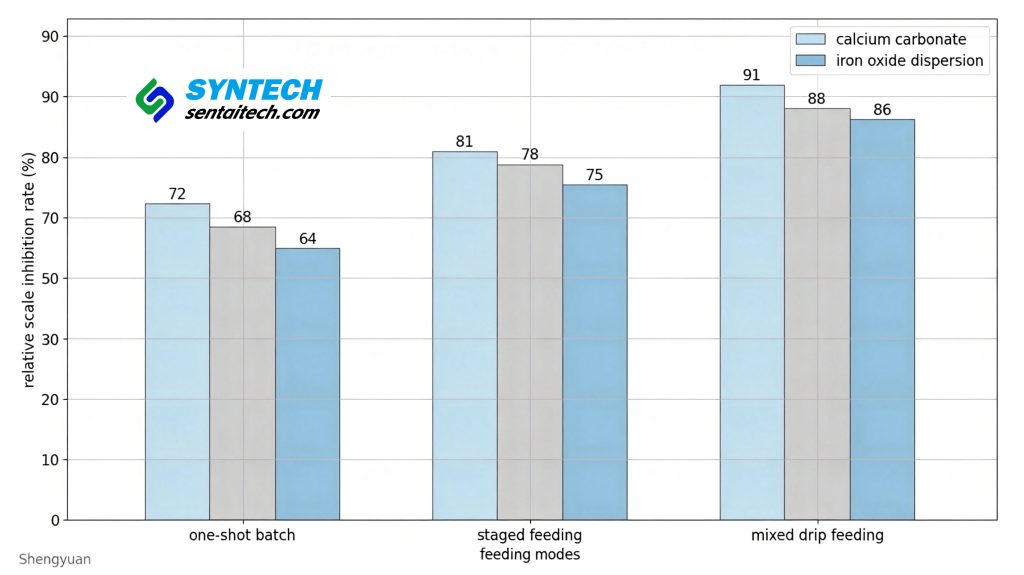
- Calcium carbonate / calcium sulfate inhibition: Uniformly distributed carboxyl and sulfonate groups deliver strong lattice distortion and higher inhibition rate. Poorly distributed copolymer from one-shot feeding can show 10–20% lower inhibition rate at the same active dosage.
- Salt tolerance: Evenly spaced sulfonate groups improve resistance to Ca²⁺/Na⁺ screening. Blocky AA–SMAS copolymer loses dispersion rapidly in high-TDS water.
- Iron oxide dispersion: Narrow molecular weight distribution gives consistent dispersion; high-MW fractions cause flocculation while low-MW fractions give no stabilization.
- Residual monomer and COD: Poor feeding leaves 2–5% unreacted SMAS, raising product COD and violating green water treatment requirements.
In short, optimizing feeding sequence is a low-cost way to raise scale inhibition performance without changing raw material cost or recipe ratio.
Frequently Asked Questions
Q1: What is the recommended feeding method for sodium methallyl sulfonate (SMAS, CAS NO.:1561-92-8) – acrylic acid scale inhibitor?
A1: The most widely recommended industrial method is pre-mixed monomer continuous dropwise feeding, in which SMAS and acrylic acid are pre-mixed at target ratio and dripped uniformly into the reactor together with initiator. This produces the most uniform copolymer composition and narrowest molecular weight distribution.
Q2: Why can’t we just charge all SMAS and acrylic acid at one time?
A2: Acrylic acid polymerizes much faster than SMAS. One-shot charging produces AA-rich high-molecular-weight chains early and SMAS-rich oligomers late, giving wide bimodal molecular weight distribution, uneven functional group distribution and 10–20% lower scale inhibition rate than properly dripped product.
Q3: Should SMAS be dissolved first before being fed into the polymerization?
A3: Yes. Solid SMAS must be fully dissolved into a homogeneous aqueous solution and filtered before feeding. Undissolved crystals cause metering error, local composition drift and increased colored impurities from thermal degradation on the reactor wall.
Q4: Should the initiator be added all at once or dripped together with monomers?
A4: Continuous synchronized drip of initiator is required. Adding all initiator at once creates a burst of radicals early in the reaction, amplifying the reactivity gap between AA and SMAS and broadening molecular weight distribution. Initiator drip should start slightly before monomer feed and end slightly after.
Q5: What molecular weight range gives the best scale inhibition for AA–SMAS copolymers?
A5: For most calcium sulfate and calcium carbonate scale applications, the optimal weight-average molecular weight lies in 2000–2500 Da with narrow polydispersity. Feeding sequence is the primary process lever to hit and hold this window.
Q6: Can we adjust SMAS feed rate during reaction to improve performance?
A6: Yes, with separate parallel feeding of SMAS and AA. Some specialty formulas vary the SMAS/AA ratio during reaction to create gradient polymer chains for multi-scale inhibition. This requires two independent metering pumps and prior lab validation.
References
[1] Alhamzah A A, Fellows C M, Hamed O A. Methallylsulfonate Polymeric Antiscalants for Application in Thermal Desalination Processes[J]. Polymers, 2023. (Optimal MW 2000–2500 Da; molecular weight more critical than sulfonation degree for calcium sulfate inhibition.)
[2] Xiong Y, et al. Effect of sodium methylacrysulfonate upon the molecular weight and performance of polycarboxylate superplasticizer[J]. Journal of Functional Polymers, 2014. (SMAS dosage inversely related to polymer molecular weight; cubic relationship between MW and 1/SMAS dosage.)
[3] Song S, Zhao W, Tang Z, et al. Synthesis and Scale Inhibition Performance of MAC-MA-SAS Terpolymer Scale Inhibitor[J]. Chemical Industry and Engineering, 2026. (Monomer drip feeding used for sulfonate-containing scale inhibitor; scale inhibition rate first rises then falls with sulfonate ratio.)
[4] Li Y, Wang J, Zhang L. Synthesis and Application of a Phosphorous-Free and Non-Nitrogen Polymer as an Environmentally Friendly Scale Inhibition and Dispersion Agent[J]. ACS Omega, 2020, 5(25): 15487–15495. (Sulfonate-carboxylate copolymer scale inhibitor synthesized via semi-continuous dropwise feeding for uniform composition.)
[5] Ningbo Innopharm. Optimizing Water Treatment: The Role of Sodium Methallyl Sulfonate (CAS 1561-92-8)[EB/OL]. https://www.nbinno.com/article/other-organic-chemicals/optimizing-water-treatment-role-sodium-methallyl-sulfonate-qn
[6] Industrial Chemical Datasheet. Sodium Methallyl Sulfonate (SMAS) for Water Treatment Scale Inhibitors, CAS NO.:1561-92-8[EB/OL]. Made-in-China Chemical Directory, 2024.