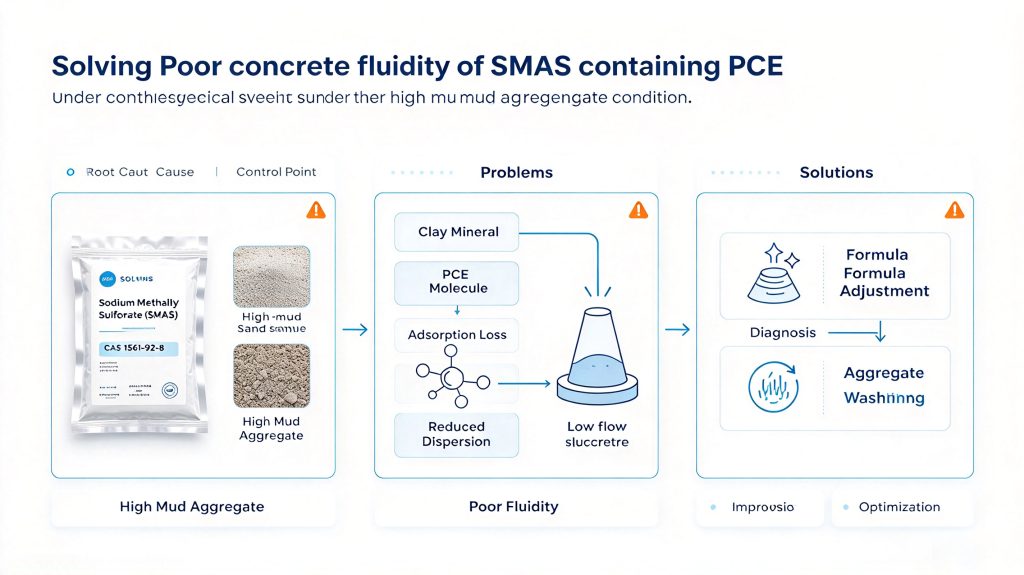

Sodium methallyl sulfonate, abbreviated as SMAS (CAS 1561-92-8), is a key sulfonate functional monomer for producing polycarboxylate ether superplasticizer (PCE). When SMAS-containing PCE is applied to concrete using sand and stone with high mud content, clay minerals in mud will adsorb PCE molecules rapidly. This phenomenon leads to sharp loss of concrete fluidity, poor workability and unstable slump retention. Below are practical solutions targeting this common engineering challenge for SMAS-containing PCE.
Optimize SMAS molecular structure and dosage of sodium methallyl sulfonate (CAS 1561-92-8)
Adjust the polymerization formula of SMAS-containing PCE to modify the molecular chain structure. Sodium methallyl sulfonate (CAS 1561-92-8) supplies sulfonic acid groups that improve dispersion, yet excessive SMAS content increases adsorption sensitivity to clay. Optimize the feeding ratio of SMAS during polymerization, properly adjust molecular weight and side-chain length, to reduce invalid adsorption on mud while maintaining the dispersion capacity of PCE for cement particles. Pilot lab polymerization tests are required to confirm the optimal SMAS dosage range.
Add clay-resistant sacrificial agents to compound formula of SMAS-containing PCE
Introduce high-efficiency clay sacrificial agents into finished SMAS-containing PCE mother liquor. Sacrificial agents preferentially bind with active clay in high-mud sand and stone, competing for adsorption sites and protecting PCE molecules synthesized with sodium methallyl sulfonate. This method effectively alleviates the rapid fluidity drop. Carry out gradient dosage tests to select compatible sacrificial agents without damaging concrete setting time and early strength.
Pre-treat high-mud sand and stone before concrete batching
Reduce mud content of aggregates through washing or screening processes. Lowering the total clay content in sand and stone can cut down the adsorption load for SMAS-containing PCE. If aggregate washing is unavailable on-site, increase the pre-wetting process of sand and stone to reduce surface-active fine mud, and adjust the water consumption in mix proportion accordingly.
Fine-tune the mixing proportion and on-site adding method of SMAS-containing PCE
Change the one-time addition mode of SMAS-containing PCE. Adopt delayed feeding of sodium methallyl sulfonate synthesized PCE after cement and aggregates are preliminarily mixed. Adjust the total PCE dosage moderately based on real-time mud content test of sand and stone. Avoid excessive PCE addition which may cause concrete bleeding or segregation. Always conduct field trial mixes before formal construction.
Inspect raw material quality of incoming SMAS (CAS 1561-92-8)
Impurities such as inorganic sulfate in low-grade sodium methallyl sulfonate (CAS 1561-92-8) will worsen fluidity loss under high mud conditions. Complete incoming quality inspection for every SMAS batch, testing purity, moisture and impurity content. Eliminate unqualified SMAS raw materials to guarantee stable performance of SMAS-containing PCE when facing high-mud aggregates.