
Sodium methallyl sulfonate, also known as SMAS (CAS 1561-92-8), is a critical functional monomer used for synthesizing polycarboxylate superplasticizer. When concrete mixed with SMAS-synthesized superplasticizer shows excessive retarding, the setting time is significantly prolonged, early compressive strength drops, and construction progress will be delayed. It is necessary to analyze root causes and adjust the formula scientifically to solve retarding problems while retaining the slump retention performance brought by SMAS.
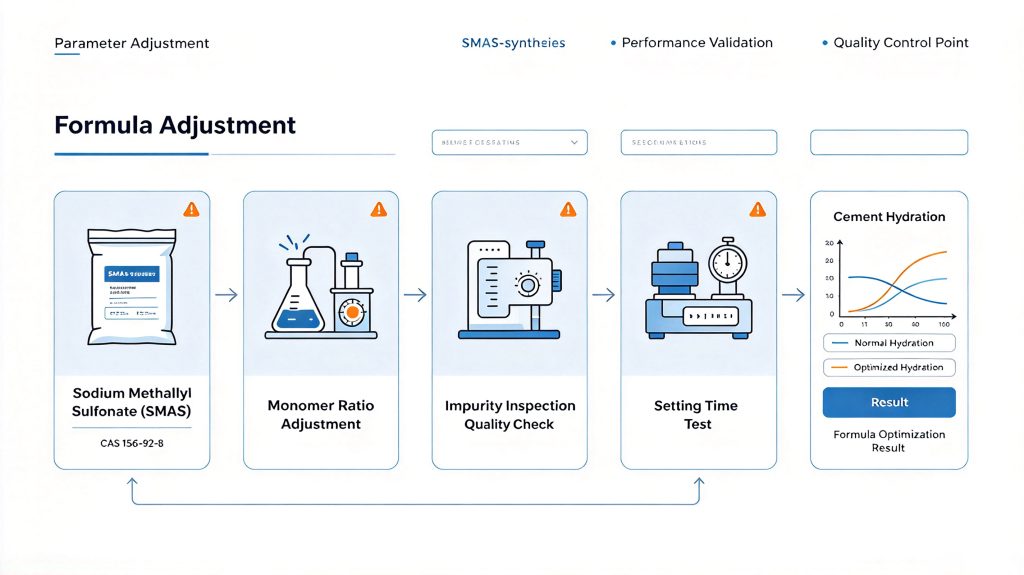
Reduce sodium methallyl sulfonate (SMAS, CAS 1561-92-8) monomer feeding proportion
Too high SMAS proportion introduces excessive sulfonic groups into the polymer molecular chain, which strongly adsorbs on cement particle surfaces and slows down cement hydration. If SMAS addition ratio exceeds the designed range, reduce the feeding amount of sodium methallyl sulfonate (CAS 1561-92-8) in the monomer formula during the next batch polymerization. Keep SMAS at the optimal range to balance slump retention and setting performance.
Optimize polymer molecular weight for superplasticizer synthesized with SMAS
Excessively long polymer side chains from improper SMAS polymerization conditions will aggravate retarding. Adjust initiator dosage and reaction temperature to control polymer molecular weight. Proper molecular weight can reduce over-adsorption on cement without losing the dispersion advantage of SMAS.
Modify finished superplasticizer compound formula with sodium methallyl sulfonate base liquid
If the polymer base liquid synthesized with sodium methallyl sulfonate already exists, avoid adding extra retarding components such as citric acid and gluconate. Introduce appropriate accelerating components compatible with polycarboxylate system to offset excessive retarding. Conduct lab concrete tests with gradient dosages before formal production.
Inspect impurity indicators of incoming SMAS (CAS 1561-92-8)
Low-quality sodium methallyl sulfonate (CAS 1561-92-8) contains residual sulfates and organic impurities, which also cause abnormal retarding. Test impurity indicators of incoming SMAS; reject batches with excessive impurities.
Perform concrete trial mix after formula adjustment of SMAS-synthesized superplasticizer
Carry out concrete trial mix verification after formula adjustment. Record setting time, slump retention and compressive strength at 1d, 3d and 7d. Fine-tune SMAS dosage step by step until the concrete setting time and strength development meet engineering requirements.