
1. Why the AMPS → SMAS Substitution Question Arises
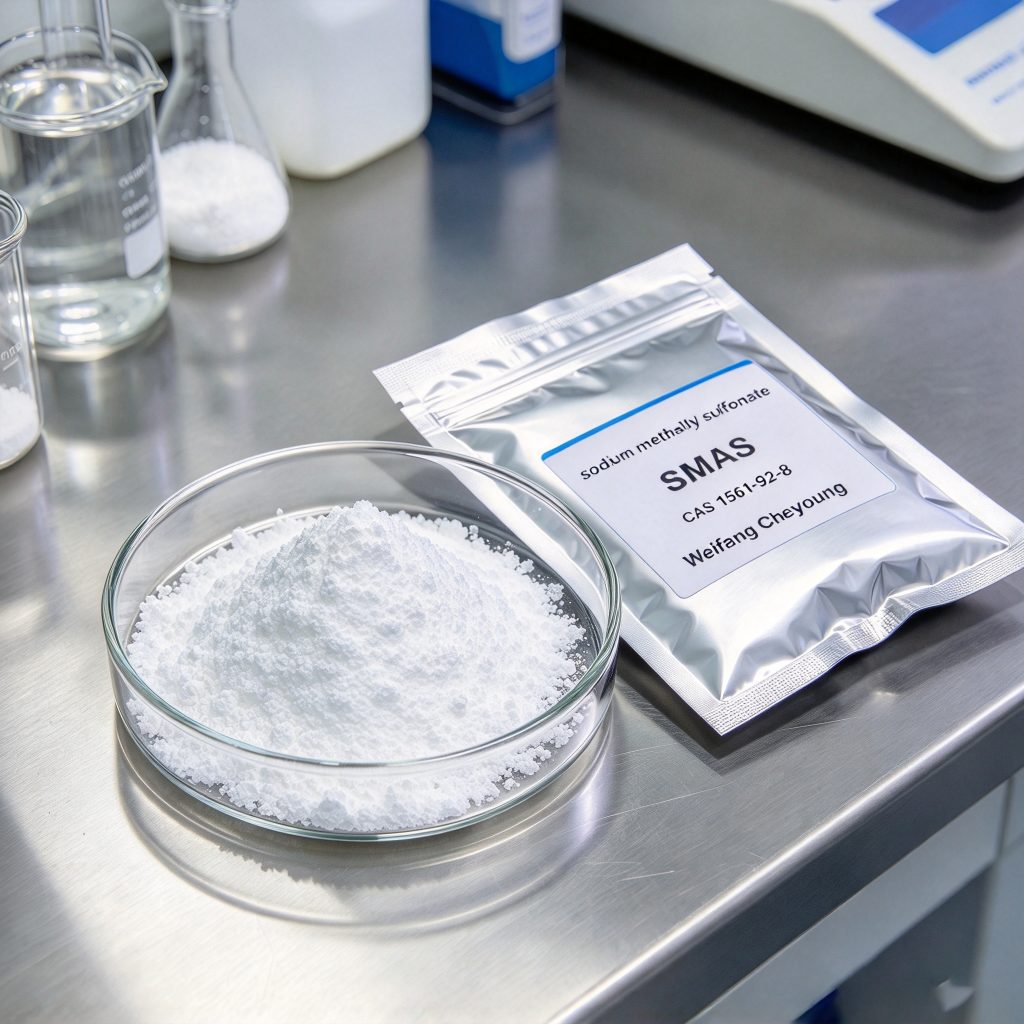
In polycarboxylate ether (PCE) superplasticizer synthesis, sulfonate functional monomers serve three simultaneous roles: they introduce negatively charged –SO₃⁻Na⁺ anchor groups on the polymer backbone, improve hydrophilicity and salt tolerance, and regulate chain growth during free-radical copolymerization. The two dominant commercial choices are 2-acrylamido-2-methylpropane sulfonic acid (AMPS) and sodium methallyl sulfonate (SMAS, CAS NO.:1561-92-8). Cost pressure, raw-material supply disruption and local sourcing strategies frequently push PCE formulators to evaluate replacing part or all of AMPS with SMAS. But the two monomers are not drop-in equivalents. Their backbone chemistry — a rigid tert-butyl amide in AMPS vs. a flexible allylic C=C in SMAS — produces measurable differences in molecular weight control, dispersion, salt tolerance, thermal stability and shrinkage. This article maps those trade-offs with a mechanistic basis, so the substitution decision can be made on performance rather than on price alone.
2. Structural Difference That Drives Every Performance Gap
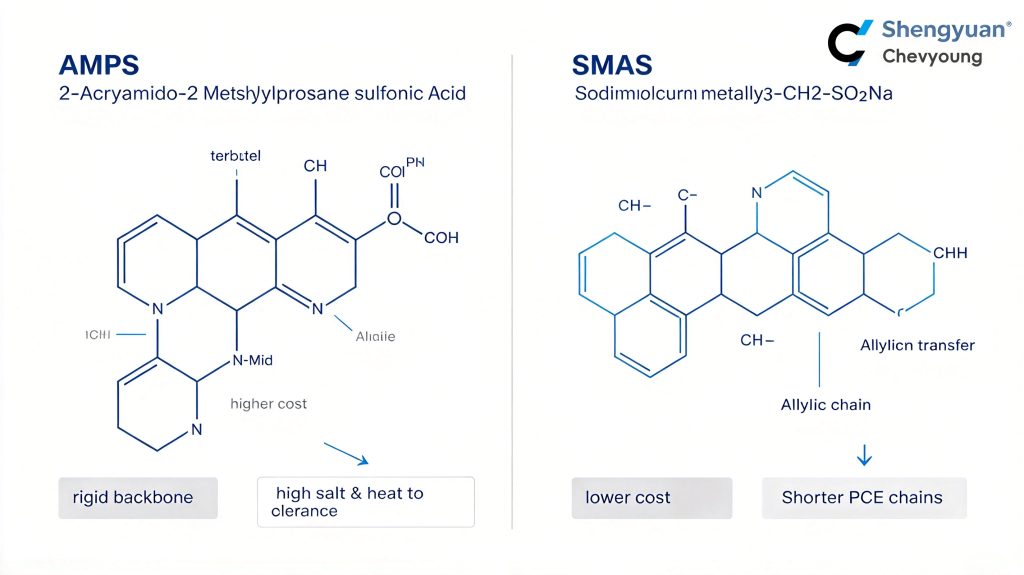
AMPS carries a strongly hydrophilic sulfonate group mounted on a bulky, rigid –C(CH₃)₂– tert-butyl spacer connected through an amide bond. The steric bulk stiffens the polymer backbone and shields the sulfonate from metal-cation screening, while the amide linkage resists hydrolysis. SMAS (sodium methallyl sulfonate, CAS NO.:1561-92-8) is an allylic sulfonate: CH₂=C(CH₃)–CH₂–SO₃Na. The allylic C–H bond is labile under free-radical conditions, which is why SMAS doubles as a chain transfer agent in PCE polymerization. Published work shows PCE molecular weight is inversely proportional to SMAS dosage, with a cubic relationship between molecular weight and the reciprocal of SMAS loading. This structural contrast is the root cause of every trade-off discussed below.
3. Trade-off 1 — Cost and Availability vs. Salt / Hard-Water Tolerance
The clearest advantage of SMAS is economic: SMAS is typically 30–50% cheaper than AMPS on an equivalent-sulfonate basis and is produced at large domestic capacity in China. For ordinary C30–C50 ready-mix concrete with low water-binder ratio and standard tap-water mixing, partial AMPS → SMAS substitution delivers acceptable dispersion at materially lower monomer cost. The penalty appears in harsh environments:
- High-salinity ready-mix return water, sea-sand concrete or high-alkali aggregate: AMPS-rich PCE retains dispersion because its rigid backbone resists Ca²⁺/Mg²⁺ ion screening. SMAS-rich PCE suffers stronger electric-double-layer compression, faster flocculation and a sharp rise in paste viscosity.
- High-clay / manufactured-sand concrete: montmorillonite cations penetrate the more flexible SMAS-bearing chains more easily, accelerating slump loss. Rule of thumb: SMAS substitution is safe below ~20–30% of total sulfonate-monomer mass for standard concrete; beyond that, salt tolerance drops measurably.
4. Trade-off 2 — Molecular-Weight Regulation vs. Tail Dispersion Control
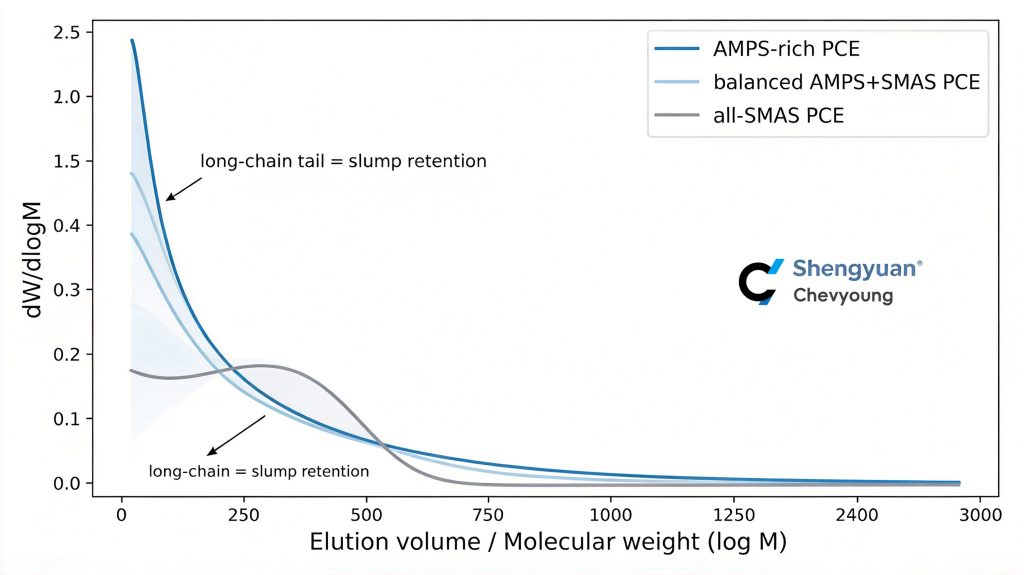
Because SMAS functions as a chain-transfer agent, raising SMAS loading conveniently lowers PCE molecular weight and narrows distribution without adding mercaptopropionic acid. This is a genuine process benefit: easier polymer dissolution, lower mother-liquor viscosity and shorter reaction time. The flip side is that SMAS dosage is inversely tied to molecular weight, and tail (long-chain) fraction is what supplies sustained dispersion and slump retention. Over-substitution:
- erodes the high-molecular-weight shoulder of the GPC trace;
- weakens steric stabilization on cement grains;
- accelerates slump loss at 60–90 min, especially under summer temperature. AMPS, by contrast, copolymerizes like a normal acrylamide monomer and does not consume radicals through allylic chain transfer, so it preserves long-chain tails and slump retention without extra chain-transfer engineering.
5. Trade-off 3 — Thermal and Hydrolytic Stability
AMPS-based copolymers show a TGA 5%-weight-loss onset around 220–280 °C and retain >90% viscosity after 30 days at 90 °C. The amide linkage in AMPS resists alkaline hydrolysis, which is why AMPS is the default sulfonate choice for oil-well cement slurry fluid-loss additives rated to 240 °C. SMAS-bearing PCE is not exposed to such extreme temperatures in conventional construction, but two downstream issues still matter:
- Precast / steam-cured concrete at 60–80 °C: SMAS-rich PCE shows slightly faster hydrolysis and mild slump loss during the hot curing window.
- Long-term storage of alkaline PCE mother liquor: allylic sulfonate chains degrade marginally faster, raising the free-sulfate background over months. For ordinary ambient-cast concrete this gap is small; for steam-cured precast, UHPC or geothermal-adjacent elements, AMPS is preferred.
6. Trade-off 4 — Initial Water Reduction vs. Shrinkage and Air Content
SMAS adds dense, small sulfonate anions to the backbone, which can boost initial adsorption and early fluidity. However, because SMAS-rich PCE chains are shorter and more hydrophilic, they:
- increase bleeding tendency at high dosage;
- raise autogenous and drying shrinkage slightly in low water-binder systems;
- stabilize smaller air bubbles that are harder to remove, reducing compactness in high-strength C80+ concrete. AMPS, with its bulky hydrophobic tert-butyl spacer, tends to give a more balanced adsorption curve and lower shrinkage contribution in high-grade concrete.
7. When Full or Partial AMPS → SMAS Substitution Is Justified
A defensible substitution strategy follows a cost–performance matrix:
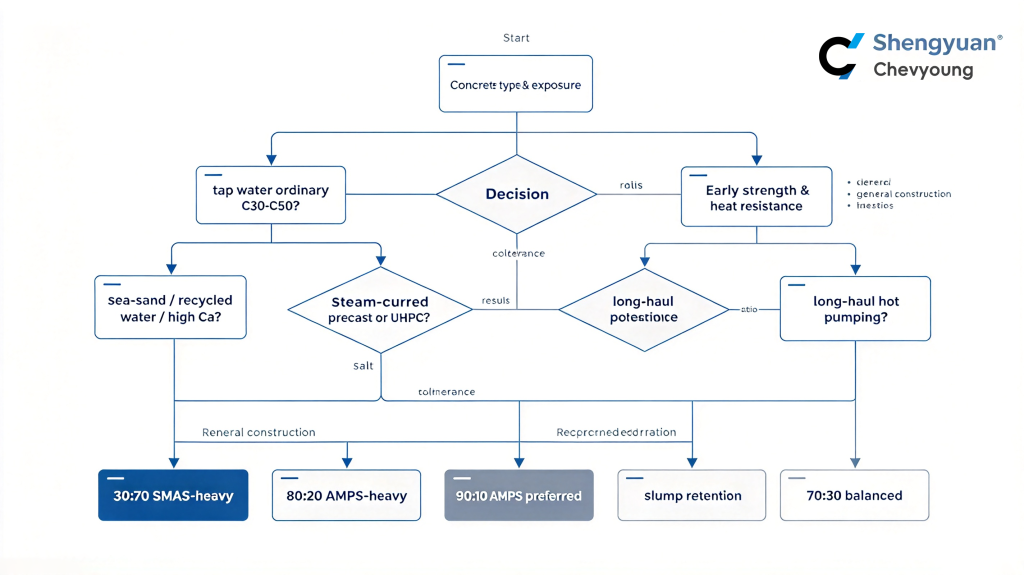
| Application | Recommended AMPS : SMAS ratio | Rationale |
|---|---|---|
| Ordinary C30–C50 ready-mix, tap water | 30 : 70 (SMAS-heavy) | Dispersion gap small, cost saving large |
| C60–C80 high-strength / low w/b | 70 : 30 (AMPS-heavy) | Shrinkage, viscosity and tail retention matter |
| Sea-sand, recycled water, high Ca²⁺ | ≥ 80 : 20 | Ion tolerance is non-negotiable |
| Steam-cured precast / UHPC | ≥ 90 : 10 | Thermal and hydrolytic stability |
| Hot-climate long-haul pumping | ≥ 70 : 30 | Slump retention needs long-chain tails |
In practice, the most robust industrial compromise is a binary sulfonate system — AMPS for backbone rigidity and salt tolerance, SMAS for molecular-weight trimming and cost — rather than an all-SMAS replacement.
8. Process Checklist Before Substitution
- Run GPC on the SMAS-modified PCE to confirm molecular-weight distribution has not collapsed.
- Test paste fluidity and 1-h loss with the customer’s actual cement, not a reference cement.
- Run a CaCl₂ / Na₂SO₄ tolerance test (5–10 wt% salt) to expose ion sensitivity.
- Verify 28-d compressive strength and drying shrinkage, not just slump.
- Check air content and bleeding; adjust defoamer dosage.
- Confirm mother-liquor stability after 14 d at 40 °C.
Frequently Asked Questions
Q1: Can sodium methallyl sulfonate (SMAS, CAS NO.:1561-92-8) completely replace AMPS in PCE superplasticizer?
A1: Technically yes for ordinary C30–C50 concrete with tap water, but full replacement loses salt tolerance, long-chain tail dispersion and thermal stability. Most producers keep AMPS in the backbone and use SMAS as a partial, cost-saving co-monomer rather than a 1:1 substitute.
Q2: Why does increasing SMAS dosage reduce PCE molecular weight?
A2: The allylic C–H bond in SMAS readily participates in radical chain transfer. Higher SMAS loading increases radical-termination frequency, so the resulting polymer chains are shorter. The relationship between PCE molecular weight and reciprocal SMAS dosage is approximately cubic, as reported in copolymerization studies.
Q3: Is SMAS-based PCE suitable for sea-sand concrete?
A3: Not in high proportion. Sea-sand introduces high Cl⁻ and Mg²⁺/Ca²⁺. The flexible SMAS-bearing backbone is more easily screened by divalent cations, causing flocculation, viscosity rise and slump loss. AMPS-rich PCE is preferred for sea-sand or recycled-water concrete.
Q4: Does SMAS substitution improve or worsen slump retention?
A4: It usually worsens retention if SMAS replaces AMPS in equal mass. SMAS shortens polymer chains and reduces the long-tail fraction responsible for sustained dispersion. Retention can be restored by adding hydrolyzable ester monomers rather than by pushing SMAS further.
Q5: Is SMAS cheaper than AMPS?
A5: Yes, typically SMAS is roughly 30–50% lower on an equivalent-sulfonate basis. The cost saving is the main industrial driver for partial substitution, but the salt- and heat-performance gap must be paid back through formulation adjustments.
Q6: What is the maximum safe AMPS-to-SMAS swap for high-strength C80 concrete?
A6: For C80 and above, keep AMPS at ≥70–80% of total sulfonate monomer and limit SMAS to ≤20–30% for molecular-weight control only. Full SMAS substitution raises viscosity, shrinkage and air-content risk in low water-binder high-grade concrete.
References
[1] Xiong Y. et al. Effect of sodium methylacrysulfonate upon the molecular weight and performance of polycarboxylate superplasticizer. Journal of Functional Polymers / PCE copolymerization studies, 2014.
[2] BenchChem Technical Report. A Comparative Performance Analysis: AMPS-Based Superplasticizers Versus Traditional Admixtures in High-Performance Concrete. https://pdf.benchchem.com/95/A_Comparative_Performance_Analysis_AMPS_Based_Superplasticizers_Versus_Traditional_Admixtures_in_High_Performance_Concrete.pdf
[3] Ningbo Innochem. Sodium Methallyl Sulfonate: Key to High-Performance Concrete Admixtures (SMAS as chain-transfer agent in PCE). https://www.nbinno.com/article/other-organic-chemicals/sodium-methallyl-sulfonate-high-performance-concrete-admixtures-qn
[4] Nechaev et al. Influence of the Composition of Acrylamide–Acrylonitrile–AMPS Terpolymer on Its Resistance to High Temperatures and Salts. (AMPS ≥20 mol% required for CaCl₂ tolerance up to 7 wt%).
[5] ACS Omega. Characterized Functional Groups of Temperature- and Salt-Resistant Copolymers, 2023, 8(35). https://pubs.acs.org/doi/10.1021/acsomega.3c03395
[6] Research on Fluid-Loss Additive with Temperature Resistance up to 240 °C for Oil-Well Cement Slurry (AMPS backbone rigidity and cation insensitivity), PMC11947803. https://pmc.ncbi.nlm.nih.gov/articles/PMC11947803/