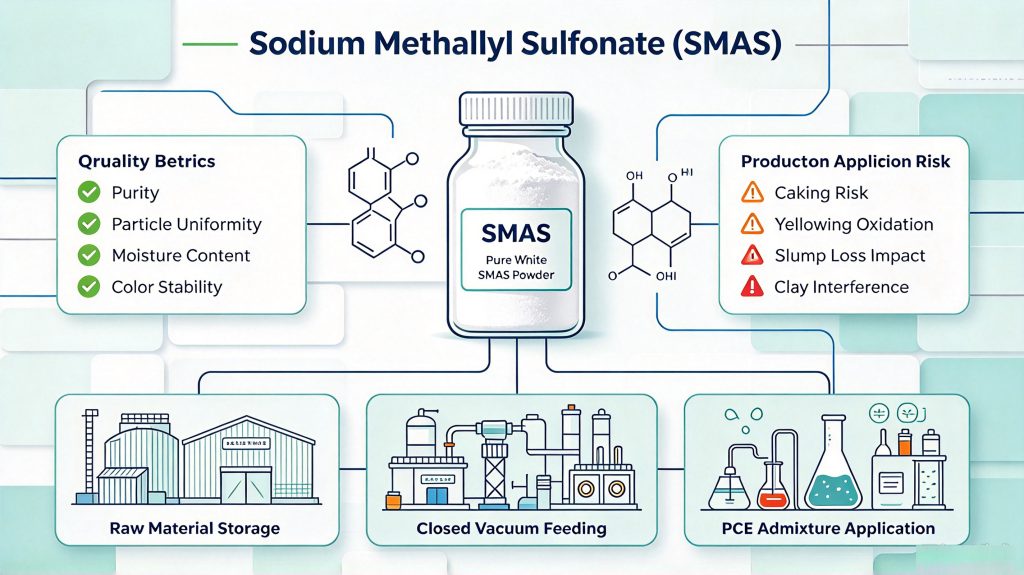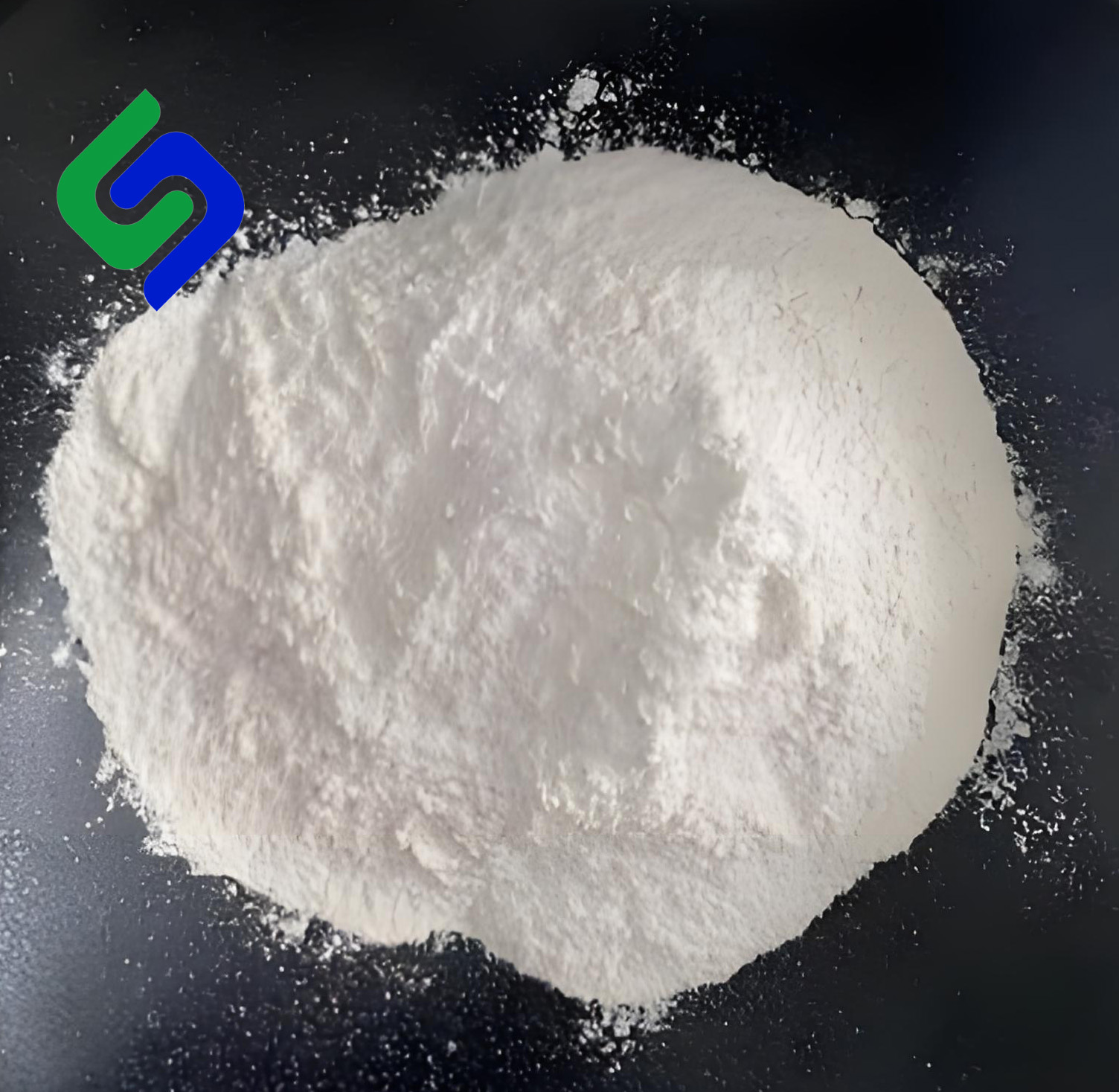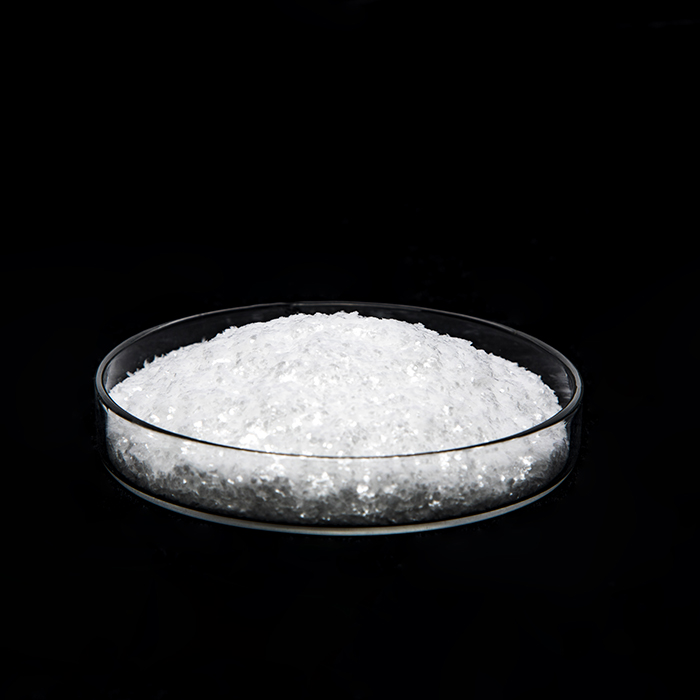

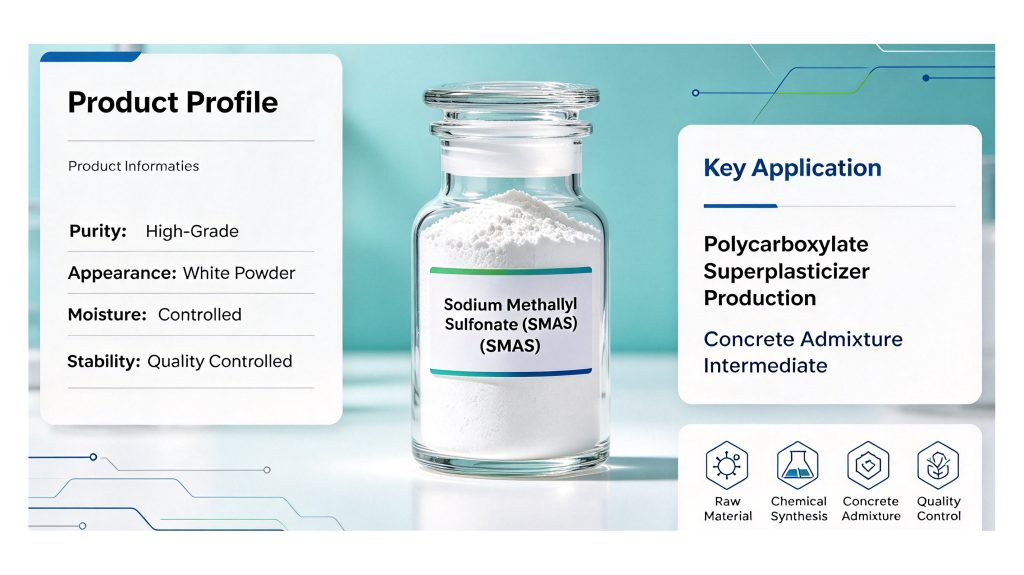
Sodium Methallyl Sulfonate, abbreviated as SMAS, is a key sulfonated monomer used in polycarboxylate superplasticizer copolymerization. Sodium Methallyl Sulfonate features strong hygroscopicity; exposed to humid air during storage, transportation and feeding, SMAS easily absorbs water vapor to form hard agglomerates and lumps. Caked Sodium Methallyl Sulfonate cannot dissolve uniformly in the reactor, leading to local high-concentration SMAS homopolymerization, unstable molecular weight distribution of PCE, reduced effective conversion rate of Sodium Methallyl Sulfonate and frequent pipeline blockage during continuous feeding. This article elaborates complete preventive measures and on-site disposal methods for caking highly hygroscopic Sodium Methallyl Sulfonate in feeding procedures, with natural full-text layout of Sodium Methallyl Sulfonate and SMAS keywords.
1. Front-End Prevention Measures to Stop Sodium Methallyl Sulfonate Caking Before Feeding
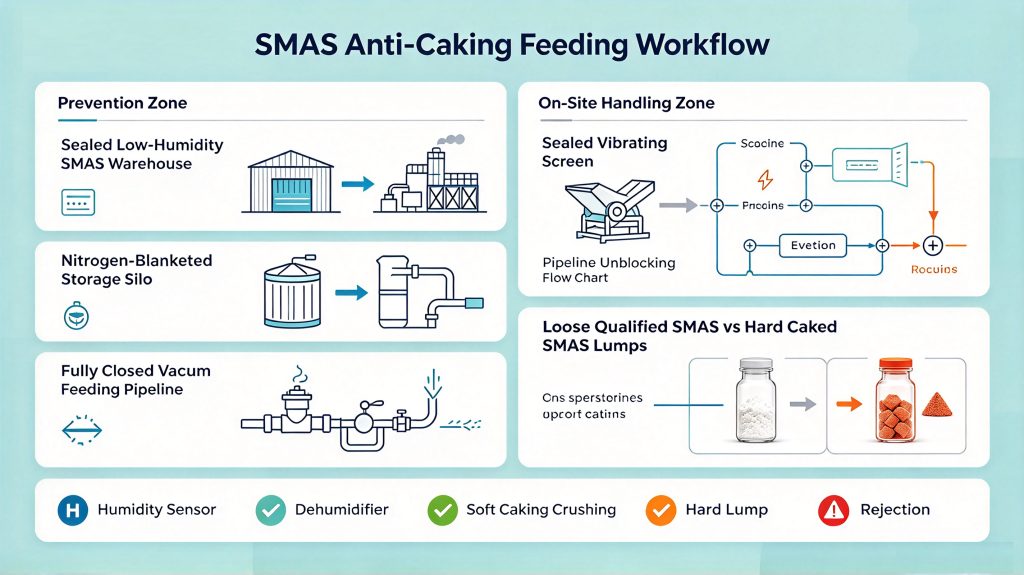
1.1 Sealed Low-Humidity Warehouse Storage for SMAS
The root cause of Sodium Methallyl Sulfonate caking is moisture absorption. All SMAS raw material packages must remain fully sealed in a constant-humidity warehouse with relative humidity controlled below 55%.
- Use double-layer moisture-proof plastic lining inside woven bags of Sodium Methallyl Sulfonate; immediately heat-seal any torn packaging to block air moisture contact with SMAS powder.
- Isolate Sodium Methallyl Sulfonate storage zones from outdoor air, water pipelines and cooling towers; install dehumidifiers and temperature probes to keep warehouse temperature 10–25℃, slowing the hygroscopic caking process of SMAS.
- Follow first-in first-out inventory rules for Sodium Methallyl Sulfonate; avoid long-term stacking exceeding 60 days, as prolonged storage greatly increases the risk of SMAS deliquescence and hard caking.
1.2 Closed Automatic Conveying System for SMAS Feeding
Open manual dumping is the main feeding link where Sodium Methallyl Sulfonate contacts humid air and forms lumps.
- Equip fully sealed silos, vacuum feeding pipelines and closed dissolving tanks for Sodium Methallyl Sulfonate; the whole feeding route is isolated from ambient moisture to prevent SMAS surface moisture absorption.
- Install nitrogen blanketing inside SMAS storage silos for large-scale production lines. Inert nitrogen displaces humid air around Sodium Methallyl Sulfonate powder, fundamentally inhibiting SMAS deliquescence and agglomeration.
- Avoid temporary open placement of unpacked Sodium Methallyl Sulfonate bags beside reactors; finish unpacking and dissolving SMAS within 10 minutes to minimize air exposure time.
1.3 Anti-Caking Pretreatment of SMAS Before Dissolution
For batches of Sodium Methallyl Sulfonate with slight surface stickiness, perform pretreatment before feeding to avoid lump formation in dissolving tanks.
- Equip sealed vibration screening devices for SMAS feeding; low-frequency vibration breaks soft surface agglomerates of Sodium Methallyl Sulfonate before entering the dissolving system.
- Pre-dissolve Sodium Methallyl Sulfonate with room-temperature low-humidity deionized water; cold water reduces SMAS dissolution heat and avoids local supersaturation recrystallization that generates secondary SMAS lumps.
- Control dissolving stirring speed at medium gear; violent high-speed stirring creates local supersaturation of Sodium Methallyl Sulfonate, forming sticky SMAS sediment and blockages at tank bottoms.
2. Real-Time On-Site Handling Methods When Caked Sodium Methallyl Sulfonate Appears During Feeding
2.1 Classification Treatment by Caking Severity of SMAS
Mild Soft Caking of Sodium Methallyl Sulfonate
Soft lumps formed by slight moisture absorption can be reused after sealed vibration screening. Put caked SMAS into a fully enclosed vibrating sieve, crush agglomerates into loose powder, and send qualified Sodium Methallyl Sulfonate directly to the dissolving tank. Discard oversized hard residual lumps that fail to pass the screen, as they contain excessively hydrolyzed Sodium Methallyl Sulfonate with low activity.
Severe Hard Caking & Deliquesced SMAS
Hard rock-like Sodium Methallyl Sulfonate lumps with visible wet surfaces cannot be crushed and recycled for standard low slump-loss PCE production.
- Isolate severely caked SMAS separately and mark the batch number; do not mix hard caked Sodium Methallyl Sulfonate with normal loose SMAS, or uneven copolymerization will occur.
- Conduct small pilot polymerization test on severely caked SMAS first. If the effective active content of Sodium Methallyl Sulfonate drops below 95%, scrap the batch or only apply it to low-grade ordinary water-reducing agent formulas after proportion compensation.
2.2 Emergency Unblocking for SMAS Feeding Pipeline Blocked by Caked Lumps
When caked Sodium Methallyl Sulfonate accumulates and blocks transfer pipelines during feeding, follow standardized unblocking steps to avoid production shutdown:
- Cut off SMAS feeding valve and stop the dropwise addition of Sodium Methallyl Sulfonate to the reactor;
- Inject low-temperature deionized water to slowly dissolve residual caked SMAS inside pipelines; high-temperature water accelerates SMAS hydrolysis and generates invalid impurities;
- After full pipeline cleaning, restart the sealed vacuum feeding system and check warehouse dehumidifier operation to prevent new SMAS caking during subsequent feeding.
2.3 Adjust Feeding Process Parameters for Slightly Caked Sodium Methallyl Sulfonate
If only minor SMAS agglomeration exists, adjust feeding parameters to stabilize copolymerization quality:
- Extend the pre-dissolution stirring time of Sodium Methallyl Sulfonate by 20–30 minutes to fully disperse tiny SMAS soft lumps into uniform aqueous solution;
- Slightly reduce the SMAS dropwise feeding speed to eliminate local high concentration of partially hydrolyzed Sodium Methallyl Sulfonate in the reactor;
- Increase the total feeding duration moderately to maintain stable chain transfer effect of Sodium Methallyl Sulfonate and offset activity loss caused by SMAS slight deliquescence.
3. Long-Term Process Optimization to Eliminate Recurring SMAS Caking During Feeding
- Procure Sodium Methallyl Sulfonate with customized anti-caking packaging from SMAS suppliers; add trace food-grade anti-caking agents compatible with PCE synthesis inside SMAS powder during production.
- Install online humidity sensors at SMAS unpacking and feeding stations; trigger automatic dehumidification once air humidity exceeds 60% RH.
- Implement batch inspection rules: test the fluidity and lump rate of each Sodium Methallyl Sulfonate batch before warehousing; reject batches with severe SMAS caking before entering the feeding production line.
- Train operators to minimize open-air operation time of Sodium Methallyl Sulfonate; formulate standard operating procedures for sealed unpacking, rapid dissolving and residual SMAS sealing preservation.
Negative Consequences of Improperly Handled Caked Sodium Methallyl Sulfonate
- Undissolved SMAS lumps lead to uneven grafting of sulfonate groups on PCE chains, causing fast slump loss of finished superplasticizer;
- Local high-concentration caked Sodium Methallyl Sulfonate triggers massive SMAS homopolymerization, producing insoluble microgel impurities that block construction screens;
- Hydrolyzed components inside caked SMAS reduce the effective active content of Sodium Methallyl Sulfonate, raising raw material cost and batch quality fluctuation of polycarboxylate products.