
1. Introduction: Sodium Methallyl Sulfonate as a Modifying Monomer for Anionic Flocculants
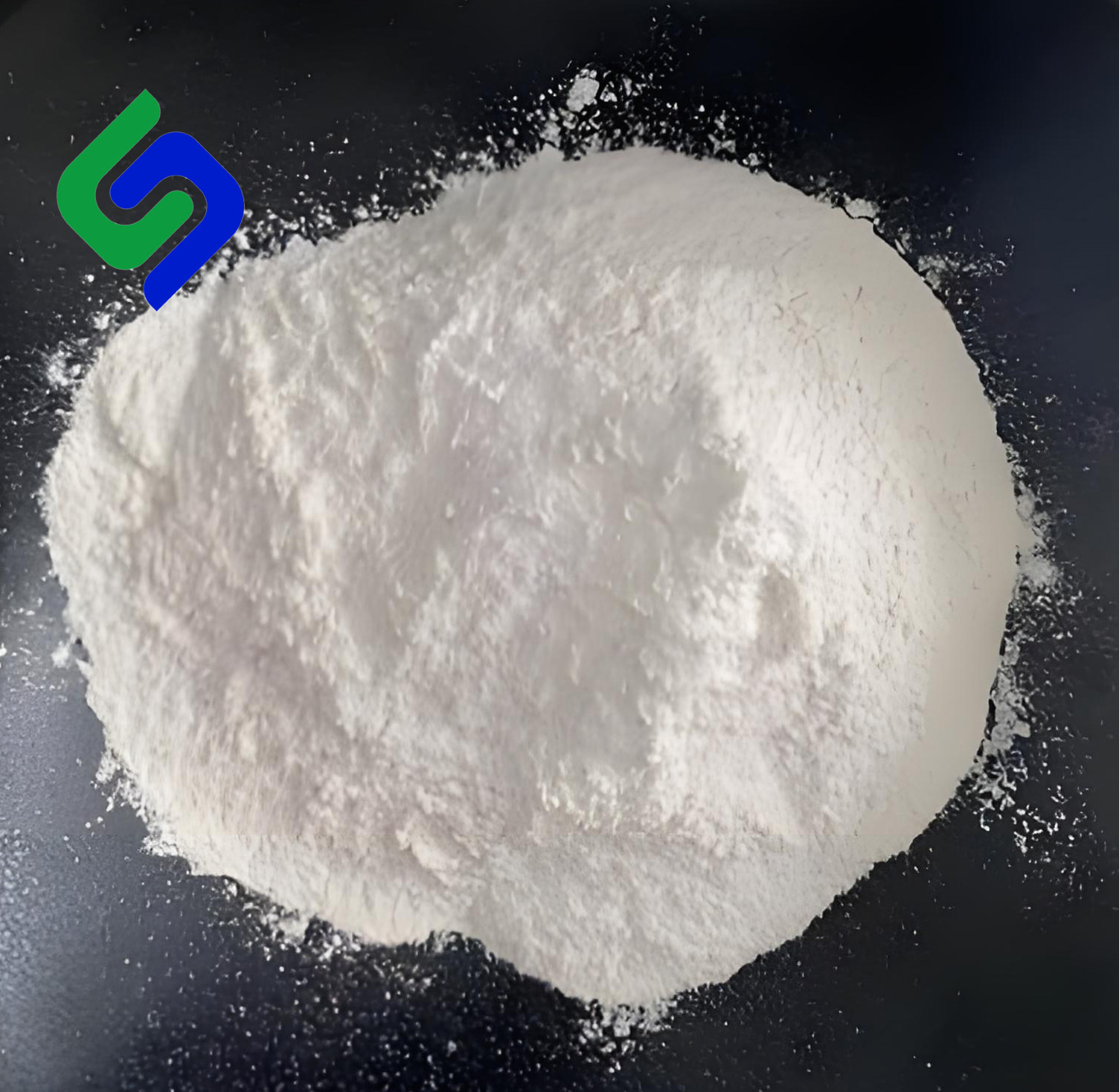
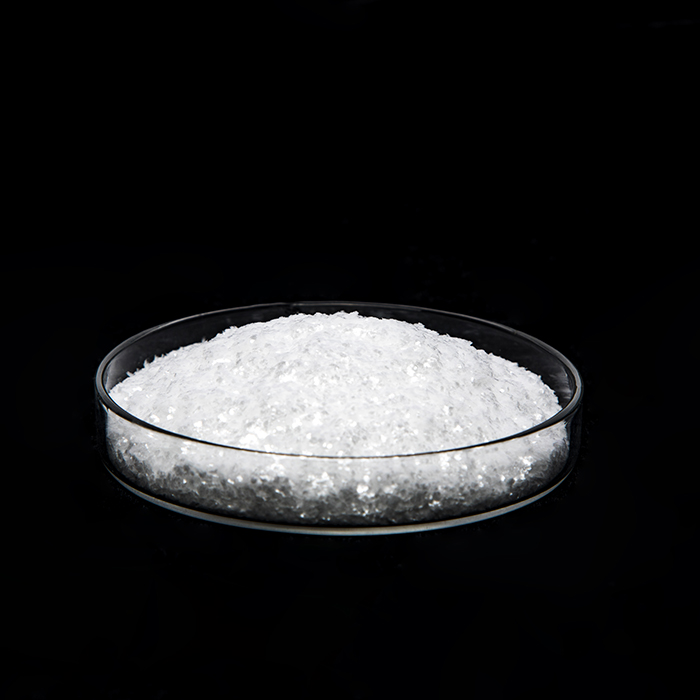
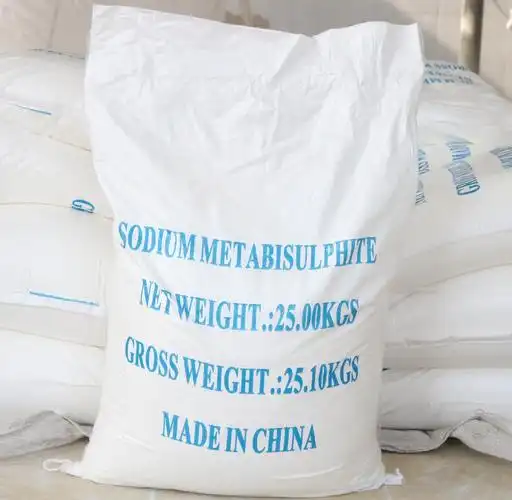
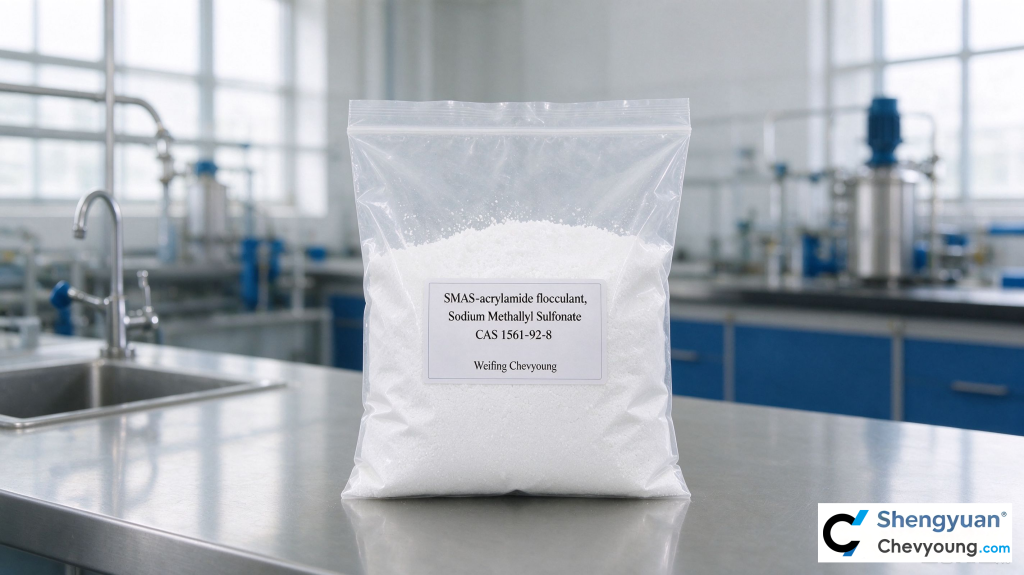
Sodium methallyl sulfonate, also named Sodium 2-methylprop-2-ene-1-sulfonate or Sodium beta-methallyl sulfonate, known as SMAS monomer with CAS NO.:1561-92-8, is a widely used sulfonate-functional monomer for modifying anionic polyacrylamide flocculants. When copolymerized with acrylamide, SMAS introduces strongly hydrophilic –SO₃⁻Na⁺ groups onto the polymer backbone, significantly improving the salt tolerance, temperature resistance and shear stability of the final flocculant product. This makes SMAS-modified acrylamide copolymers particularly suitable for high-salinity industrial wastewater, mineral processing tailings and oilfield produced water treatment.
However, the allylic structure of sodium methallyl sulfonate gives it strong inherent chain-transfer activity during free-radical polymerization. As a result, SMAS monomer dosage exerts a far stronger influence on copolymer molecular weight than conventional anionic monomers. Molecular weight is the single most critical structural parameter governing flocculation performance: too low and bridging capacity collapses; too high and over-flocculation, shear sensitivity and poor dispersion occur. For water-treatment chemical producers, precise molecular weight control of SMAS-acrylamide copolymer is the key to avoiding unstable flocculation and ensuring consistent product performance.
2. Molecular Weight Regulation Mechanism of Sodium Methallyl Sulfonate Monomer in Acrylamide Copolymerization
The core reason why sodium methallyl sulfonate dominates molecular weight lies in its allylic chain-transfer effect. Unlike acrylic sulfonate monomers such as AMPS that polymerize like standard vinyl monomers, SMAS carries highly active allylic C–H bonds adjacent to the double bond. During free-radical polymerization, growing polymer radicals readily abstract hydrogen from the allylic position of SMAS, which terminates the growing chain and generates a new allylic radical of low reactivity.
In practice, this means:
- Sodium methallyl sulfonate acts simultaneously as a functional monomer and as an implicit chain transfer agent. Even at 1–2 mol% loading, it noticeably reduces average molecular weight.
- Increasing SMAS monomer dosage accelerates chain termination frequency, causing a near-linear drop in weight-average molecular weight.
- Higher polymerization temperature amplifies the chain-transfer constant of SMAS, leading to further molecular weight reduction.
For flocculant synthesis, this dual role creates a fundamental trade-off: higher SMAS content improves salt tolerance but reduces molecular weight and weakens bridging flocculation ability. Optimizing this trade-off is the central challenge of SMAS-modified flocculant formulation.
3. How Molecular Weight of SMAS-Acrylamide Copolymer Determines Flocculation Performance
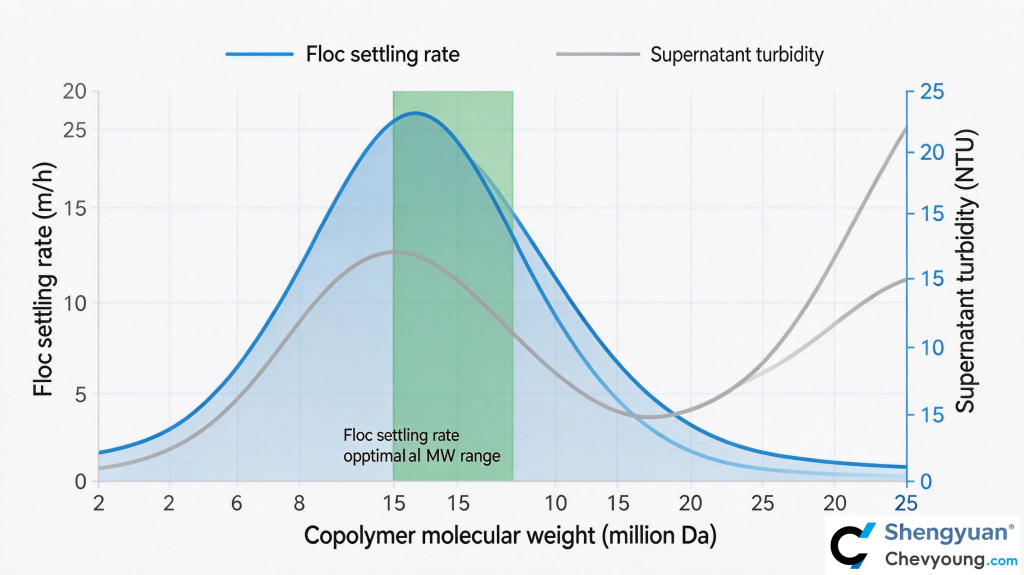
Flocculation by anionic polymers relies primarily on the bridging mechanism: a single polymer chain adsorbs onto multiple suspended particles simultaneously, physically linking them into large, rapidly settling flocs. Molecular weight directly defines the maximum bridging distance and adsorption capacity of each chain.
3.1 Insufficient molecular weight: weak bridging and deteriorated flocculation
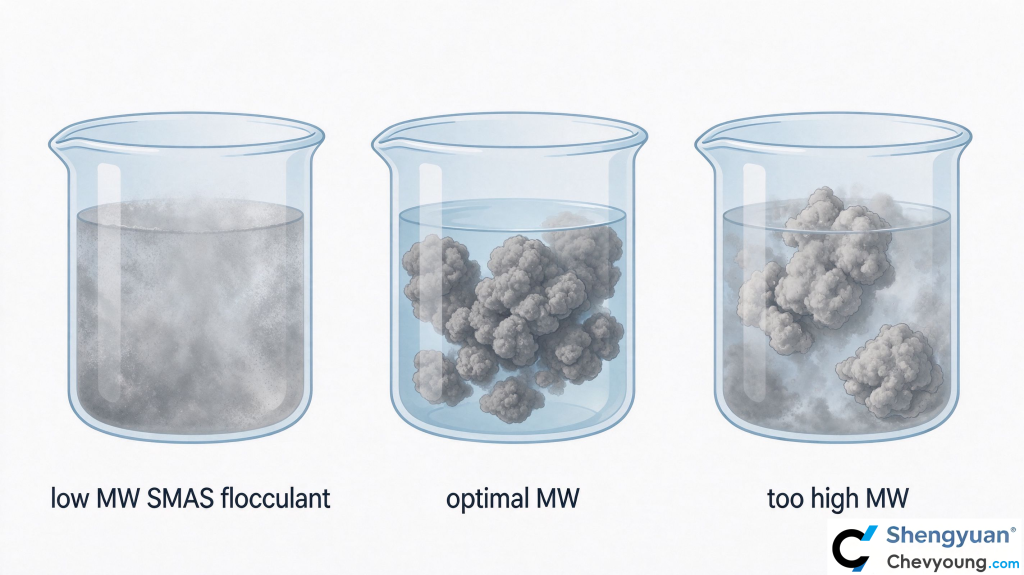
When the molecular weight of SMAS-acrylamide copolymer is too low (typically below 4–5 million Da), the polymer chains are too short to span multiple particles. Each chain adsorbs onto only one or two particles, unable to form effective inter-particle bridges.
- Flocs remain fine and poorly settled, with slow sedimentation velocity.
- Supernatant turbidity stays high because fine colloidal particles cannot be captured.
- Higher dosage does not improve performance; excess short-chain polymer only increases solution charge density without enhancing bridging.
This failure mode is very common when SMAS monomer is over-dosed in pursuit of better salt tolerance, without compensating process adjustments to preserve molecular weight.
3.2 Excessively high molecular weight: over-flocculation and shear fragility
On the other side of the optimum, ultra-high molecular weight (above 20–25 million Da) also degrades flocculation quality.
- The polymer solution has extremely high viscosity and dissolves poorly, forming gel-like “fish-eye” agglomerates that cannot disperse evenly.
- Local over-dosing causes over-flocculation: large, loose, water-entrapped flocs form that are difficult to dewater.
- High-molecular-weight chains are easily broken under mechanical shear (e.g., in pumps and pipelines). Once sheared, the fragmented chains cannot reassemble, leading to irreversible flocculation failure downstream.
4. Key Strategies to Control Molecular Weight of SMAS-Acrylamide Flocculant
Achieving the target molecular weight with narrow distribution requires coordinated control of monomer ratio, initiation system, temperature and feeding procedure.
4.1 Precise dosage control of sodium methallyl sulfonate monomer
SMAS loading is the primary molecular weight tuning knob. The appropriate ratio depends on target salt tolerance and required molecular weight:
- High-molecular-weight, moderate-salt grade: 0.5–2.0 mol% SMAS of total monomers, target Mw 12–18 million Da, suitable for general industrial wastewater and municipal sludge dewatering.
- Medium-salt industrial grade: 2.0–5.0 mol% SMAS, target Mw 8–12 million Da, balances salt resistance and bridging capacity for circulating cooling water and moderate-salinity tailings.
- High-salinity modified grade: 5.0–10.0 mol% SMAS, target Mw 5–8 million Da, for high-TDS produced water and seawater treatment systems.
As a rule of thumb, SMAS dosage above 10 mol% is not recommended for flocculant products, as chain transfer becomes so strong that molecular weight drops below the threshold for effective bridging flocculation.
4.2 Initiator system optimization to preserve molecular weight
Initiator type and concentration control radical generation rate and strongly influence final molecular weight.
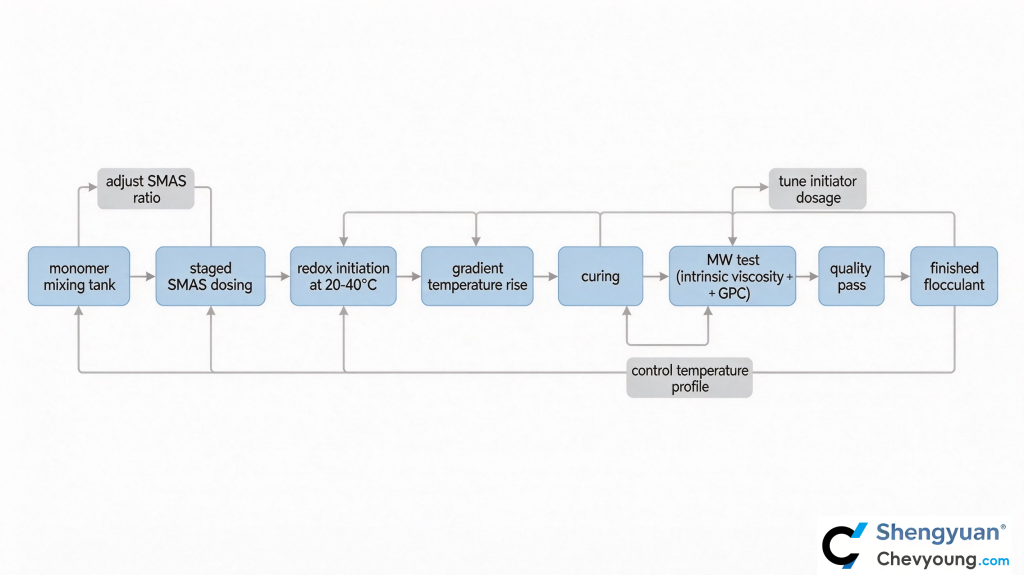
- For SMAS-modified flocculants, low-temperature redox initiation systems (e.g. ammonium persulfate / sodium bisulfite) are preferred over single thermal initiators. Redox systems generate radicals steadily at 20–40 °C, allowing long-chain growth without excessive SMAS chain transfer, making it easier to produce high-molecular-weight products.
- Initiator dosage is inversely related to molecular weight. Typical loading is 0.01–0.1 wt% of total monomers. When increasing SMAS ratio, reduce initiator dosage moderately to compensate for enhanced chain transfer and maintain target molecular weight.
4.3 Gradient temperature control to suppress SMAS chain transfer
Polymerization temperature has an especially strong effect on SMAS-acrylamide systems because the chain-transfer constant of sodium methallyl sulfonate rises sharply with temperature.
- Initiation stage (20–40 °C): Low-temperature initiation keeps SMAS chain transfer at a low level, allowing polymer chains to grow long.
- Propagation stage (50–60 °C): Slow temperature ramp maintains steady polymerization rate and uniform composition.
- Curing stage (70–80 °C): Short-time high-temperature post-treatment reduces residual monomer without excessive molecular weight degradation.
Avoid one-step high-temperature polymerization; this causes explosive chain transfer by SMAS and produces very low-molecular-weight oligomers with almost no flocculation activity.
4.4 Monomer concentration and medium adjustment
Total monomer concentration affects polymerization rate, heat release and molecular weight.
- For high-molecular-weight SMAS flocculants, total monomer concentration is typically controlled at 20–28 wt%.
- Higher SMAS formulas should use slightly lower monomer concentration to avoid excessive heat accumulation and runaway chain transfer.
- A small amount of chelating agent (EDTA or sodium citrate) is often added to sequester trace metal ions, which would otherwise catalyze radical decomposition and broaden molecular weight distribution.
4.5 Staged SMAS feeding for uniform molecular weight distribution
If all SMAS monomer is charged at once, the early polymerization stage has high SMAS concentration and strong chain transfer, producing short chains; later, as SMAS is depleted, chain transfer weakens and longer chains form. The result is a broad, bimodal molecular weight distribution with poor flocculation consistency. Staged or continuous dropwise feeding of SMAS maintains a nearly constant SMAS concentration throughout the reaction, yielding copolymer with more uniform composition and narrower molecular weight distribution. Narrow-distribution products deliver more predictable, stable flocculation performance across different water qualities.
5. Validation and On-Site Tuning of SMAS-Acrylamide Flocculant Molecular Weight
5.1 Laboratory characterization
- Intrinsic viscosity measurement with an Ubbelohde viscometer is the standard industrial method to estimate weight-average molecular weight of polyacrylamide flocculants.
- GPC (Gel Permeation Chromatography) provides full molecular weight distribution data, revealing high or low molecular tails that cause performance inconsistency.
- Standard jar tests with the target water sample directly verify flocculation effect: settling rate, supernatant turbidity, floc size and dewaterability are the key performance indicators.
5.2 On-site adjustment approach
If a SMAS-modified flocculant shows poor on-site flocculation:
- First confirm dissolution quality — many apparent performance issues come from insufficient dissolution, especially for high-molecular-weight grades.
- If flocs are fine and slow-settling, molecular weight is likely too low. In production, reduce SMAS ratio, lower initiator dosage or decrease polymerization temperature.
- If flocs are loose, shear-sensitive and high in water content, molecular weight may be too high. Slightly increase SMAS dosage, add a small amount of auxiliary chain transfer agent (e.g. isopropanol), or raise initiation temperature.
6. Common Mistakes and Corrective Measures
- Mistake 1: Increasing SMAS indefinitely for better salt tolerance, ignoring molecular weight collapse. Correction: Keep SMAS within 0.5–10 mol%, and use other monomers (e.g. AMPS) for higher salt demand if necessary.
- Mistake 2: Using the same polymerization temperature for SMAS-modified products as for plain polyacrylamide. Correction: Reduce initiation temperature by 5–10 °C for SMAS-containing formulas to compensate for enhanced chain transfer.
- Mistake 3: Evaluating quality only by charge density, without molecular weight verification. Correction: Make intrinsic viscosity and jar-test flocculation performance mandatory release criteria.
Frequently Asked Questions (FAQ)
Q1: Why does sodium methallyl sulfonate (SMAS, CAS NO.:1561-92-8) strongly affect the molecular weight of acrylamide flocculant?
A1: Sodium methallyl sulfonate carries highly active allylic C–H bonds that act as an efficient chain transfer agent during free-radical polymerization. It terminates growing polymer chains and reduces average molecular weight significantly even at low dosage. This makes SMAS both a functional sulfonate monomer and a powerful molecular weight regulator.
Q2: What is the optimal molecular weight range for SMAS-acrylamide copolymer flocculants?
A2: It varies by application. General municipal wastewater works well at 8–15 million Da; mineral tailings dewatering requires 12–20 million Da; high-salinity SMAS-modified grades typically target 5–10 million Da to balance salt tolerance and bridging ability.
Q3: What is the recommended dosage range of SMAS monomer for anionic flocculant production?
A3: For most flocculant grades, Sodium 2-methylprop-2-ene-1-sulfonate accounts for 0.5–10 mol% of total monomers. 0.5–3 mol% is used for medium-salt high-MW products; 3–10 mol% for high-salt modified grades. Exceeding 10 mol% usually pushes molecular weight below the minimum required for effective bridging flocculation.
Q4: What are the signs that the molecular weight of SMAS-acrylamide flocculant is too high?
A4: Typical signs include slow dissolution rate, high solution viscosity, easy formation of undissolved gel particles, over-flocculation with loose, water-rich flocs, flocs that break easily under shear, and higher supernatant turbidity than medium-MW products at equivalent dosage.
Q5: How to quickly adjust molecular weight if SMAS-acrylamide flocculant shows poor flocculation?
A5: First measure intrinsic viscosity to confirm molecular weight level. If too low: reduce SMAS dosage, lower initiator concentration, decrease polymerization temperature or moderately increase monomer concentration. If too high: slightly increase SMAS ratio, add a small amount of auxiliary chain transfer agent, or raise initiation temperature appropriately.
Q6: Can we achieve both high salt tolerance and good flocculation with Sodium beta-methallyl sulfonate modified flocculant?
A6: Yes, with balanced formulation and process control. Use 5–8 mol% Sodium beta-methallyl sulfonate to provide sulfonate groups for salt resistance, and adopt a low-temperature redox initiation system to maintain molecular weight above 6 million Da. This combination delivers both salt tolerance and sufficient bridging capacity for effective flocculation in high-TDS water systems.
References
[1] Nasser M S, James A E. The effect of polyacrylamide charge density and molecular weight on the flocculation and sedimentation behaviour of kaolinite suspensions[J]. Separation and Purification Technology, 2006, 52(2): 241–252.
[2] Xiong Y, et al. Effect of sodium methylacrysulfonate upon the molecular weight and performance of polycarboxylate superplasticizer[J]. Journal of Functional Polymers, 2014.
[3] Anionic Polyacrylamide (APAM) for Wastewater Treatment: Complete Guide 2026[EB/OL]. https://anionicpolyacrylamide.com/anionic-polyacrylamide-for-wastewater-treatment/
[4] Ningbo Innopharm. High Molecular Weight Anionic Polyacrylamide Flocculant for Industrial Wastewater Treatment[EB/OL]. https://www.nbinno.com/water-treatment-agents/high-molecular-weight-anionic-polyacrylamide-flocculant-for-industrial-water-treatment-xi
[5] Nuoer Chemical. Selecting Anionic PAM Molecular Weight for Mining Efficiency[EB/OL]. https://www.nuoer.com/selecting-anionic-pam-molecular-weight-for-mining-efficiency/
[6] Industrial Chemical Datasheet. Sodium Methallyl Sulfonate (SMAS, CAS NO.:1561-92-8) for Water Treatment Flocculants[EB/OL]. Made-in-China Chemical Directory, 2024.