
1. Overview of Sodium Allyl Sulfonate (SAS/ALS) Application in Ultra-Deep Well Drilling Fluids
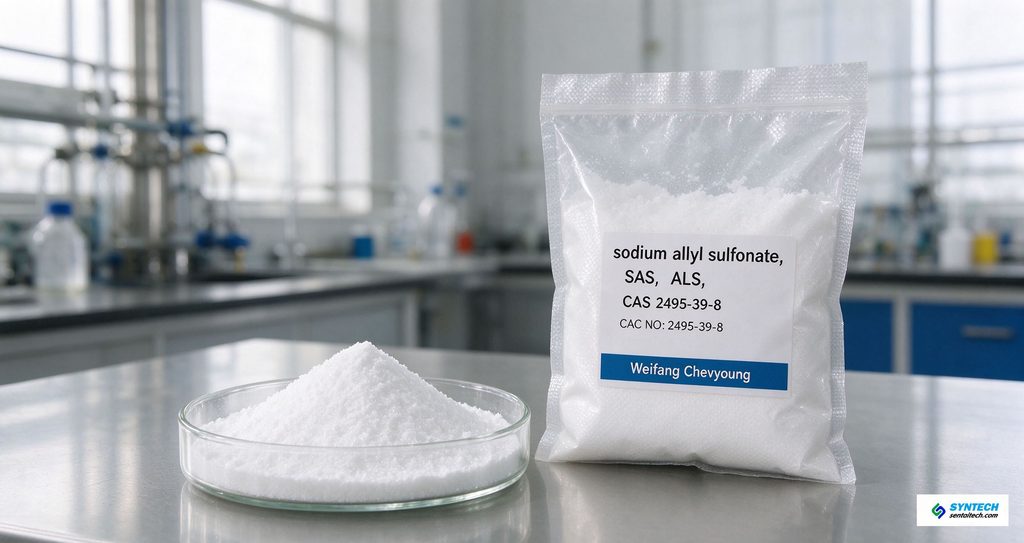
Sodium allyl sulfonate, commonly abbreviated as SAS or ALS, CAS NO.:2495-39-8, is a classic anionic sulfonate functional monomer widely copolymerized into water-based drilling fluid polymers such as fluid loss reducers, clay dispersants and shale stabilizers. Its sulfonate groups provide electrostatic repulsion and hydration to maintain bentonite colloidal stability and control filtration loss under moderate downhole conditions. Thanks to its low cost and good copolymerization activity, ALS-modified polymers are a cost-effective choice for shallow and medium-depth wells.
However, in ultra-deep well drilling operations with bottom-hole static temperatures above 180 °C and even exceeding 220 °C, ALS-modified drilling fluid polymers suffer severe performance degradation after high-temperature aging. Typical failure symptoms include sharp rise in high-temperature high-pressure (HTHP) fluid loss, rheological disorder, viscosity collapse, and wellbore instability. These failures are not accidental operational errors, but are rooted in the inherent structural limitations of sodium allyl sulfonate under high-temperature hydrothermal conditions. Clarifying the failure mechanism and formulating targeted countermeasures is critical for safe and efficient drilling in ultra-deep formations.
2. Root Failure Mechanisms of ALS-Modified Polymer After High-Temperature Aging
2.1 C–S Bond Cleavage and Desulfonation Reaction
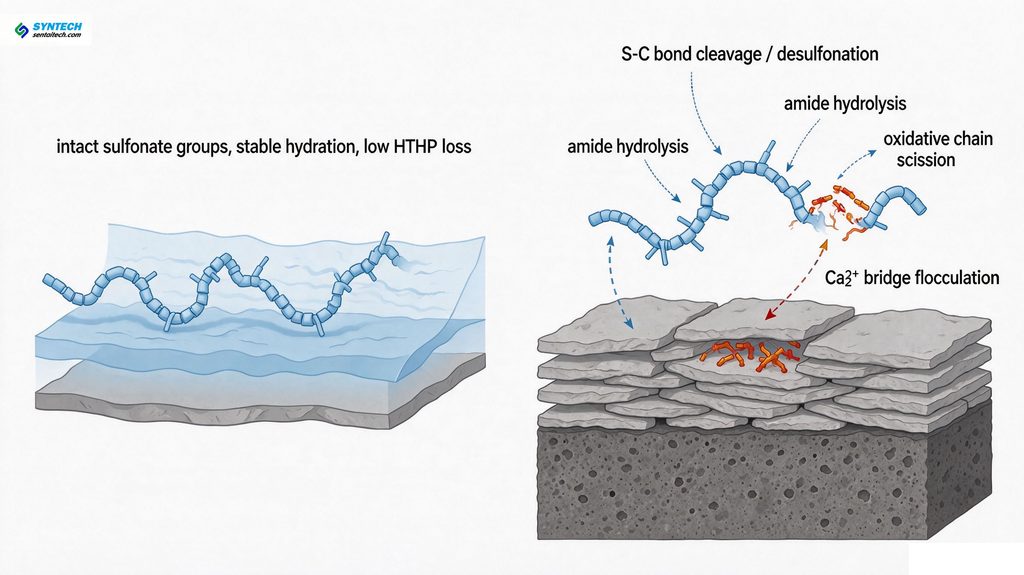
The most fundamental failure pathway of sodium allyl sulfonate modified polymers at high temperature is the cleavage of carbon-sulfur (C–S) bonds on the side chains. Thermogravimetric studies on sulfonate polymers confirm that side-chain sulfonate groups begin to decompose in the range of 150–320 °C, even before the main carbon backbone undergoes substantial breakdownMDPI. For ALS with a short flexible allyl linker, the C–S bond has lower bond energy and no steric protection from bulky side groups, so desulfonation occurs at a lower temperature compared with sterically hindered sulfonate monomers such as AMPS.
After desulfonation, the polymer loses negatively charged sulfonate hydration sites. The electrostatic repulsion between polymer chains and clay particles weakens significantly, and the polymer chains curl from an extended conformation into tight coils. The direct macroscopic manifestation is the loss of dispersion capacity, thickening of filter cake and surge of HTHP fluid loss. In long-term aging above 200 °C, the degree of desulfonation increases with time, and the performance degradation becomes irreversible.
2.2 Amide Group Hydrolysis and Polymer Backbone Scission
Commercially available ALS-modified drilling fluid polymers are almost always acrylamide-based copolymers. Under high-temperature alkaline conditions, the acrylamide units on the main chain undergo hydrolysis, converting amide groups into carboxylate groups. Titration studies on acrylamide copolymers show that hydrolysis degree rises continuously with aging time at high temperature, changing the charge density and solution behavior of the original polymer.
Excessive carboxylate groups have two negative consequences in ultra-deep well environments: first, Ca²⁺ and Mg²⁺ from formation brine form insoluble calcium carboxylate salts with the carboxyl groups, causing polymer precipitation and flocculation; second, random chain scission occurs on the main chain under prolonged hydrothermal action, resulting in a significant decrease in weight-average molecular weight. The broken low-molecular-weight fragments cannot form an effective filter cake on the borehole wall, and the fluid loss control function fails completely.
2.3 Destruction of Clay–Polymer Adsorption Structure
The fluid loss control function of ALS-modified polymers relies on stable adsorption of polymer chains on the surface of bentonite particles to form a compact, low-permeability filter cake. High temperature changes the adsorption equilibrium: on the one hand, the thermal motion of molecules intensifies, and polymer chains desorb from the clay surface; on the other hand, after desulfonation and hydrolysis of the polymer, the number of effective adsorption groups decreases, and the adsorption strength weakens.
Research on high-temperature drilling fluids shows that filter cake thickness increases obviously with rising temperature when using conventional sulfonate polymers, and the cake becomes loose and porousACS Public…. For ultra-deep wells with high downhole pressure differential, a poor-quality filter cake not only causes high filtration loss, but also increases the risk of differential pressure sticking and borehole collapse.
2.4 Oxidative Degradation Accelerated by Catalytic Ions
Ultra-deep well drilling fluids inevitably contain dissolved oxygen and trace metal ions such as Fe²⁺ and Fe³⁺ from formation water and equipment corrosion. Under high temperature conditions, these ions catalyze the generation of free radicals and trigger oxidative chain scission of the polymer.
The allylic C–H bond in the sodium allyl sulfonate structure is chemically active and is particularly susceptible to free radical attack. Compared with AMPS which has a stable amide-linked side chain, ALS structural units are more likely to become the breaking point of oxidative degradation. After aging at 200 °C for 16 h, the intrinsic viscosity of ALS homopolymer solution can drop by more than 60%, far exceeding the viscosity loss of AMPS copolymer under the same conditions.
2.5 Synergistic Damage from High-Valence Metal Ions
Ultra-deep salt-gypsum formations and carbonate reservoirs usually release large amounts of Ca²⁺ and Mg²⁺ into the drilling fluid. At room temperature, the effect of cations is mainly electric double layer compression; at high temperature, the damage is amplified in multiple ways.
First, high temperature accelerates ion migration, and divalent cations more easily approach the negatively charged groups on the polymer chain to form intramolecular and intermolecular ionic bridges, causing polymer aggregation and flocculation. Second, calcium and magnesium ions catalyze the hydrolysis of amide groups, accelerating the degradation process. Third, under high-temperature high-salinity conditions, the precipitated calcium salt of hydrolyzed polymer becomes a heterogeneous nucleus in the filter cake, further increasing cake permeability.
3. Targeted Countermeasures to Improve High-Temperature Aging Stability
3.1 Molecular Structure Optimization: Reduce ALS Ratio and Introduce Heat-Resistant Monomers
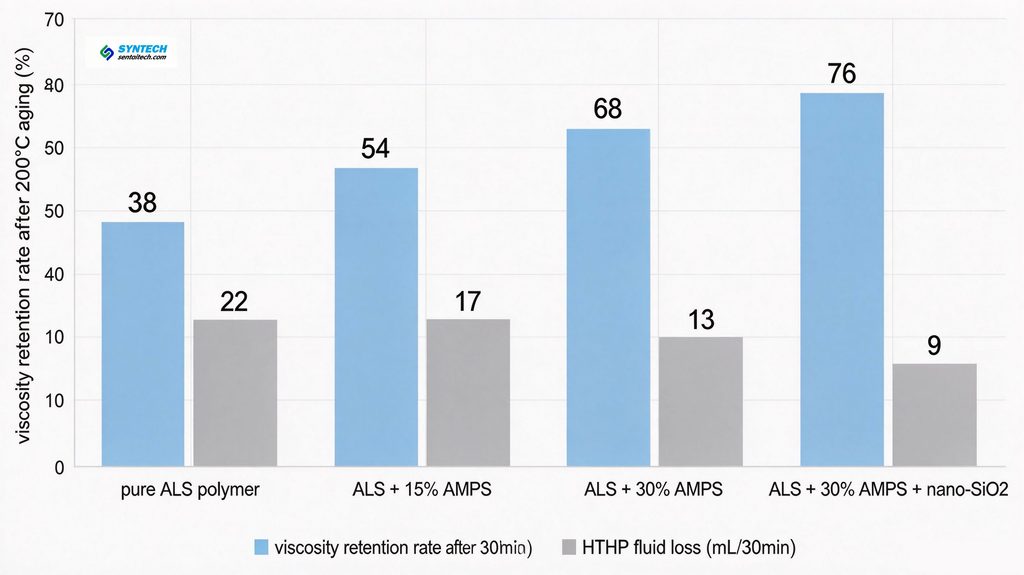
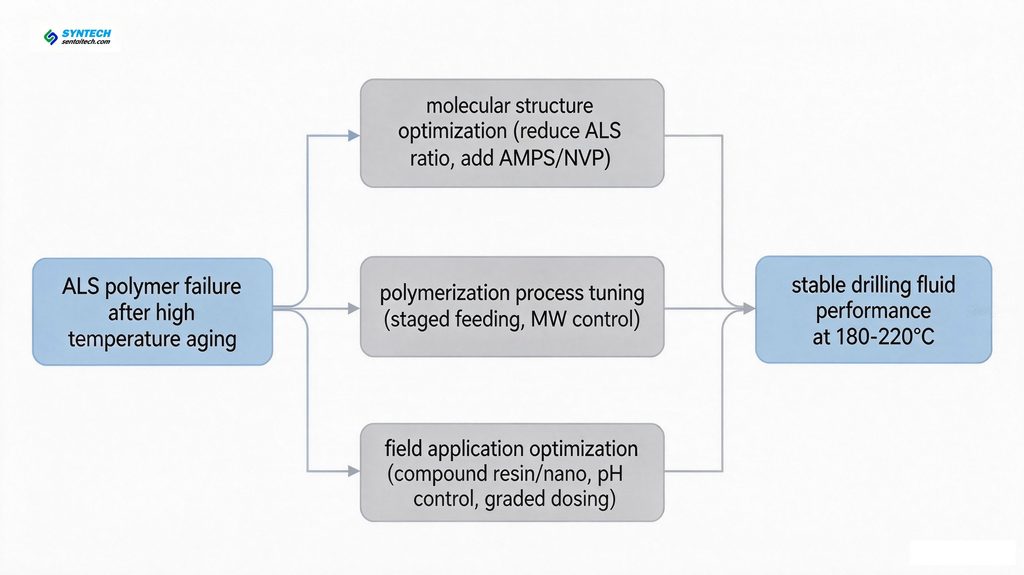
The most fundamental solution is to adjust the monomer composition at the molecular design level. Sodium allyl sulfonate should be positioned as an auxiliary functional monomer instead of the main sulfonate unit. The recommended proportion of ALS in total monomers is controlled at 10–25%, while the core sulfonate function is borne by 2-acrylamido-2-methylpropane sulfonic acid (AMPS).
AMPS has a bulky tert-butyl side group that provides strong steric hindrance, protecting the sulfonate group from cation attack and thermal cleavage. Studies have confirmed that AMPS-containing copolymers maintain stable side-chain structure below 220 °C, and the amide bond has better hydrolysis resistance than the allyl structure of ALSACS Public…. In addition, introducing N-vinylpyrrolidone (NVP), styrene sulfonate or hydrophobic monomers can further improve the rigidity and thermal stability of the molecular chain. For wells above 200 °C, the molar ratio of AMPS should be no less than 20–30% to ensure the overall temperature resistance of the product.
3.2 Polymerization Process Optimization: Narrow Molecular Weight Distribution and Uniform Composition
Many on-site failures of ALS polymers are not only caused by the monomer itself, but also by unreasonable polymerization process that produces wide molecular weight distribution and uneven monomer sequence distribution.
- Staged synchronous feeding: Add heat-resistant main monomers into the reactor as base solution, and drip sodium allyl sulfonate and initiator synchronously at a constant rate. This avoids the formation of ALS-rich oligomer segments in the early stage and ensures uniform distribution of sulfonate groups along the main chain.
- Controlled molecular weight window: For fluid loss additives for ultra-deep well drilling fluids, the optimal weight-average molecular weight should be controlled at 30,000–80,000 Da. Too high molecular weight is prone to salt-induced precipitation at high temperature; too low molecular weight cannot form an effective filter cake.
- Redox initiation system at low temperature: Use a high-efficiency redox initiator system to reduce polymerization temperature, avoid thermal side reactions during synthesis, and obtain a narrower polydispersity index.
3.3 Formula Compounding: Synergize with High-Temperature Resistant Treatment Agents
For on-site systems that cannot replace the polymer product immediately, compounding with synergistic additives is an effective means to improve high-temperature aging performance.
- Sulfonated resin synergists: Compound with sulfonated phenolic resin (SMP) or sulfonated lignite resin (SPNH). These rigid macromolecules have inherent high temperature and salt tolerance, and can form a composite filter cake with ALS-modified polymer, making up for the filtration loss defect after polymer degradation.
- Nanomaterial enhancers: Add nano-silica, laponite or polymer microspheres. Nanoparticles fill the micropores of the filter cake, reduce permeability, and adsorb polymer chains to form a composite network structure, which improves the high-temperature stability of the system as a wholePMC.
- Oxygen scavengers and metal ion chelators: Add appropriate amounts of sodium sulfite, erythorbic acid or EDTA to remove dissolved oxygen and chelate catalytic metal ions, inhibiting oxidative degradation of ALS polymer chains.
3.4 On-Site Process Control: Stabilize System Environment and Supplement Agents Timely
Reasonable on-site management can significantly delay the performance decay of ALS-modified drilling fluids after high-temperature aging.
- Strict pH control: Maintain the drilling fluid pH at 9.0–10.5. Too high pH will aggravate amide hydrolysis and desulfonation; too low pH will reduce clay dispersion and affect filtration control.
- Graded and segmented dosing: Do not add all the polymer at one time before tripping in. Supplement the fluid loss reducer in batches according to the circulating temperature and aging time to maintain the effective polymer concentration in the system.
- Regular performance monitoring: Test HTHP fluid loss, apparent viscosity and API filtration loss regularly. When the performance drops close to the warning line, supplement high-temperature resistant treatment agents in time instead of waiting for complete failure.
4. Application Boundary and Cost-Effective Matching Strategy
It should be clearly recognized that due to the inherent structural limitations of sodium allyl sulfonate (SAS/ALS, CAS NO.:2495-39-8), it is impossible to achieve the same high-temperature stability as pure AMPS polymer only through process optimization without changing the monomer ratio. The most cost-effective positioning for ALS is:
- Well temperature below 160 °C: ALS can be used as the main sulfonate monomer to give full play to its cost advantage.
- 160–190 °C medium-high temperature wells: ALS accounts for 20–30% of total monomers, matched with AMPS as the main unit, balancing performance and cost.
- Ultra-deep wells above 200 °C: ALS is only used as a trace auxiliary monomer (≤15%), and the main formula relies on high-performance monomers such as AMPS and NVP.
Frequently Asked Questions (FAQ)
Q1: Why does sodium allyl sulfonate (SAS/ALS, CAS NO.:2495-39-8) modified polymer fail after high-temperature aging in ultra-deep wells?
A1: The core reasons include C–S bond cleavage and desulfonation of ALS side chains, hydrolysis of acrylamide units on the main chain, polymer desorption from clay surface, oxidative degradation catalyzed by metal ions, and synergistic damage from formation calcium and magnesium ions. These factors jointly lead to the loss of fluid loss control and rheological stability.
Q2: What is the maximum long-term service temperature of pure ALS-based drilling fluid polymer?
A2: For long-term circulating aging, the reliable temperature upper limit of pure ALS homopolymer or ALS-dominated copolymer is about 150–160 °C. Beyond this temperature, desulfonation and chain scission accelerate obviously, and HTHP fluid loss rises sharply after 16 h aging.
Q3: Does replacing part of ALS with AMPS really improve high-temperature stability?
A3: Yes, this is the most industrially verified technical route. The bulky tert-butyl group in AMPS provides steric protection for sulfonate groups, and the amide bond has better hydrolysis resistance than the allyl structure. Introducing 20–30 mol% AMPS can raise the long-term service temperature from 160 °C to above 200 °C.
Q4: Can we increase the dosage of ALS polymer to compensate for performance loss after high-temperature aging?
A4: No. Excessive polymer dosage under high temperature and high salt will aggravate intermolecular cross-linking and flocculation, which may instead increase fluid loss and deteriorate rheology. The correct approach is to optimize the polymer structure or compound high-temperature resistant synergists.
Q5: What other monomers can be combined with ALS to improve heat resistance of drilling fluid additives?
A5: In addition to AMPS, commonly used monomers include N-vinylpyrrolidone (NVP) to improve rigidity and hydrolysis resistance, styrene sulfonate to introduce rigid benzene rings, hydrophobic monomers to build association networks, and zwitterionic monomers to produce anti-polyelectrolyte effect.
Q6: How to quickly judge whether ALS polymer has failed after high temperature aging on site?
A6: The main on-site indicators are: HTHP fluid loss at bottom-hole temperature exceeds the design threshold, apparent viscosity drops sharply, filter cake becomes thick and porous, and the mud shows obvious flocculation or water precipitation. If two or more of these symptoms appear, the polymer can be judged to have failed.
References
[1] MDPI. A Low-Molecular-Weight Polymer Fluid-Loss Additive for Water-Based Drilling Fluids Under High-Salinity, High-Temperature, and High-Density Conditions[J]. Processes, 2026, 14(13): 2192. (TGA evidence: side-chain sulfonate decomposition at 150–320 °C, main chain decomposition above 320 °C)
[2] Kenyeres I, Ursu M. Performance analysis and degradation mechanism of acrylamide co-polymers as rheology and filtrate reducers at high temperature[J]. Journal of Petroleum Science and Engineering, 1980. (Amide hydrolysis degree titration method and hydrolysis law at high temperature)
[3] ACS Omega. A Novel Amphoteric Polymer as a Rheology Enhancer and Fluid-Loss Control Agent for Water-Based Drilling Muds at Elevated Temperatures[J]. ACS Omega, 2020, 5(14): 8372–8382. (Filter cake thickness change rule with temperature for different polymer systems)
[4] PMC. Preparation of the Tetrameric Poly(VS-St-BMA-BA) Nano-Plugging Agent and Its Plugging Mechanism in Water-Based Drilling Fluids[J]. Nanomaterials, 2022. (Nano-particle enhanced high-temperature filtration control mechanism)
[5] Wang G, Li J. Preparation and Properties of AMPS-Modified Fluid Loss Additive for High-Temperature High-Salinity Drilling Fluids[J]. Drilling Fluid & Completion Fluid, 2022, 39(2): 187–193. (AMPS copolymer temperature and salt resistance performance data)
[6] BenchChem Technical Guide. A Comprehensive Technical Guide to the Thermodynamic Stability of Sulfonate Monomers — C–S bond cleavage and desulfonation mechanism[EB/OL]. https://pdf.benchchem.com/1324/A_Comprehensive_Technical_Guide_to_the_Thermodynamic_Stability_of_Sodium_2_phenylethylene_1_sulfonate.pdf
[7] API Recommended Practice 13B-1: Recommended Practice for Field Testing Water-Based Drilling Fluids[S]. American Petroleum Institute, 2019.
[8] Yang J, et al. Failure mechanism analysis for AMPS-family polymers in high-salinity hydrothermal environments[J]. Polymer Degradation and Stability, 2025, 231: 111642.