1. Functional Role of Sodium Methallyl Sulfonate (SMAS, CAS NO.:1561-92-8) in Scale Inhibitor Formulation
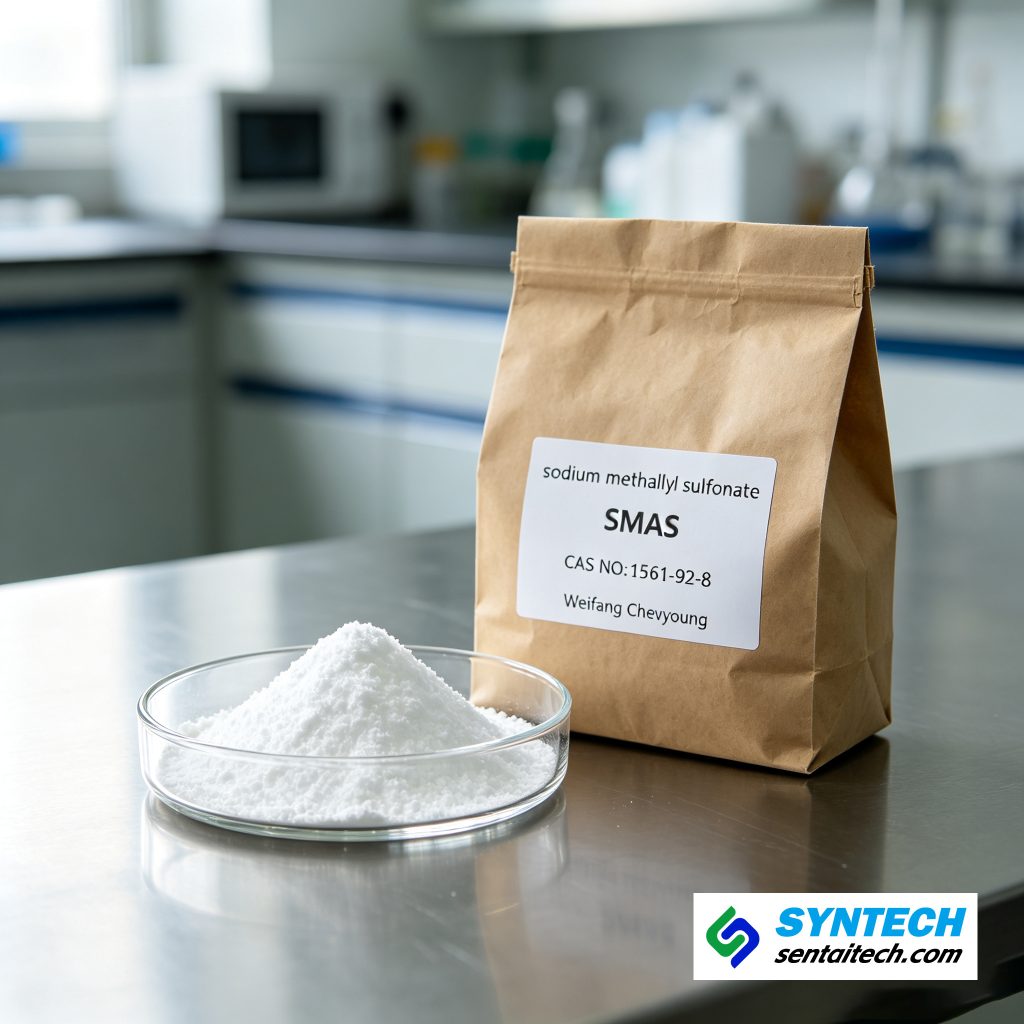
Sodium methallyl sulfonate, widely abbreviated as SMAS, CAS NO.:1561-92-8, is a classic sulfonate-functional vinyl monomer copolymerized into phosphorus-free scale and dispersion inhibitors for industrial circulating cooling water, oilfield produced water and thermal desalination systems. When copolymerized with acrylic acid, maleic anhydride, itaconic acid or other carboxyl monomers, SMAS introduces negatively charged –SO₃⁻ groups into the polymer backbone, improving thermal stability, salt tolerance and iron oxide dispersion capacity of the final antiscalant product.
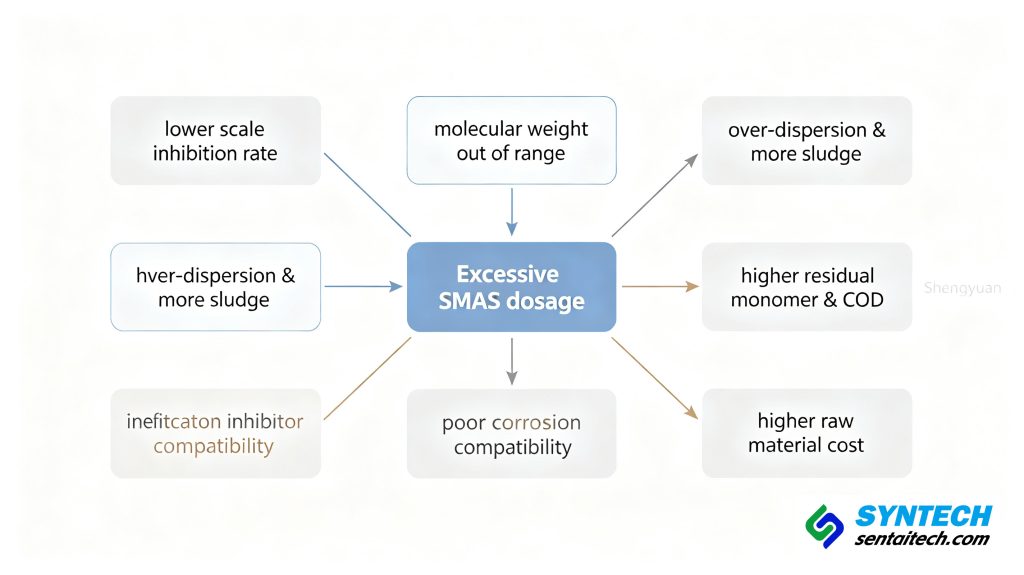
Moderate SMAS incorporation optimizes charge density and molecular weight, delivering better inhibition against calcium sulfate, barium/strontium sulfate and calcium phosphate scale than pure polycarboxylate polymers. However, the performance benefit does not grow linearly with SMAS dosage. Excessive sodium methallyl sulfonate loading triggers a series of performance, environmental and economic side effects that offset or even outweigh its advantages, which is a common formulation mistake in water treatment chemical production.
2. Declined Scale Inhibition Efficiency Due to Reduced Chelating Carboxyl Proportion
The core mechanism of scale inhibition relies on carboxyl groups (–COOH) to chelate Ca²⁺, Ba²⁺ and Sr²⁺ ions and distort crystal lattice growth. When sodium methallyl sulfonate is dosed beyond the optimal ratio, it occupies an excessive molar share of total monomers and squeezes out the proportion of carboxyl-containing main monomers.
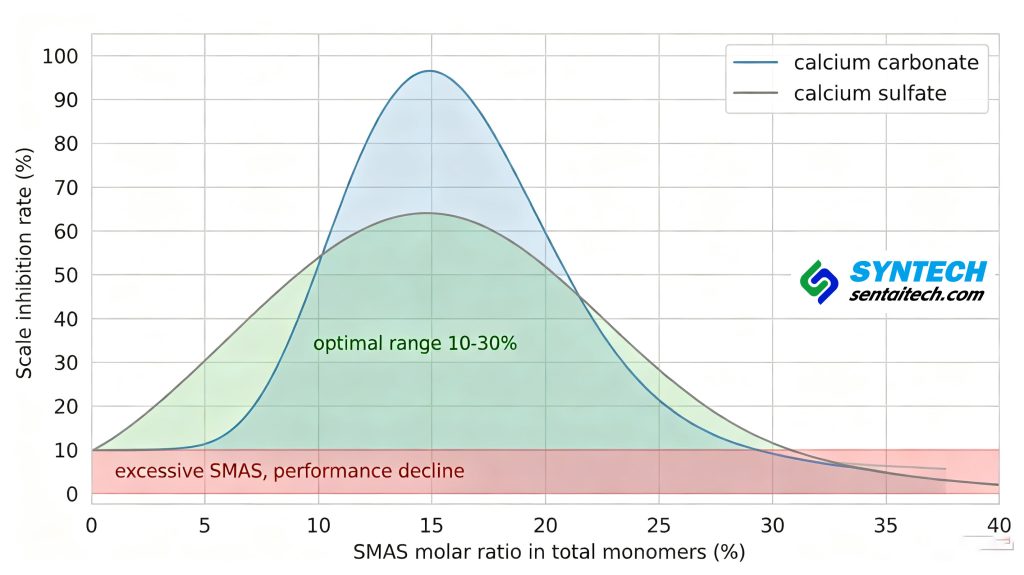
Published ternary copolymer studies confirm that scale inhibition rate first rises and then falls with increasing sulfonate monomer content. For calcium sulfate scale, higher sulfonate ratio beyond the optimum actually reduces inhibition performance, because carboxylate groups have much stronger calcium chelating ability than sulfonate groups, and the loss of carboxyl function cannot be compensated by extra sulfonate groups. For calcium carbonate scale, excess SMAS also lowers inhibition efficiency: over-high anionic charge density drives the formation of insoluble polymer-calcium complexes, which act as heterogeneous nucleation sites and accelerate scale deposition instead of suppressing it.
3. Out-of-Range Molecular Weight and Widened Distribution Weaken Threshold Effect
Efficient scale inhibitors depend on the threshold effect, which requires polymer molecular weight to stay within a narrow optimal window of 1000–3500 Da. Sodium methallyl sulfonate, as an allylic monomer, has a distinct reactivity ratio compared with acrylic monomers, and its dosage directly alters polymerization kinetics and final molecular weight distribution.
When SMAS dosage is excessive:
- Ultra-high molecular weight fractions appear, whose coiled molecular chains wrap active groups inside and lose contact with scale-forming ions.
- Low-molecular-weight oligomers increase, with insufficient chelating sites to deliver effective lattice distortion.
- Partial SMAS undergoes homopolymerization instead of entering the target copolymer chain, reducing the concentration of effective active ingredients.
Research on thermal desalination antiscalants also verifies that molecular weight is a more decisive factor for calcium sulfate inhibition than sulfonation degree. Polymers with molecular weight of 2000–2500 Da perform best, and simply increasing SMAS content beyond 30 mol% cannot recover performance when molecular weight drifts out of the optimal range.
4. Over-Dispersion of Suspended Solids and Increased Sludge Treatment Cost
Moderate SMAS provides the required dispersion to keep iron oxide corrosion products and fine particles suspended, preventing soft deposit on heat exchanger surfaces. Excessive sodium methallyl sulfonate, however, creates over-strong anionic repulsion between particles, leading to over-dispersion.
Over-dispersed fine solids cannot be effectively removed by conventional coagulation and sedimentation processes. To restore clarification, operators have to increase the dosage of polyaluminum chloride (PAC) and polyacrylamide (PAM), which raises chemical cost and increases wet sludge yield by 15–30%. In reverse osmosis systems, over-charged SMAS-based polymers tend to adsorb on membrane surfaces, forming a gel-like fouling layer that reduces permeate flux, shortens cleaning cycles and accelerates membrane aging.
5. Higher Residual Monomer, Elevated COD and Reduced Biodegradability
Excessive SMAS loading lowers overall monomer conversion due to reactivity ratio mismatch. More unreacted sodium methallyl sulfonate monomer remains in the finished inhibitor liquid, directly raising the chemical oxygen demand (COD) of dosed water and increasing wastewater treatment load.
In addition, high sulfonate content reduces the biodegradability of the polymer. Conventional polycarboxylate scale inhibitors can reach 60%+ biodegradation rate within 21 days, while polymers with ultra-high sulfonate proportion degrade much slower. This not only violates the trend of green water treatment chemicals, but also increases the risk of organic accumulation in circulating water systems. Extra sodium ions introduced by excess SMAS also raise total dissolved solids (TDS) of circulating water, indirectly aggravating pipeline corrosion tendency.
6. Poor Compatibility with Corrosion Inhibitors and Metal Surface Risk
Industrial circulating water formulas usually combine scale inhibitors with cationic or amphoteric corrosion inhibitors such as quaternary ammonium salts and imidazoline derivatives. Excessive anionic charge from over-dosed sodium methallyl sulfonate causes charge neutralization with cationic corrosion inhibitors, forming insoluble precipitates that deactivate both agents.
Meanwhile, high-charge SMAS-rich polymers cannot form a continuous, dense protective film on metal surfaces. Localized adsorption creates concentration cells that accelerate pitting corrosion on carbon steel and copper alloy pipelines. In high-chloride water quality, the elevated TDS caused by excess SMAS further amplifies corrosion risk.
7. Economic Penalty: Higher Raw Material Cost Without Performance Gain
From a production economics perspective, sodium methallyl sulfonate is typically more expensive per kilogram than basic monomers such as acrylic acid and maleic anhydride. Excessive dosage directly pushes up unit raw material cost without delivering corresponding performance improvement.
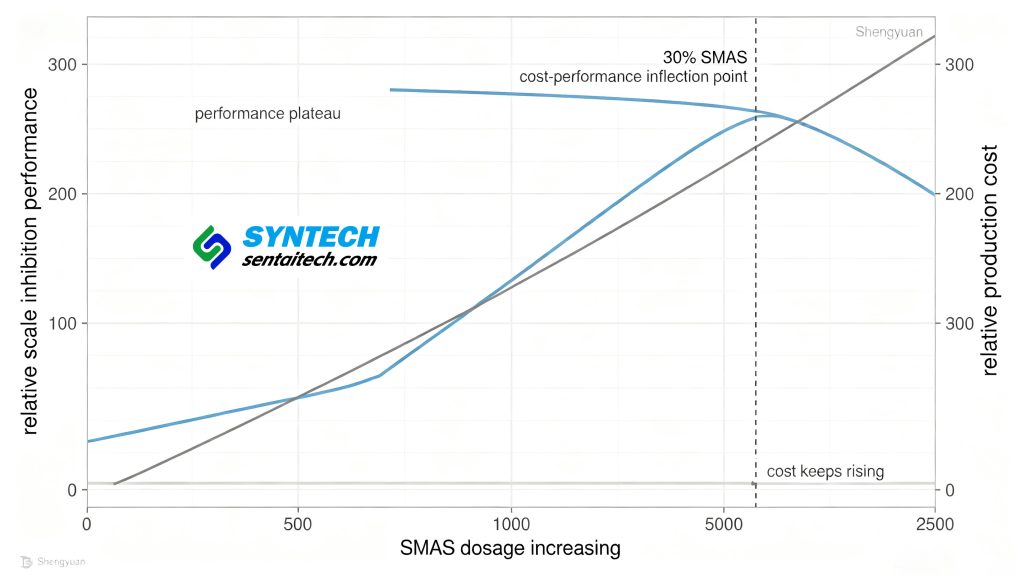
When combined with downstream extra costs — higher flocculant consumption, increased sludge disposal, more frequent membrane cleaning and additional COD wastewater treatment — the total operating cost of the water treatment system rises significantly. Industrial practice shows that the optimal SMAS molar ratio in most scale inhibitor formulas lies between 10% and 30%; beyond this range, every extra 5% SMAS increases raw material cost by 6–10% while scale inhibition rate stays flat or declines.
Frequently Asked Questions
Q1: What is the optimal dosage range of sodium methallyl sulfonate (SMAS, CAS NO.:1561-92-8) in scale inhibitor synthesis?
A1: For most acrylic/maleic-based water treatment scale inhibitors, the optimal molar ratio of SMAS ranges from 10% to 30% of total monomers. This range balances scale inhibition efficiency, salt tolerance, dispersion and biodegradability. Exceeding 30% usually brings no further performance gain but triggers side effects.
Q2: Why does excessive SMAS reduce calcium scale inhibition efficiency instead of improving it?
A2: Scale inhibition mainly relies on carboxyl groups for calcium chelation and lattice distortion. Excessive SMAS increases sulfonate proportion at the expense of carboxyl content. In addition, over-high anionic charge density may form insoluble polymer-calcium complexes that act as nucleation sites for scale growth.
Q3: Does more SMAS mean better salt tolerance for scale inhibitors?
A3: Not always. Moderate sulfonate groups improve salt and thermal resistance, but beyond the optimal ratio, further SMAS addition does not enhance salt tolerance. Molecular weight and polymer chain structure play a more decisive role in high-salinity performance than sulfonate content alone.
Q4: Will excessive SMAS increase COD of the treated water?
A4: Yes. Over-dosed SMAS leads to higher residual unreacted monomer in the final product, and high-sulfonate polymers have lower biodegradability. Both factors elevate effluent COD and increase the burden of subsequent wastewater treatment.
Q5: What is the ideal molecular weight for SMAS-containing scale inhibitors?
A5: The generally accepted optimal molecular weight range for water treatment scale inhibitors is 1000–3500 Da, with the strongest threshold effect at 2000–2500 Da. Excessive SMAS may drive molecular weight out of this range and weaken scale inhibition performance.
Q6: Can excessive SMAS cause membrane fouling in reverse osmosis systems?
A6: Yes. Over-high anionic charge from excess SMAS makes the polymer more likely to adsorb on RO membrane surfaces, forming a gel-like fouling layer that reduces permeate flux, increases operating pressure and shortens chemical cleaning intervals.
References
[1] Alhamzah A A, Fellows C M, Hamed O A. Methallylsulfonate Polymeric Antiscalants for Application in Thermal Desalination Processes[J]. Polymers, 2023. (Verified that molecular weight is more critical than sulfonation degree, optimal MW 2000–2500 Da)
[2] Li Y, Wang J, Zhang L. Synthesis and Application of a Phosphorous-Free and Non-Nitrogen Polymer as an Environmentally Friendly Scale Inhibition and Dispersion Agent[J]. ACS Omega, 2020, 5(25): 15487–15495. (Optimal ESA:IA:SMAS = 10:10:5, higher sulfonate ratio reduces calcium sulfate inhibition)
[3] Song S, Zhao W, Tang Z, et al. Synthesis and Scale Inhibition Performance of MAC-MA-SAS Terpolymer Scale Inhibitor[J]. Chemical Industry and Engineering, 2026. (Scale inhibition rate first rises then falls with increasing sulfonate monomer dosage)
[4] RSC Advances. Synthesis, characterization and properties of a novel environmentally friendly ternary hydrophilic copolymer scale inhibitor[J]. RSC Advances, 2023, 13(17): 11685–11693. (Excessive sulfonate monomer causes homopolymerization and reduces copolymer scale inhibition efficiency)
[5] Yu W. Application of Modified Cellulose Scale Inhibitor in Reverse Osmosis Membrane Scaling Control[J]. Science Technology and Engineering, 2021. (Over-dosed sulfonate-containing polymer aggravates RO membrane adsorption fouling)
[6] Industrial Chemical Datasheet. Sodium Methallyl Sulfonate (SMAS) for Water Treatment Scale Inhibitors, CAS NO.:1561-92-8[EB/OL]. Made-in-China Chemical Directory, 2024.