Common Polymerization Problems When Matching Initiator Systems with SMAS for Water Treatment Chemicals
1. Introduction: Initiator Matching as a Critical Variable for Sodium Methallyl Sulfonate Water Treatment Polymers
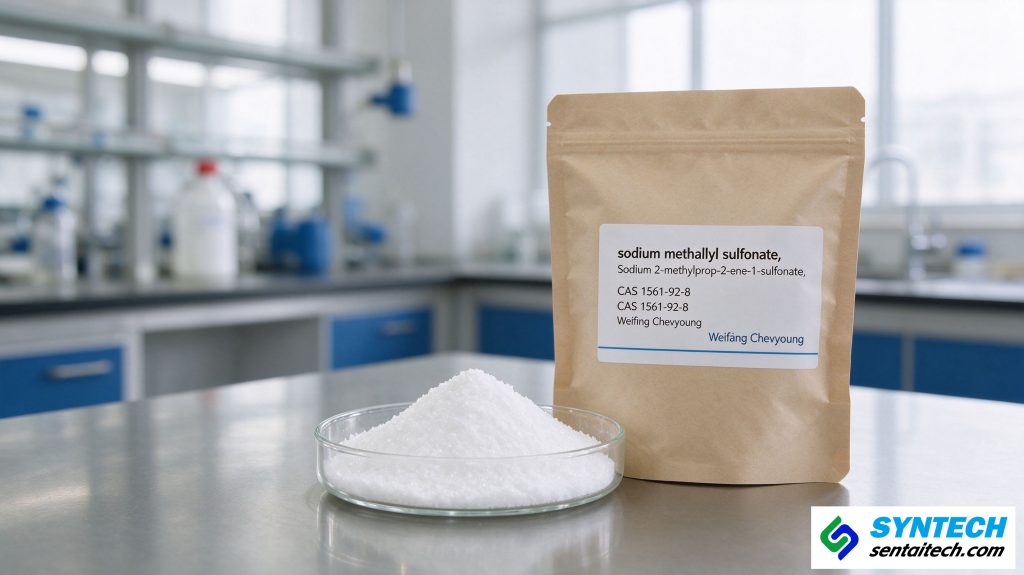
Sodium methallyl sulfonate, also named Sodium 2-methylprop-2-ene-1-sulfonate or Sodium beta-methallyl sulfonate, widely referred to as SMAS monomer with CAS NO.: 1561-92-8, is a core sulfonate-functional vinyl monomer for manufacturing phosphorus-free scale inhibitors, anionic flocculants and iron oxide dispersants for industrial water treatment. When copolymerized with acrylic acid, maleic anhydride or acrylamide, SMAS introduces strongly hydrophilic –SO₃⁻Na⁺ groups, improving salt tolerance, thermal stability and dispersion capacity of the finished water treatment chemicals.
Among all process parameters in aqueous free-radical polymerization, the initiator system exerts the most direct influence on polymerization rate, monomer conversion, molecular weight and copolymer composition. Unlike conventional acrylic monomers, Sodium beta-methallyl sulfonate has an inherent allylic C–H structure that gives it strong chain-transfer activity. This unique property means standard initiator formulas designed for pure polyacrylate or polyacrylamide do not transfer directly to SMAS-containing systems. Mismatched initiator systems cause a series of persistent polymerization defects, which ultimately degrade scale inhibition efficiency, flocculation performance and batch-to-batch consistency of the final product.
2. Uncontrolled Molecular Weight Collapse and Broad Distribution from SMAS Chain Transfer – Initiator Mismatch
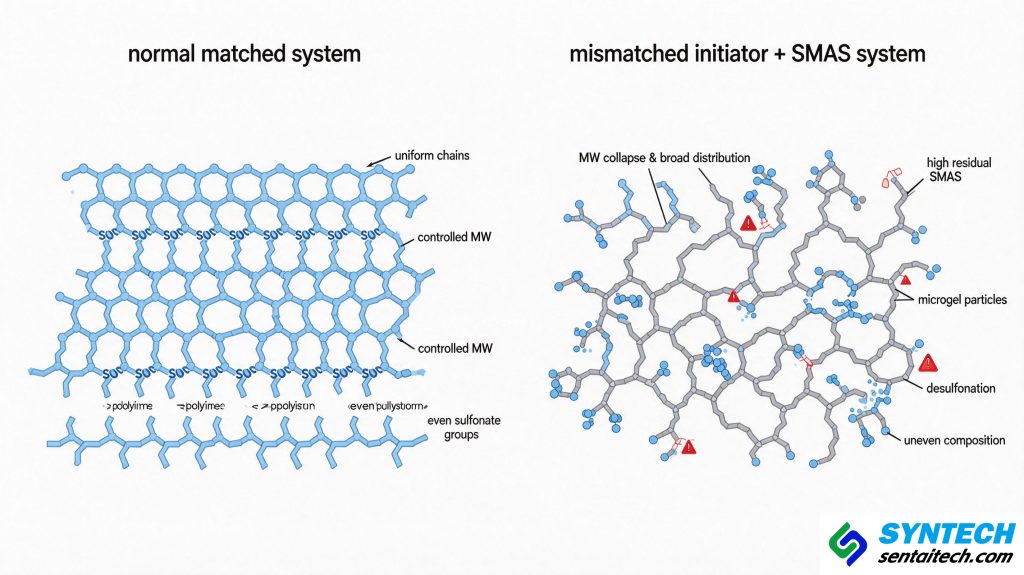
The most frequent polymerization problem when pairing initiators with sodium methallyl sulfonate is severe, unpredictable molecular weight drift. The root cause is the allylic chain-transfer effect of SMAS monomer: the active allylic C–H bonds on SMAS readily abstract hydrogen from growing polymer radicals, terminating chain growth and generating low-reactivity allylic radicals.
For conventional thermal initiators such as ammonium persulfate (APS), this problem is amplified at high reaction temperatures:
- As temperature rises, the chain-transfer constant of SMAS monomer increases exponentially. At 95–105 °C, a common temperature for persulfate-initiated scale inhibitor synthesis, the chain-transfer intensity of Sodium 2-methylprop-2-ene-1-sulfonate is 3–5 times higher than at 60 °C.
- The combination of fast initiator decomposition and strong SMAS chain transfer cuts average molecular weight far below the design target. For scale inhibitors, molecular weight often drops below 1500 Da, losing the threshold effect required for crystal lattice distortion. For flocculants, molecular weight can collapse from 12 million Da to below 3 million Da, eliminating bridging flocculation capacity.
- The resulting product has a very broad molecular weight distribution (high polydispersity index, PDI), with a large fraction of inactive low-molecular-weight oligomers and a small fraction of over-long chains. Performance becomes erratic and dosage-sensitive.
This issue is the top reason why many water treatment plants see scale inhibition or flocculation performance drop sharply after increasing SMAS monomer loading without adjusting the initiator system.
3. Incomplete Monomer Conversion and High Residual SMAS Monomer from Mismatched Initiation Activity
A second common failure is low overall conversion and elevated residual Sodium beta-methallyl sulfonate in the finished product. This problem typically occurs when low-temperature redox initiator systems are applied to high-SMAS formulas without activity adjustment.
Sodium methallyl sulfonate has a different reactivity ratio from main monomers such as acrylic acid and acrylamide. At low initiation temperatures (20–40 °C) typical of redox systems, the reaction activity of SMAS monomer is significantly lower than that of acrylic monomers. Most initiator radicals are consumed by fast-reacting main monomers, while a large fraction of SMAS remains unreacted in the liquid phase:
- Residual free SMAS monomer does not contribute to scale inhibition or dispersion, but increases the COD and total dissolved solids (TDS) of the finished chemical, violating green water treatment requirements.
- Unreacted SMAS also causes batch-to-batch variation in effective sulfonate content, so the same dosage delivers inconsistent performance in field use.
- For export products, residual monomer levels may exceed regulatory limits for industrial water treatment chemicals.
On the other hand, using excessive initiator to force higher conversion only worsens molecular weight distribution and does not eliminate residual SMAS completely, due to the reactivity ratio gap.
4. Localized Runaway Polymerization and Gel Formation with Improper Initiator Feeding
Although Sodium 2-methylprop-2-ene-1-sulfonate exerts a chain-transfer regulating effect that generally suppresses ultra-high molecular weight, poorly designed initiator feeding can still cause localized runaway polymerization and gel formation.
When all initiator is charged into the reactor in one shot at high temperature:
- A burst of radicals is generated in the initial stage, triggering extremely fast polymerization of acrylic main monomers. The reaction releases large amounts of heat within a short time, causing local temperature spikes.
- Even with SMAS chain transfer, local over-concentration of radicals produces a small fraction of ultra-high-molecular-weight cross-linked microgels. These gel particles are insoluble in water and appear as fine suspended matter in the finished product.
- In severe cases, the entire reaction system thickens abruptly, stirring fails, and the batch must be scrapped.
This problem is more pronounced in high-solid-content polymerization formulas. Many water treatment chemical manufacturers increase monomer concentration to boost productivity, but keep the original one-shot initiator process, greatly raising the risk of thermal runaway and gelation when SMAS monomer is present.
5. Non-Uniform Copolymer Composition and Unstable Water Treatment Performance
Because sodium methallyl sulfonate and main carboxyl/amide monomers have different reactivity ratios, the initiator addition mode directly determines how evenly SMAS structural units are distributed along the copolymer backbone. Uniform sulfonate distribution is essential for consistent salt tolerance and scale inhibition.
With one-shot initiator addition:
- Fast-reacting acrylic monomers polymerize preferentially in the early stage, forming chains with low SMAS content.
- As main monomers are depleted, the proportion of SMAS monomer in the residual liquid phase rises, and later-formed chains are rich in sulfonate groups.
- The final product is a mixture of carboxyl-rich high-molecular-weight chains and SMAS-rich oligomers, rather than a uniformly structured copolymer.
The performance consequences are tangible:
- Salt tolerance is lower than designed, because many polymer chains lack enough sulfonate groups to resist cation screening.
- Scale inhibition efficiency fluctuates widely with water quality. In low-hardness water the product may perform normally, but in high-calcium high-sulfate water performance drops sharply.
- Batch repeatability is poor: small changes in temperature or initiator dosage cause large swings in copolymer composition and final performance.
6. Desulfonation Side Reaction and Loss of Sulfonate Functionality Under High-Temperature Initiation
A less obvious but performance-critical problem is thermal desulfonation of SMAS monomer and polymer units under high-temperature initiation conditions. The carbon-sulfur (C–S) bond linking the sulfonate group to the allyl backbone has limited thermal stability.
When persulfate initiation is run above 110 °C for extended holding time:
- A portion of the sulfonate groups on Sodium beta-methallyl sulfonate cleave from the polymer chain, releasing free sulfate ions.
- Effective sulfonate group density in the copolymer drops below the design value, weakening salt tolerance and dispersion capacity.
- Released sulfate ions increase the inorganic salt content of the product, which can accelerate calcium sulfate scaling in circulating cooling water systems instead of inhibiting it.
For scale inhibitors intended for high-temperature systems (e.g. thermal desalination, high-temperature circulating water), desulfonation caused by improper high-temperature initiation silently erodes product performance, often without being detected by routine QC tests.
7. Initiator Residue and By-Product Risks in Finished Water Treatment Products
Mismatched initiator systems also leave harmful residues and by-products that affect both shelf life and field application of SMAS-based water treatment chemicals.
- Residual initiator: If initiator dosage is too high or holding time is too short, unreacted persulfate or redox components remain in the product. During storage, residual initiators continue to trigger slow polymerization, causing gradual viscosity drift and performance degradation.
- Inorganic by-products: Persulfate decomposes into sulfate ions; ammonium persulfate introduces ammonium ions. These increase TDS and total nitrogen of the treated water, worsening system corrosion and eutrophication risk.
- Metal ion contamination: Trace transition metals from impure initiators or corroded equipment catalyze oxidative degradation of SMAS copolymer chains during storage, reducing product shelf life.
8. Optimization Strategies for Matching Initiator Systems with SMAS Monomer
The above problems can be systematically resolved by aligning the initiator system with SMAS monomer’s unique polymerization behavior:
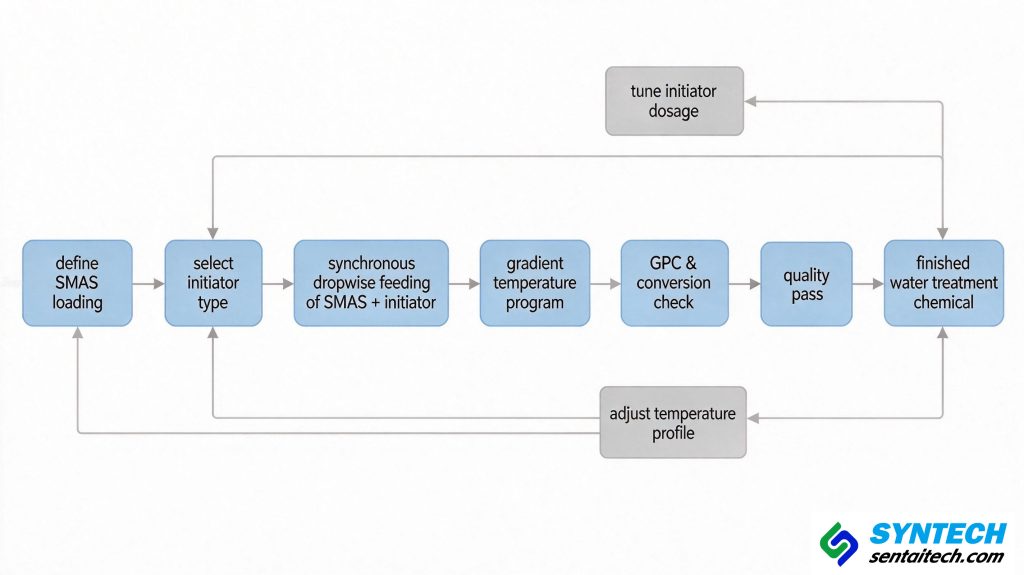
- Select initiator type according to SMAS loading
- Low-SMAS formulas (<10 mol%): Use low-temperature redox initiation to control chain transfer and maintain target molecular weight.
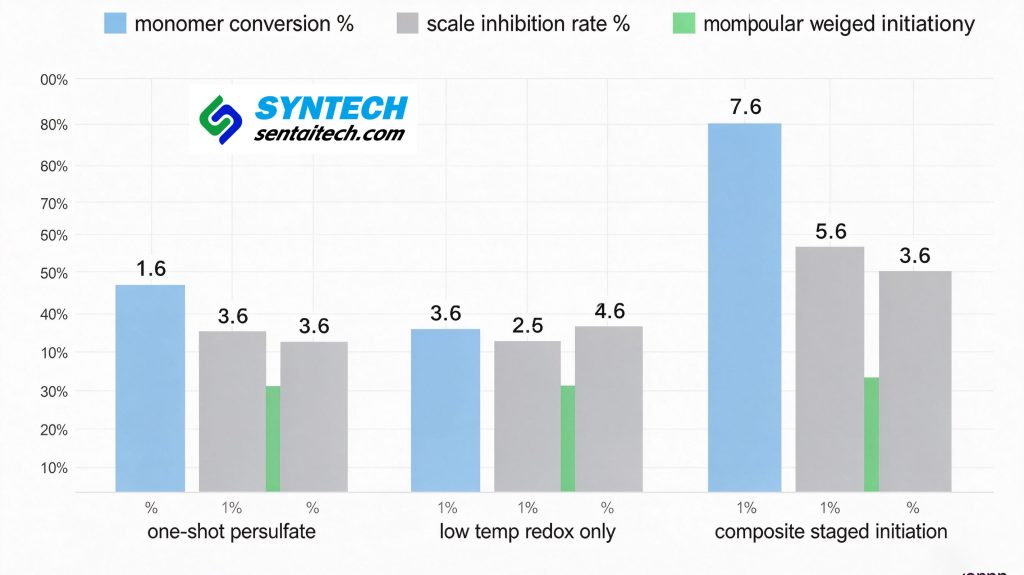
- Medium-SMAS formulas (10–25 mol%): Use composite redox + thermal initiator systems to balance conversion and molecular weight.
- High-SMAS formulas (>25 mol%): Moderately raise initiation temperature and use staged initiator feeding to avoid excessive molecular weight collapse while ensuring full conversion.
- Synchronous dropwise feeding of initiator and SMAS monomer Drip both initiator and Sodium 2-methylprop-2-ene-1-sulfonate solution at a constant rate throughout the main polymerization stage. This maintains stable monomer ratio and radical concentration, producing copolymer with uniform composition and narrow molecular weight distribution.
- Gradient temperature control Start initiation at low temperature (60–70 °C for thermal, 25–35 °C for redox) to establish stable chain growth, then gradually raise temperature to complete conversion and reduce residual monomer. Avoid sustained high temperature above 105 °C to suppress desulfonation.
- Add trace chelating agent A small dose of EDTA or sodium citrate sequesters trace metal ions, preventing uncontrolled initiator decomposition and oxidative chain degradation, and improves batch reproducibility.
Frequently Asked Questions (FAQ)
Q1: Why does sodium methallyl sulfonate (SMAS monomer, CAS NO.: 1561-92-8) often cause molecular weight control problems with persulfate initiators?
A1: SMAS monomer has active allylic C–H bonds with strong chain-transfer activity. At the high temperatures used for persulfate initiation, the chain-transfer constant of Sodium beta-methallyl sulfonate rises sharply, terminating polymer chains prematurely and causing severe molecular weight drop. Standard persulfate dosages designed for pure acrylic systems produce far lower molecular weights when SMAS is present.
Q2: Can redox initiator systems solve the low conversion issue of SMAS monomer in water treatment polymer synthesis?
A2: Partially, but not by themselves. Redox systems operate at lower temperatures, which reduces SMAS chain transfer but also lowers the reaction activity of Sodium 2-methylprop-2-ene-1-sulfonate relative to acrylic monomers. The best solution is staged temperature programming: low-temperature redox initiation for uniform chain growth, followed by a short high-temperature curing step to push residual SMAS conversion above 99%.
Q3: What causes insoluble gel particles in SMAS-based water treatment polymer products?
A3: Gel formation usually comes from one-shot initiator addition and poor heat dissipation. A burst of radicals at the start causes localized ultra-fast polymerization and micro-crosslinking, even with SMAS chain transfer. Switching to continuous dropwise initiator feeding, reducing monomer concentration slightly and improving jacket cooling effectively eliminates gel defects.
Q4: Why does measured sulfonate content sometimes fall below design value in finished SMAS copolymer?
A4: This is usually caused by thermal desulfonation. When polymerization temperature exceeds 110 °C for extended periods, the C–S bond of sodium methallyl sulfonate units cleaves, releasing free sulfate and reducing effective sulfonate groups on the polymer chain. Keeping peak temperature below 105 °C and shortening high-temperature holding time prevents significant desulfonation.
Q5: How does non-uniform SMAS distribution affect water treatment chemical performance?
A5: Unevenly distributed sulfonate groups create two polymer populations: carboxyl-rich chains with poor salt tolerance and sulfonate-rich oligomers with weak scale inhibition. The product performs well in low-hardness water but fails quickly in high-salinity, high-hardness systems. Uniform SMAS distribution via synchronous monomer-initiator feeding delivers stable performance across a wider water quality range.
Q6: What is the recommended initiator system for high-SMAS water treatment scale inhibitors?
A6: For SMAS loadings of 20–30 mol%, a composite initiation system is recommended: a primary redox pair (ammonium persulfate / sodium bisulfite) for low-temperature kickoff, plus a small supplemental dose of thermal initiator added in the later stage. Paired with synchronous dropwise feeding and gradient temperature rise, this achieves >99% monomer conversion, controlled molecular weight in the 2000–3000 Da optimal window, and uniform sulfonate distribution.
References
[1] Li Y, Wang J, Zhang L. Synthesis and Application of a Phosphorous-Free and Non-Nitrogen Polymer as an Environmentally Friendly Scale Inhibition and Dispersion Agent [J]. ACS Omega, 2020, 5(25): 15487–15495.
[2] Xiong Y, et al. Effect of sodium methylacrysulfonate upon the molecular weight and performance of polycarboxylate superplasticizer [J]. Journal of Functional Polymers, 2014.
[3] IA/SMAS copolymer scale inhibitor synthesis: optimal conditions 95 °C, 6 h, ammonium persulfate initiator, 5% isopropanol chain transfer agent [J]. Science of Advanced Materials, 2022.
[4] Alhamzah A A, Fellows C M, Hamed O A. Methallylsulfonate Polymeric Antiscalants for Application in Thermal Desalination Processes [J]. Polymers, 2023.
[5] Industrial Chemical Datasheet. Sodium Methallyl Sulfonate (SMAS, CAS NO.: 1561-92-8) for Water Treatment Scale Inhibitors and Dispersants [EB/OL]. Made-in-China Chemical Directory, 2024.
[6] Nuoer Chemical. Initiator Selection Guide for Anionic Polyacrylamide and Sulfonate-Modified Water Treatment Polymers [EB/OL]. 2025.