
1. Role of Sodium Methallyl Sulfonate (SMAS) in High-Salt Scale Inhibitor Formulation
Sodium methallyl sulfonate, widely known as SMAS, CAS NO.:1561-92-8, is a core anionic sulfonate functional monomer for phosphorus-free polycarboxylate scale inhibitors designed for high-salinity water systems, including seawater cooling circuits, oilfield produced water, reverse osmosis concentrate and high-hardness industrial circulating water. When copolymerized with carboxyl monomers such as acrylic acid, maleic anhydride and itaconic acid, SMAS introduces negatively charged –SO₃⁻Na⁺ groups into the polymer backbone, which are far more resistant to cation screening than carboxylate groups alone.
In high-salt environments, divalent Ca²⁺, Mg²⁺, Ba²⁺ and Sr²⁺ ions strongly compress the electric double layer of carboxylate-only polymers, causing chain curling, precipitation and loss of scale inhibition activity. Sulfonate groups from sodium methallyl sulfonate maintain hydration and electrostatic repulsion even at high ionic strength, stabilizing the polymer’s extended conformation and preserving its crystal lattice distortion effect. However, SMAS is not a monomer that can be added indefinitely. Its allylic structure gives it inherent chain-transfer activity, so the molar ratio of SMAS must be carefully balanced against charge density, molecular weight and copolymer composition to maximize salt resistance without sacrificing inhibition efficiency.
2. How SMAS Molar Ratio Shapes Salt Tolerance: Charge Density vs. Molecular Weight Trade-off
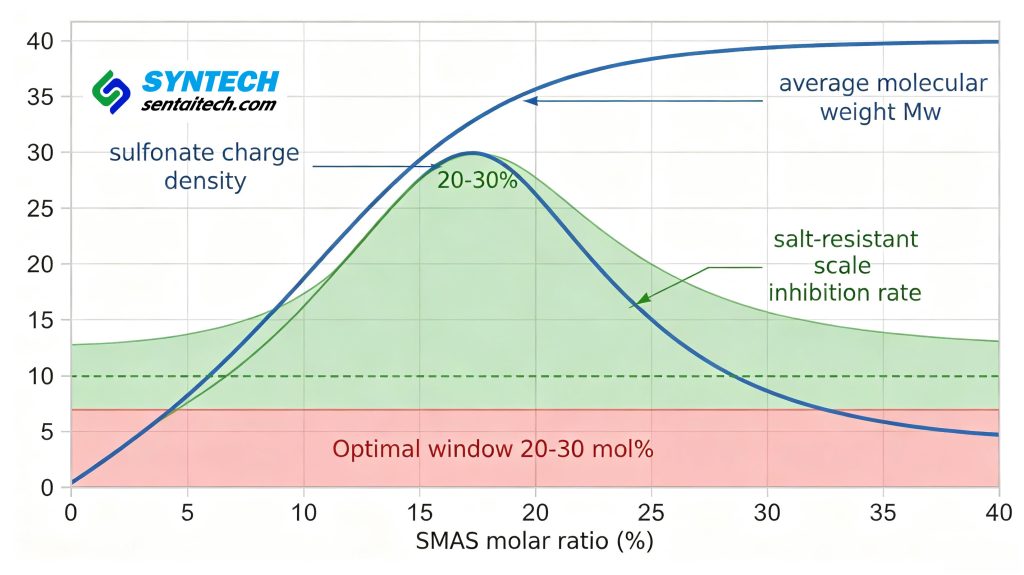
The salt resistance of SMAS-based copolymers is governed by two opposing effects, both controlled by the molar ratio of sodium methallyl sulfonate:
- Positive effect: Higher SMAS ratio increases sulfonate group density on the polymer backbone, strengthening resistance to cation screening and improving stability in high-TDS brine. Sulfonate groups also enhance calcium tolerance and prevent polymer–calcium precipitation.
- Negative effect: SMAS acts as an implicit chain transfer agent during free-radical polymerization. As molar ratio rises, average polymer molecular weight decreases significantly, and the fraction of low-molecular-weight oligomers increases. Below a critical molecular weight threshold (~1500–2000 Da), the polymer loses its threshold inhibition effect and can no longer effectively distort crystal growth.
Published copolymerization data confirms that sodium methallyl sulfonate exerts a strong chain-transfer influence that intensifies with increasing dosage and temperature. For high-salt scale inhibitors, the optimal design point occurs where sulfonate density is high enough to resist cation screening, while molecular weight remains within the 2000–3000 Da window required for effective scale inhibition. Deviating to either side — too low SMAS with poor salt tolerance, or too high SMAS with collapsed molecular weight — degrades final performance.
3. Optimal SMAS Molar Ratios for Different High-Salt Scaling Scenarios
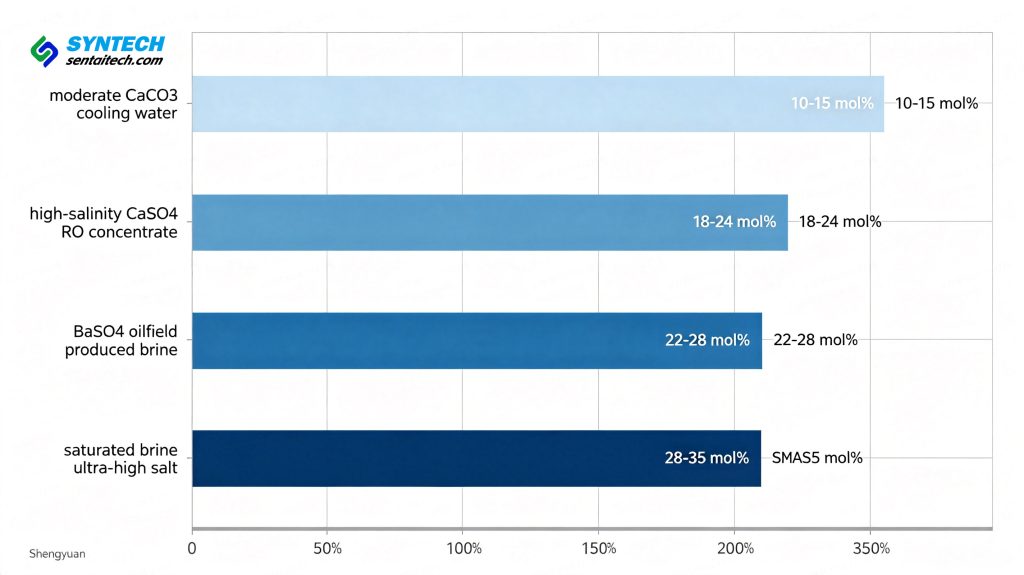
There is no universal best SMAS ratio; the optimal value depends on the dominant scale type and salinity level of the target water system.
3.1 Moderate-salinity calcium carbonate systems (TDS 3000–10000 mg/L)
For conventional circulating cooling water with moderate hardness and salinity, SMAS is primarily used to improve dispersion and calcium tolerance. The recommended molar ratio of sodium methallyl sulfonate to total monomers is 10–20 mol%. A classic verified formulation uses epoxysuccinic acid, itaconic acid and SMAS at a mass ratio of 10:10:5, corresponding to roughly 15–20 mol% SMAS, achieving 100% calcium carbonate and calcium sulfate inhibition at standard test dosages. Within this range, carboxyl groups provide the main chelating and lattice-distortion function, while SMAS supplements salt tolerance and iron oxide dispersion capacity.
3.2 High-salinity calcium sulfate and calcium phosphate systems (TDS 10000–50000 mg/L)
For seawater cooling systems, reverse osmosis concentrate and high-sulfate oilfield produced water, stronger salt resistance is required. The SMAS molar ratio should be raised to 20–30 mol%. The extra sulfonate groups maintain polymer hydration and prevent flocculation under high calcium and sulfate ion concentrations. At this ratio level, initiator dosage and polymerization temperature must be adjusted upward moderately to compensate for SMAS chain transfer and keep molecular weight in the optimal window.
3.3 Ultra-high-salinity barium/strontium sulfate systems (saturated brine)
For oilfield produced water and formation brine with high Ba²⁺ and Sr²⁺ content, barium sulfate and strontium sulfate scales are extremely difficult to inhibit because of their very low solubility. The highest SMAS ratios, 30–35 mol%, are used in these scenarios to maximize sulfonate-mediated barium tolerance. Even so, SMAS alone is usually insufficient; it is typically paired with more sterically hindered sulfonate monomers or zwitterionic units to achieve long-term inhibition in saturated brine.
3.4 Upper limit of SMAS ratio
For all scale types, exceeding 35–40 mol% SMAS is almost never beneficial. Beyond this point, further increases in sulfonate density give diminishing salt-tolerance returns, while molecular weight drops sharply, oligomer fraction rises and overall scale inhibition efficiency declines. The product also becomes more hygroscopic and raises total dissolved solids in treated water.
4. SMAS Molar Ratio Tuning in Ternary and Multicomponent Copolymer Systems
Most industrial high-salt scale inhibitors are ternary or quaternary copolymers, not simple binary AA–SMAS systems. The optimal SMAS ratio must be tuned together with other functional monomers.
4.1 Maleic anhydride – SMAS systems
Maleic anhydride-based copolymers have inherently good calcium tolerance and thermal stability. When copolymerized with sodium methallyl sulfonate, the typical SMAS molar ratio is 25–35%. Research on maleic acid–sulfonate copolymers for barium sulfate inhibition shows that around 30% sulfonate monomer content delivers up to 98% barium sulfate inhibition rate under optimized polymerization conditions.
4.2 SMAS – AMPS hybrid systems
For ultra-high-salinity and high-temperature applications, part of the SMAS is often replaced with 2-acrylamido-2-methylpropane sulfonic acid (AMPS). AMPS provides stronger steric protection for sulfonate groups and better thermal stability, but is more expensive. A common cost-effective formula uses 15–20 mol% SMAS + 10–15 mol% AMPS, combining the cost advantage of SMAS with the superior salt resistance of AMPS. This blend outperforms pure SMAS polymers in saturated brine while remaining cheaper than all-AMPS formulations.
4.3 Zwitterionic and hydrophobic modification
When very high salt tolerance is required, 2–5 mol% of zwitterionic sulfobetaine monomer or hydrophobic alkyl monomer can be introduced together with SMAS. The SMAS ratio is usually kept at 15–25% in these systems, as the zwitterionic anti-polyelectrolyte effect provides most of the extreme salinity resistance.
5. Step-by-Step Molar Ratio Optimization Workflow for High Salt Resistant SMAS Copolymers
Systematic ratio optimization avoids trial-and-error waste and ensures the final formula meets both performance and cost targets.
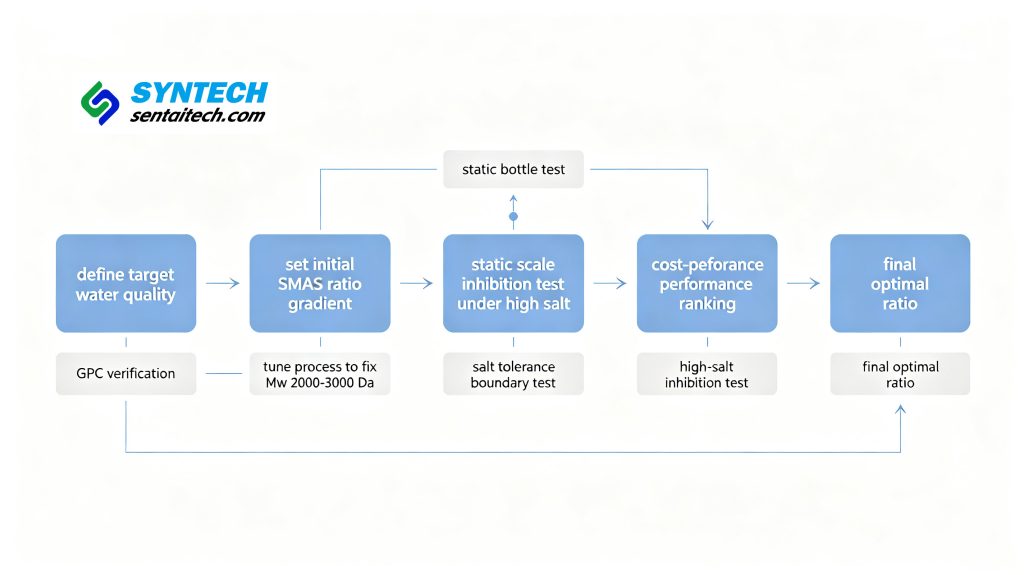
- Define target water quality and scale type: First clarify salinity, ion composition, temperature and dominant scale (CaCO₃, CaSO₄, BaSO₄, etc.). This sets the baseline salt-resistance requirement.
- Set initial SMAS ratio range: Based on the scaling scenario above, select a starting range (e.g. 15%, 20%, 25%, 30%, 35% molar).
- Fix molecular weight by adjusting process parameters: For each SMAS ratio, fine-tune initiator dosage and polymerization temperature to keep weight-average molecular weight within the 2000–3000 Da target window, verified by GPC.
- Static scale inhibition test under high-salt conditions: Run standard static bottle tests using simulated high-salinity water, testing inhibition rate at multiple dosages.
- Evaluate salt tolerance boundary: Increase salinity stepwise until the inhibition rate drops below the acceptance threshold, to compare the salt-resistance ceiling of each formula.
- Verify long-term stability and biodegradability: Test storage stability, calcium compatibility and COD contribution to ensure the optimized ratio does not create secondary problems.
- Cost-performance ranking: Select the lowest SMAS ratio that meets all performance requirements, to minimize raw material cost and chain-transfer side effects.
6. Common Mistakes in SMAS Ratio Adjustment and Corrective Measures
Mistake 1: Treating SMAS as a purely functional monomer and ignoring its chain transfer effect
Many formulators raise SMAS to boost salt resistance without adjusting initiator and temperature, resulting in unexpectedly low molecular weight and poor inhibition efficiency.
- Correction: For every 5 mol% increase in SMAS, reduce initiator dosage moderately and lower polymerization temperature by 2–3 °C to compensate for enhanced chain transfer and keep molecular weight stable.
Mistake 2: Using the same SMAS ratio for all scale types
A formula optimized for calcium carbonate will perform poorly for barium sulfate, and vice versa.
- Correction: Match SMAS ratio to the dominant scale; for multi-scale systems, use a ternary or quaternary copolymer design with balanced functional groups.
Mistake 3: Pursuing maximum salt resistance with ultra-high SMAS loading
Above 35 mol%, salt tolerance improves very little, but inhibition efficiency drops and cost rises.
- Correction: If higher salt resistance is needed beyond the 30–35% SMAS limit, add AMPS, zwitterionic or hydrophobic monomers instead of further increasing SMAS.
Mistake 4: Evaluating only in fresh water and assuming high-salt performance
Good performance in standard tap-water tests does not guarantee function under high-salinity conditions.
- Correction: Always run final validation tests with the actual high-salinity water composition, including target levels of Ca²⁺, Mg²⁺, Na⁺ and sulfate.
Frequently Asked Questions (FAQ)
Q1: What is the typical molar ratio range of sodium methallyl sulfonate (SMAS, CAS NO.:1561-92-8) for high-salt scale inhibitors?
A1: For most industrial high-salinity water systems, the recommended SMAS molar ratio ranges from 10 to 35% of total monomers. Moderate-hardness circulating water uses 10–20%, high-salinity calcium sulfate systems use 20–30%, and barium/strontium sulfate brine systems use up to 30–35%. Exceeding 35% is generally not recommended due to severe molecular weight collapse.
Q2: Does increasing SMAS molar ratio always improve salt tolerance of scale inhibitors?
A2: No. Within 0–30 mol%, higher SMAS generally improves salt resistance by increasing sulfonate charge density. Beyond 30–35%, the chain-transfer effect of sodium methallyl sulfonate dominates, sharply reducing molecular weight and causing inhibition efficiency to decline. The salt-resistance benefit also shows diminishing returns at high loading.
Q3: How does SMAS chain transfer effect interfere with molar ratio optimization for high-salt products?
A3: SMAS is both a functional monomer and a chain transfer agent. As molar ratio rises, average polymer molecular weight decreases. If process parameters are not adjusted, high-SMAS formulas will produce excessive low-molecular-weight oligomers that lack effective threshold inhibition. Initiator dosage and polymerization temperature must be tuned together with SMAS ratio to keep Mw in the 2000–3000 Da optimal window.
Q4: What SMAS ratio is recommended for calcium sulfate / barium sulfate scale in high-salinity brine?
A4: For calcium sulfate in seawater-level salinity, 20–30 mol% SMAS is recommended. For barium/strontium sulfate in produced water brine, 30–35 mol% is typical, usually combined with other sterically hindered sulfonate or zwitterionic monomers to achieve reliable long-term inhibition.
Q5: Can we replace part of SMAS with AMPS to further improve salt resistance?
A5: Yes, this is a widely used industrial strategy. A typical blend is 15–20 mol% SMAS + 10–15 mol% AMPS. AMPS provides stronger steric protection for sulfonate groups and better thermal stability, while SMAS reduces overall raw material cost. The combination outperforms all-SMAS formulas in extreme high-salt environments.
Q6: What tests are necessary to verify the optimal SMAS molar ratio for high-salt applications?
A6: Required tests include: GPC molecular weight and distribution measurement, static scale inhibition test under target high-salinity conditions, calcium compatibility / precipitation test, thermal stability evaluation, and storage stability test. For field deployment, on-site dynamic simulation is also recommended.
References
[1] Li Y, Wang J, Zhang L. Synthesis and Application of a Phosphorous-Free and Non-Nitrogen Polymer as an Environmentally Friendly Scale Inhibition and Dispersion Agent [J]. ACS Omega, 2020, 5(25): 15487–15495. (Verified ESA:IA:SMAS = 10:10:5 formula with 100% CaCO₃ / CaSO₄ inhibition.)
[2] SYNTECH. Sodium Methallyl Sulfonate (SMAS) – Key Process Parameters for Industrial Applications: Water Treatment Dispersant Formulation Guide [EB/OL]. https://www.sentaitech.com/related-research/sodium-methallyl-sulfonate-smas-key-process-parameters-industrial-applications/
[3] Synthesis and characterization of maleic acid and sodium methallyl disulfonate new copolymer: application as a barium sulfate scale inhibitor [J]. E-Journal of Chemistry, 2012, 9(4): 2173–2182. (98% BaSO₄ inhibition at optimized SMAS-derived sulfonate ratio.)
[4] Alhamzah A A, Fellows C M, Hamed O A. Methallylsulfonate Polymeric Antiscalants for Application in Thermal Desalination Processes [J]. Polymers, 2023. (Molecular weight more critical than sulfonation degree for calcium sulfate inhibition, optimal MW 2000–2500 Da.)
[5] Euro Chemical Supplies. Antiscalants & Scale Inhibitors: Polycarboxylate antiscalants for high-salinity systems [EB/OL]. https://eurochemsupplies.com/blog/antiscalants-and-scale-inhibitors/
[6] Industrial Chemical Datasheet. Sodium Methallyl Sulfonate (SMAS, CAS NO.:1561-92-8) for Water Treatment Scale Inhibitors [EB/OL]. Made-in-China Chemical Directory, 2024.