
1. Introduction: Sodium Allyl Sulfonate (SAS/ALS, CAS NO.:2495-39-8) in Oilfield Drilling Fluid
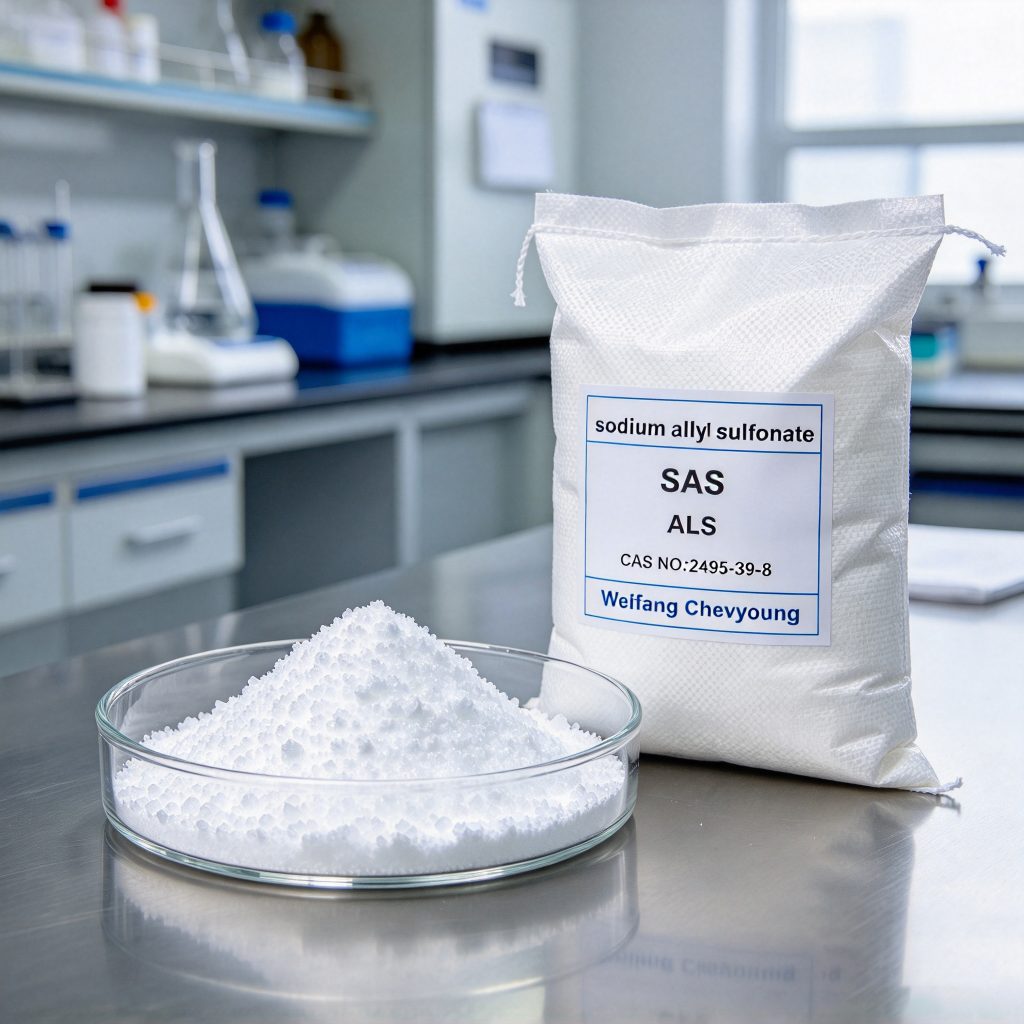
Sodium allyl sulfonate, commonly abbreviated as SAS or ALS, CAS NO.:2495-39-8, is a water-soluble sulfonate functional monomer widely copolymerized into water-based drilling fluid polymers, including fluid loss reducers, clay dispersants and shale stabilizers. It carries sulfonate anionic groups that improve monomer copolymerization activity, enhance polymer hydration and provide negative charge for bentonite dispersion at moderate temperature ranges. In shallow and medium-depth well drilling below 150 °C, SAS-modified polymers deliver acceptable filtration control and rheology stability.
However, deep high-temperature wells usually have bottom-hole temperatures above 180 °C, accompanied by high pressure, high salinity, high-density brine and reactive shale formations. Under these extreme downhole conditions, polymer chains containing sodium allyl sulfonate exhibit obvious performance weaknesses, which restrict the application of SAS-based drilling fluid additives in ultra-deep high-temperature well operations. Understanding these inherent shortcomings helps formulators select monomers and optimize polymer structures for high-temperature resistant drilling fluid systems.
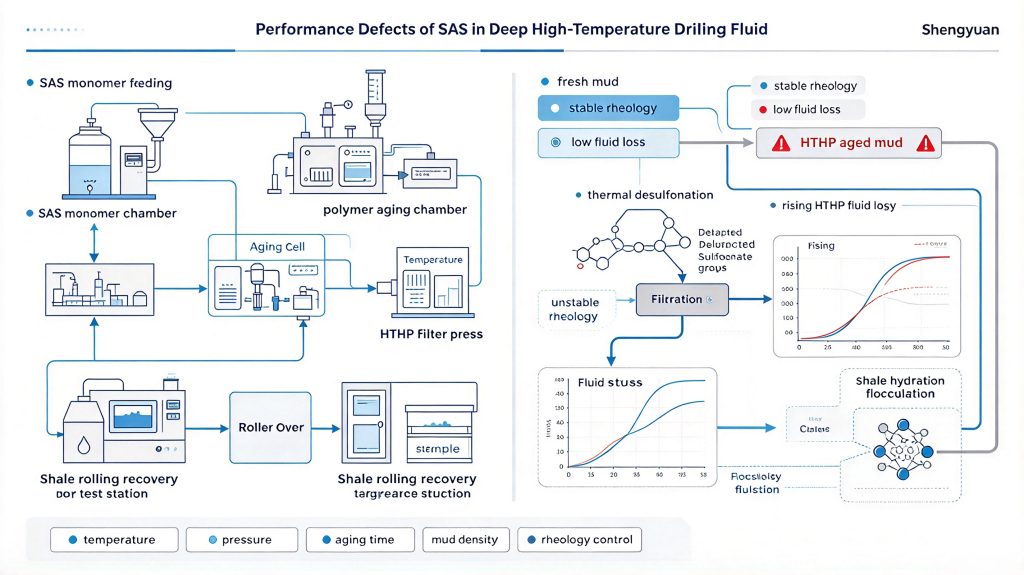
2. Limited Thermal Stability of SAS-Containing Polymer Backbone
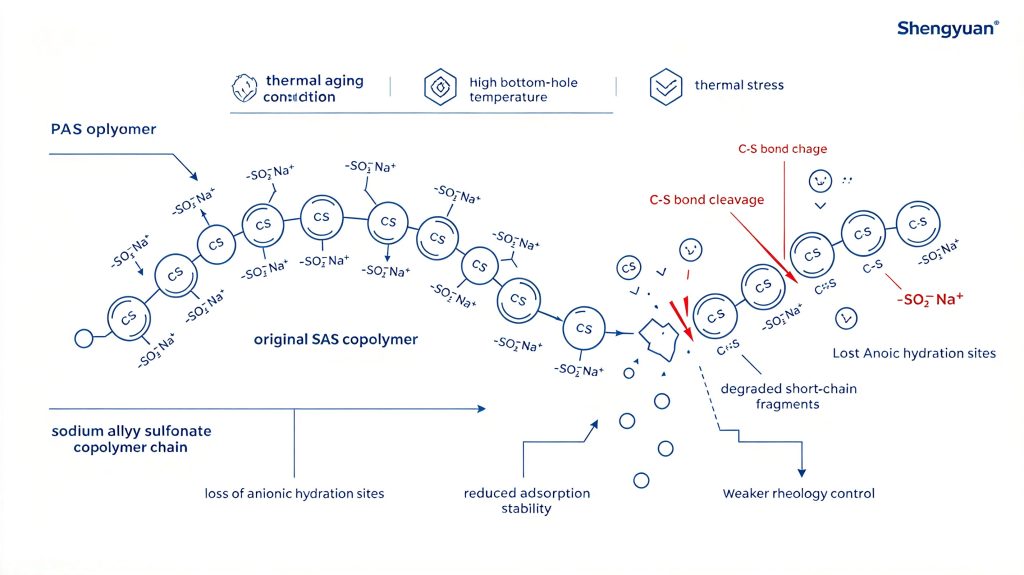
The first core shortcoming is the relatively low thermal decomposition threshold of sodium allyl sulfonate segments. Although the sulfonate group itself has good chemical stability, the carbon-carbon linkage between the allyl backbone and sulfonate group is susceptible to thermal cleavage under long-term static aging above 170–180 °C. After thermal aging in deep well conditions, the sulfonate side groups detach gradually from the polymer main chain.
Once desulfonation occurs, the polymer loses a large proportion of anionic hydration sites. The adsorption balance between polymer and bentonite clay particles breaks down. The drilling fluid loses its original colloidal protection, and the HTHP (high temperature high pressure) fluid loss surges sharply. Unlike AMPS (2-acrylamido-2-methylpropane sulfonic acid) units which have higher thermal resistance, SAS-derived sulfonate groups are not anchored by bulky rigid amide side structures, so thermal shedding is much easier under sustained high bottom-hole temperature. This makes SAS unsuitable as the main sulfonated functional monomer for drilling fluids designed for temperatures exceeding 200 °C.
3. Poor Anti-Salinity and Divalent Cation Tolerance in Deep Formation Brine
Deep high-temperature reservoirs often contain high concentrations of Na⁺, Ca²⁺ and Mg²⁺. Sodium allyl sulfonate only provides simple monovalent sulfonate anions without chelating groups or zwitterionic structures. When the drilling fluid invades high-salinity formations, metal cations compress the electric double layer of bentonite and SAS copolymer chains.
Compression of the double layer reduces hydration film thickness on clay particles. Bentonite particles tend to flocculate, leading to abnormal rise of plastic viscosity and yield point. Severe flocculation destroys filter cake integrity, increases filtrate invasion into shale, and triggers borehole collapse risks. In saturated brine or calcium-rich formation water, the performance decay of SAS-containing drilling fluid is far more serious than that of polymers built with AMPS, NVP or amphoteric functional monomers. This salt sensitivity is a major limitation for offshore deep wells and carbonate reservoir drilling.
4. Weak Inhibition on Hydration and Dispersion of Reactive Shale
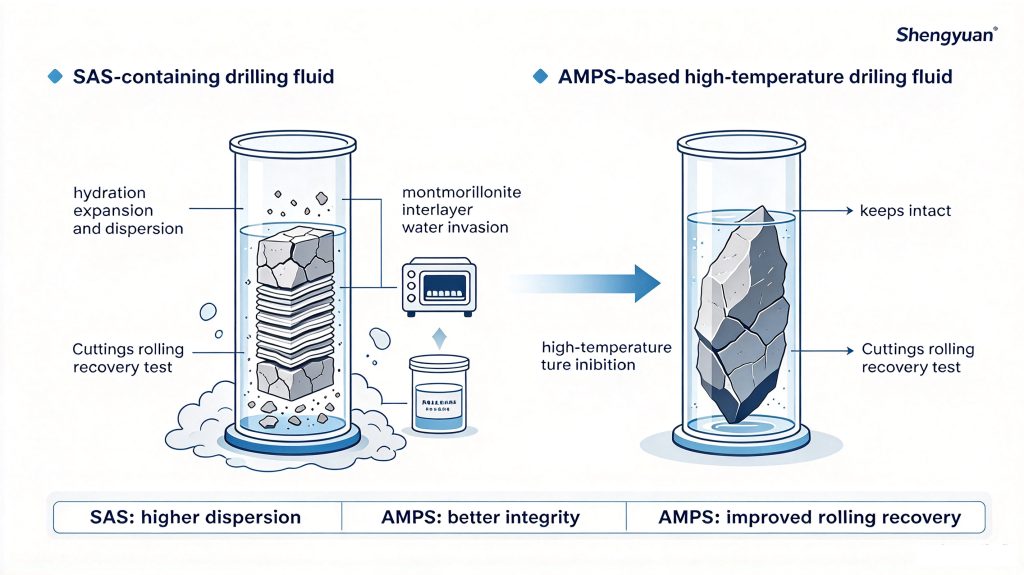
Sodium allyl sulfonate is purely anionic. SAS-based polymers rely only on electrostatic repulsion to stabilize clay, lacking cationic adsorption sites or strong hydrogen-bonding anchoring groups for shale surface. For active montmorillonite-rich shale commonly encountered in deep stratums, simple anionic repulsion cannot effectively block water molecule penetration into clay interlayers.
At elevated temperature, clay mineral lattice activity increases. The hydration expansion and dispersion rate of shale accelerate. SAS-modified additives cannot form dense hydrophobic adsorption films on shale surfaces. The rolling recovery rate of shale cuttings drops significantly after hot rolling aging. Poor shale inhibition brings frequent wellbore instability problems: borehole sloughing, cuttings dispersion, mud making and increase of solid phase content, which further deteriorate rheology and filtration control of the whole drilling fluid system.
5. Unstable Rheology After Long-Time High-Temperature Aging
Rheology stability is critical for cuttings carrying and suspension in deep high-temperature wells. When sodium allyl sulfonate is used in drilling fluid polymers, two opposite rheology failure modes may appear after thermal aging, depending on formula and salinity. In fresh-water base mud, thermal degradation of SAS copolymer reduces polymer molecular weight, resulting in viscosity loss, low yield point and poor suspension capacity for weighting agents and rock cuttings. In high-salinity mud, cation-induced flocculation causes abnormal thickening, excessive yield point and gel strength, which raises pumping pressure and brings risks of stuck pipe.
This dual instability is difficult to adjust on-site. After thermal aging, the rheology curve changes irregularly, and it is hard for field engineers to restore the target rheological window simply by adding conventional thinner or viscosifier. For long horizontal sections in deep wells, unstable rheology greatly increases downhole operation risks.
6. Side Effects of Degradation Products and Compatibility Limitations
Thermal decomposition fragments of sodium allyl sulfonate are small-molecule sulfonate byproducts. These low-molecular fragments do not contribute to filtration control or shale inhibition. Moreover, the decomposed sulfonate ions increase the total dissolved solids in the drilling fluid. When compounded with some cationic shale inhibitors or cationic plugging agents, SAS degradation anions can cause charge neutralization and precipitation, damaging the performance of matched additives.
Another practical limitation is the narrow formula matching range. SAS works best under neutral to weakly alkaline pH. At the high pH environment required for some high-temperature drilling fluids, the hydrolysis tendency of SAS copolymer accelerates. For this reason, SAS is mostly used as an auxiliary co-monomer rather than the dominant functional monomer for deep high-temperature drilling fluid formulas.
FAQ
Q1: What is the general temperature upper limit for drilling fluid polymers copolymerized with sodium allyl sulfonate (SAS, CAS NO.:2495-39-8)?
A1: Most SAS-containing drilling fluid additives maintain stable performance below 170–180 °C. Once the bottom-hole temperature continuously exceeds 180 °C, obvious desulfonation, fluid loss rise and shale inhibition decline will occur, so SAS is not suitable for long-term aging above 200 °C.
Q2: Why is SAS less temperature-resistant than AMPS monomer in drilling fluid polymer synthesis?
A2: AMPS has a bulky tert-butyl amide structure to lock sulfonate groups, which suppresses thermal desulfonation. Sodium allyl sulfonate only has a simple allyl carbon chain connected to sulfonate, and the C-S linkage is much easier to break under sustained high temperature.
Q3: Can SAS be added together with cationic shale inhibitors in deep well drilling fluid?
A3: Not recommended at high temperature. The anionic sulfonate groups of SAS and cationic inhibitors will generate ionic complexation and precipitation, which deactivate both additives. If compounding is required, compatibility evaluation under target HTHP aging conditions must be completed first.
Q4: Can we increase SAS dosage to improve shale inhibition for deep reactive shale sections?
A4: No. SAS is purely anionic. Higher SAS dosage only increases negative charge repulsion, and cannot block water entry into clay interlayers. Excess SAS will worsen salt sensitivity and flocculation risk in formation brine.
Q5: What monomers can replace SAS to overcome these high-temperature shortcomings for deep well drilling fluid?
A5: AMPS, N-vinylpyrrolidone (NVP), acrylamide derivatives and zwitterionic monomers are preferred alternatives. They deliver better thermal stability, anti-salt property and shale adsorption performance for HTHP drilling fluid systems.
Q6: Is sodium allyl sulfonate completely banned in deep high-temperature drilling fluid formulas?
A6: Not absolutely banned. SAS can be used as a minor auxiliary co-monomer (low mole fraction) to adjust copolymerization reactivity, while the main functional high-temperature resistant units rely on AMPS or other heat-stable monomers. It should never act as the primary sulfonate functional monomer.
References
[1] Zhang Q, Li G. Thermal degradation mechanism of sulfonated anionic monomers used in water-based drilling fluid additives. Drilling Fluid & Completion Fluid, 2021, 38(2): 187–193. [2] Ahmad H M, Kamal M S. A review of high-temperature resistant polymers for water-based drilling fluids. Journal of Petroleum Science and Engineering, 2022, 211: 110145. [3] Wang Z, Liu J. Comparative study on anti-aging performance of SAS and AMPS copolymer for drilling fluid fluid-loss agent. Oilfield Chemistry, 2020, 37(4): 695–701. [4] API Recommended Practice 13B-1, Recommended Practice for Field Testing Water-Based Drilling Fluids. American Petroleum Institute, 2019.