1. Role of sodium methallyl sulfonate (SMAS, CAS NO.:1561-92-8) in PCE for High-Strength High-Grade Concrete
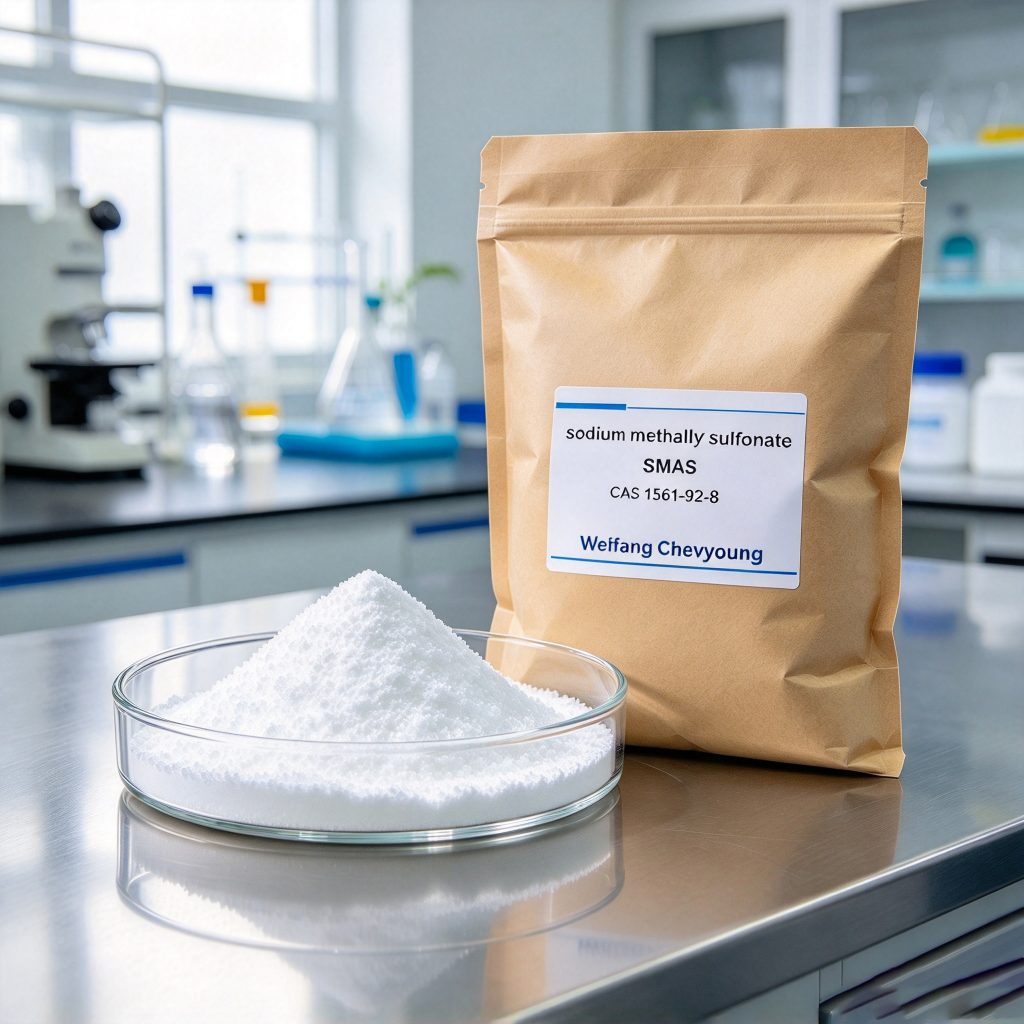
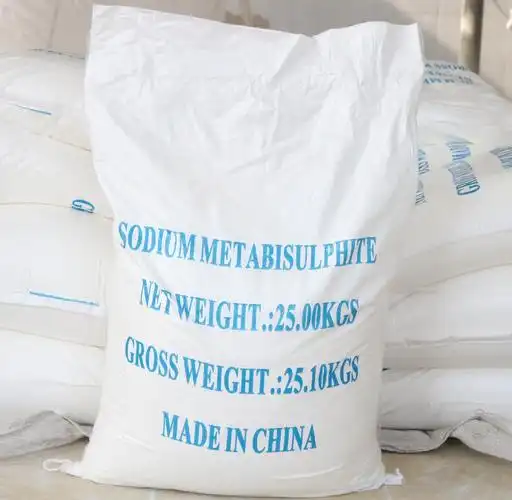
sodium methallyl sulfonate, known as SMAS, CAS NO.:1561-92-8, is a key sulfonate-containing functional monomer used in the copolymerization of polycarboxylate superplasticizer (PCE). High-strength high-grade concrete generally refers to concrete with strength grade C60 and above, characterized by low water-binder ratio, high cementitious material dosage, strict requirements on workability, low viscosity, slump retention and minimal shrinkage. Unlike ordinary commercial concrete, high-strength concrete puts forward stricter requirements on the molecular structure of polycarboxylate superplasticizer.
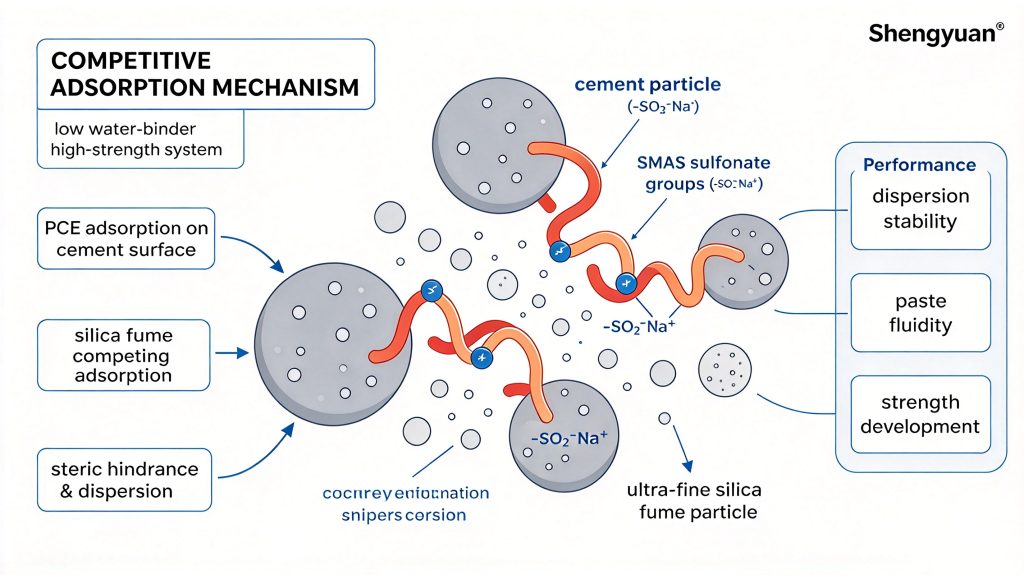
In PCE synthesis for high-strength high-grade concrete, SMAS provides sulfonate anionic groups to increase backbone charge density, adjusts copolymerization reactivity, controls polymer molecular weight and narrows molecular weight distribution. Appropriate SMAS addition helps PCE adsorb uniformly on cement and supplementary cementitious materials such as silica fume, fly ash and slag powder. However, SMAS is not a monomer that can be increased indefinitely. Excessive SMAS will change adsorption kinetics, raise the viscosity of cement paste, accelerate slump loss and increase shrinkage risk of hardened high-strength concrete. Therefore, confirming the proper upper limit of SMAS dosage becomes a core index in PCE formula development for high-grade concrete.
2. Definition of SMAS Dosage Basis and Baseline Range
SMAS dosage is calculated by mass fraction relative to the total mass of all polymerized monomers in PCE mother liquor, excluding water, chain transfer agent and initiator solvent. This calculation method is the common standard adopted by admixture factories.
For PCE specially developed for high-strength high-grade concrete, the conventional safe SMAS dosage window is 1.0%–3.0% of total monomer mass. The proper upper limit under most stable production and application conditions is 3.0% by mass of total monomers. This upper limit is different from PCE for ordinary C30–C50 concrete, which often allows SMAS up to 4.0%–5.0%. The reason for the tighter upper limit for high-strength concrete lies in its low water-binder ratio system: the pore solution has extremely high ion concentration, and the competitive adsorption environment is much harsher.
It should be emphasized that this 3.0% upper limit is not an absolute fixed value. It will shift according to side-chain macromonomer type, acrylic acid proportion, slow-release ester monomer content, cement mineral composition and whether silica fume is incorporated. If silica fume is added at high dosage in high-strength concrete, the SMAS upper limit should be further reduced to 2.0%–2.5%.
3. Performance Risks When SMAS Dosage Exceeds the Proper Upper Limit
When SMAS dosage goes above the recommended upper limit for high-strength high-grade concrete, a series of adverse effects will appear sequentially. First, excessive sulfonate groups lead to excessively fast initial adsorption of PCE molecules on cementitious particles. Free PCE in the liquid phase is rapidly consumed in the early hydration stage, resulting in insufficient reserved polymer for follow-up dispersion and obvious slump loss, which is very harmful for pumping high-strength concrete.
Second, excessive negative charge density increases electrostatic repulsion too strongly in the low water-binder system, raising paste viscosity. High viscosity brings poor pumping performance, bubble stabilization and difficult air removal. Bubbles trapped inside will reduce the compactness and strength of high-strength hardened concrete.
Third, excessive SMAS content increases the proportion of short-chain polymer fractions. Short-chain PCE fractions are weakly adsorbed and easy to desorb, which aggravates the drying shrinkage and autogenous shrinkage of high-strength concrete and raises the cracking risk. In addition, high SMAS dosage may increase the salt content in the admixture system, which is unfavorable for projects requiring low shrinkage and low cracking risk.
4. Factors That Adjust the Acceptable Upper Threshold of SMAS
4.1 Side-chain macromonomer structure
If the PCE adopts long-side-chain isoprenyl polyether macromonomer, the adsorption capacity of the main chain is inherently strong, so the SMAS upper limit should be lower. Short-side-chain PCE needs relatively more anionic groups to assist dispersion and can tolerate a slightly higher SMAS limit.
4.2 Compound supplementary cementitious materials
Silica fume has high specific surface area and strong adsorption capacity for anionic polymers. When silica fume is used, the upper limit of SMAS must be cut down. If only slag powder and low-content fly ash are used, the SMAS threshold can be closer to 3.0%.
4.3 Construction temperature and transport time
For summer high-temperature construction and long-distance pumping that requires long slump retention time, the SMAS dosage should be controlled below 2.0%. High temperature accelerates cement hydration, and high SMAS will amplify the rapid adsorption disadvantage.
5. Test Verification Method to Confirm the SMAS Upper Limit for High-Grade Concrete
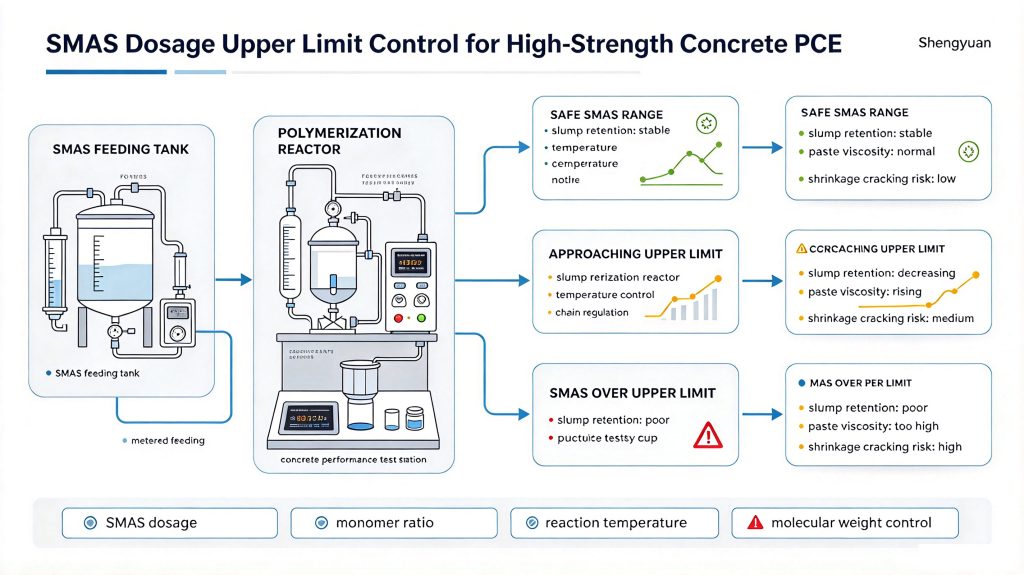
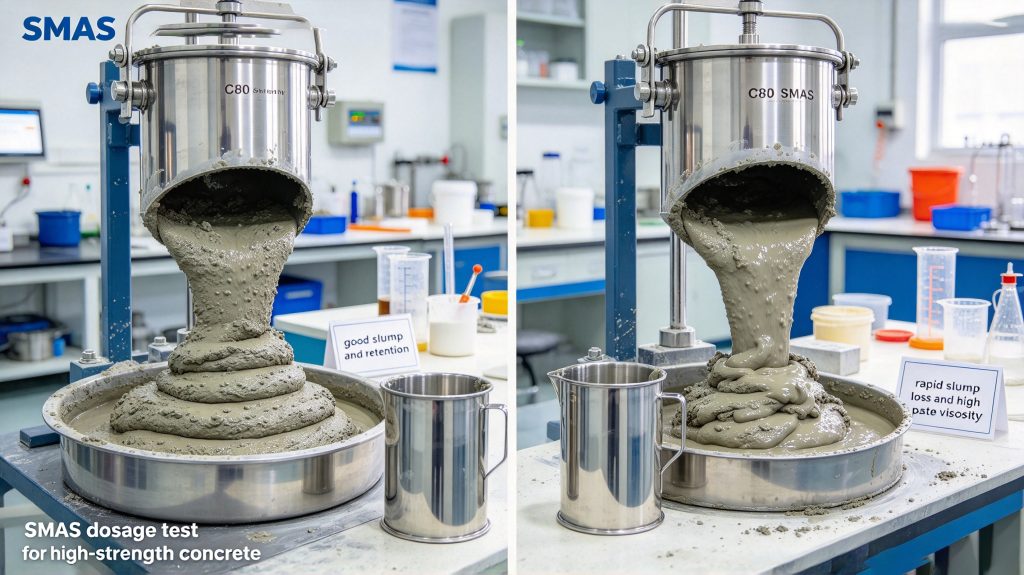
The theoretical upper limit is only a reference boundary. The final confirmed dosage must pass systematic laboratory tests. The test sequence includes monomer polymerization to prepare PCE mother liquor, cement paste fluidity and loss test, mini-slump test, then high-strength concrete mixing test. The key detection indicators are initial slump, slump retention at 60 min, concrete apparent viscosity, air content, compressive strength at 3d, 7d, 28d and shrinkage rate.
A practical judgment rule: when SMAS gradually rises, once the 60 min slump retention rate drops below the design target or the paste viscosity rises sharply, this dosage has exceeded the applicable upper limit for this formula system.
6. Formula Optimization Measures If SMAS Already Approaches or Exceeds the Upper Limit
If the formula needs to keep high charge density without lifting SMAS beyond the upper limit, formulators can properly adjust acrylic acid proportion or introduce slow-release ester monomers. Slow-release monomers continuously produce carboxylate groups under alkaline hydration conditions, which can supplement dispersion and slump retention without adding extra SMAS. Meanwhile, adjust initiator feeding procedure and chain transfer agent to stabilize molecular weight distribution. Blindly increasing SMAS is not a correct way to improve dispersion of high-strength high-grade concrete.
FAQ
Q1: What is the generally accepted proper upper limit of SMAS dosage for high-strength high-grade concrete PCE?
A1: For most PCE systems for high-strength high-grade concrete, sodium methallyl sulfonate (SMAS, CAS NO.:1561-92-8) should not exceed 3.0% of total monomer mass. When silica fume is incorporated, the safer upper limit drops to 2.0%–2.5%.
Q2: Why is the SMAS upper limit of high-strength concrete lower than ordinary concrete?
A2: High-strength concrete uses a very low water-binder ratio. The liquid phase has high ionic strength. Excess sulfonate groups from over-dosed SMAS cause ultra-fast adsorption, rapid consumption of free PCE, increased paste viscosity and higher shrinkage cracking risk.
Q3: Can I increase SMAS above 3.0% if the initial dispersion of high-strength concrete is insufficient?
A3: Not recommended. Insufficient initial dispersion should be solved by adjusting side-chain macromonomer, acrylic acid or solid content, rather than raising SMAS beyond the upper limit. Higher SMAS will sacrifice retention and increase viscosity.
Q4: Will low SMAS dosage below 1.0% cause problems for high-strength concrete PCE?
A4: Too low SMAS may lead to insufficient backbone charge density, poor dispersion stability, wider molecular weight distribution and even gel risk during polymerization. The recommended safe range is 1.0%–3.0%.
Q5: Does the SMAS upper limit apply equally to C60, C80 and C100 ultra-high-strength concrete?
A5: No. With the rise of strength grade and reduction of water-binder ratio, the allowable SMAS upper limit gradually decreases. C80 and C100 ultra-high-strength systems usually control SMAS below 2.0%.
Q6: How to distinguish whether poor slump retention is caused by SMAS exceeding upper limit or unreasonable slow-release monomer design?
A6: Carry out gradient SMAS dosage test. If retention improves after cutting SMAS, the original dosage exceeds the upper limit. If retention remains poor after SMAS reduction, the slow-release monomer structure and feeding scheme need to be optimized.
References
[1] Plank J, Hirata T. Adsorption behaviour of polycarboxylate superplasticizers on cement and silica fume in low w/b systems. Cement and Concrete Research, 2010, 40(7): 1024–1031.
[2] Zhang Y, Wang Z. Effect of sodium methallyl sulfonate (SMAS) dosage on performance of polycarboxylate superplasticizer for high-strength concrete. Journal of Building Materials, 2020, 23(5): 912–917.
[3] Lei L, Plank J. Influence of anionic monomer content on viscosity and slump retention of high-performance concrete superplasticizer. Journal of Applied Polymer Science, 2015, 132(18).
[4] GB/T 8076-2008, Concrete admixtures. Standardization Administration of China, 2008.