
Sodium methallyl sulfonate (SMAS, CAS 1561-92-8) is a critical sulfonate-containing monomer for synthesizing polycarboxylate superplasticizer. SMAS blended polycarboxylate superplasticizer provides excellent dispersion for cement particles, but improper formulation or raw material quality will cause excessive bubbles on the surface and inside concrete precast components. Too many pores reduce the density, compressive strength and surface finish of precast parts. This article analyzes the root causes of excessive bubbles when using SMAS blended polycarboxylate superplasticizer.
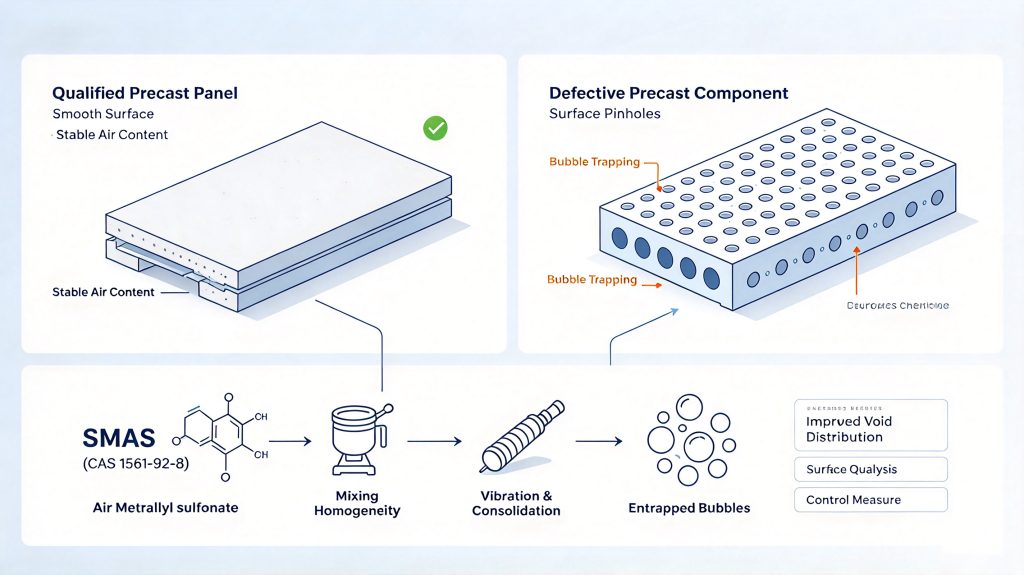
Molecular structure of sodium methallyl sulfonate introduces weak air-entraining property
SMAS (CAS 1561-92-8) contains hydrophilic sulfonate groups on its molecular chain. When SMAS is copolymerized into polycarboxylate superplasticizer, the sulfonic group segment can reduce the surface tension of fresh concrete pore solution. This feature brings inherent weak air-entraining performance to SMAS blended polycarboxylate superplasticizer. If the SMAS dosage in polymerization is too high, more tiny air bubbles will be stabilized inside concrete mixture. These bubbles cannot escape during vibrating and remain inside precast components.
Impurities in SMAS raw material stabilize bubbles in precast concrete
Low-grade sodium methallyl sulfonate often contains residual organic impurities and inorganic salts. These impurities act as surfactants and strengthen the stability of air bubbles. When impure SMAS is used to produce polycarboxylate superplasticizer, bubbles trapped in fresh concrete become hard to break. Even after sufficient vibration, numerous small pores stay on the surface of precast components, causing honeycomb and pitting defects.
H3: Unmatched defoamer dosage for SMAS blended polycarboxylate superplasticizer
SMAS modified polycarboxylate superplasticizer needs matched defoamer during compounding. The sulfonate group from SMAS will weaken defoaming efficiency. If defoamer addition amount is insufficient or defoamer type is not compatible with SMAS blended polycarboxylate superplasticizer, air bubbles generated in mixing process will not be eliminated effectively. Excessive bubbles will remain in precast concrete after casting.
Improper vibration process amplifies bubble defect for SMAS blended superplasticizer concrete
Fresh concrete with SMAS blended polycarboxylate superplasticizer has good fluidity. If vibration time is too short or vibration frequency is not suitable, internal bubbles cannot rise out of concrete matrix. Over-vibration is also harmful: it will trigger secondary bubble generation, especially when SMAS content in superplasticizer is relatively high. Both under-vibration and over-vibration lead to surface pinholes in finished precast components.
Mix proportion mismatch increases bubble retention with SMAS blended polycarboxylate superplasticizer
Higher water-to-cement ratio and excessive fine powder content help bubbles stabilize. When using SMAS blended polycarboxylate superplasticizer, if sand fineness modulus is too small or mud content of aggregate is high, bubble discharge becomes difficult. The sulfonate structure of sodium methallyl sulfonate further increases bubble stability, leaving abundant closed pores inside precast concrete after hardening.
High mixing speed and feeding sequence bring extra entrained air
Rapid stirring speed and wrong feeding sequence can trap large volumes of air into fresh concrete. For SMAS blended polycarboxylate superplasticizer, adding the admixture too early will fully activate the surfactant effect of SMAS. The mixture wraps and locks more air, forming fine and stable bubbles. This issue is more obvious in precast production with high-speed batching mixers.