
Sodium Methallyl Sulfonate, abbreviated as SMAS, is an essential bifunctional monomer for polycarboxylate ether (PCE) superplasticizer polymerization, providing sulfonate anchoring groups and adjustable chain transfer performance. Standard qualified Sodium Methallyl Sulfonate presents white or off-white crystalline powder. Once SMAS turns yellow or light brown due to oxidation, hydrolysis and long-term deliquescence, the chemical activity of Sodium Methallyl Sulfonate is severely damaged. Discolored yellow SMAS introduces large amounts of oxidized impurity fragments, disrupts copolymerization balance, and triggers a series of quality defects in finished polycarboxylate superplasticizer products. This article comprehensively sorts out all negative impacts caused by yellow discolored Sodium Methallyl Sulfonate (SMAS), with natural and reasonable layout of core keywords Sodium Methallyl Sulfonate and SMAS in all sections.
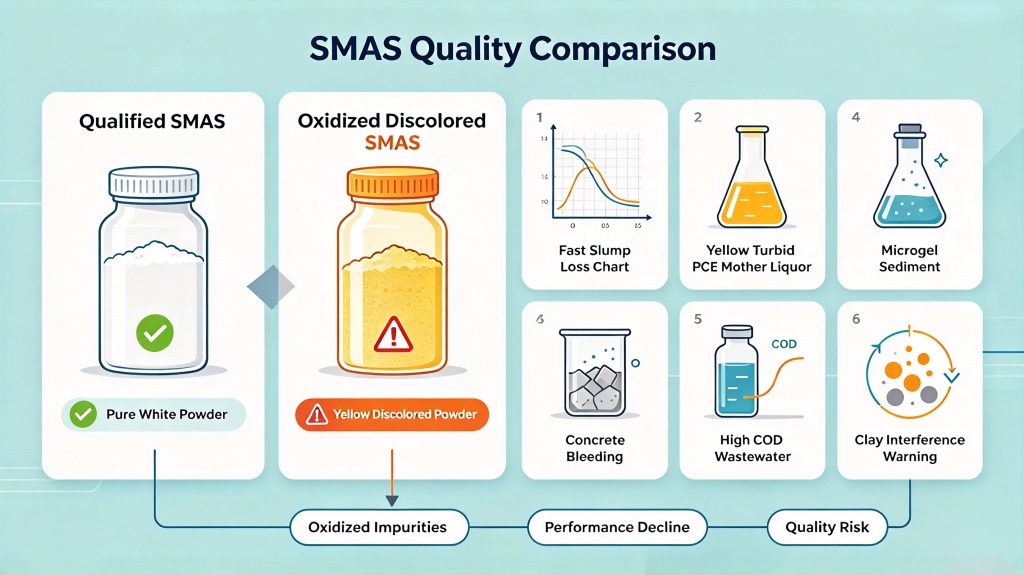
1. Reduced Effective Active Content of Sodium Methallyl Sulfonate Destroys Designed Molecular Weight Control
Yellow discoloration of SMAS originates from oxidative cleavage of the allyl sulfonate structure of Sodium Methallyl Sulfonate under high temperature and high humidity storage conditions.
- The oxidized part of yellow SMAS loses double bond activity and cannot participate in free radical graft copolymerization with TPEG and acrylic acid. When calculating feeding mass based on raw SMAS weight without deducting invalid oxidized components, the actual effective Sodium Methallyl Sulfonate dosage is far lower than the preset molar ratio.
- Insufficient functional Sodium Methallyl Sulfonate weakens the chain transfer regulation effect of SMAS during polymerization. Polymer chains grow excessively long without termination control, generating high-molecular cross-linked polymers that cause finished PCE mother liquor to thicken, stratify and precipitate after storage.
- Batch molecular weight fluctuation becomes obvious when yellow SMAS is used alternately with qualified white SMAS, leading to unstable initial water reducing rate between different batches of polycarboxylate superplasticizer.
2. Insufficient Grafted Sulfonate Groups Cause Rapid Slump Loss of PCE Products
The core function of Sodium Methallyl Sulfonate is to graft negative sulfonate groups onto polycarboxylate molecular backbones for long-term cement dispersion retention.
- Oxidized yellow SMAS loses most sulfonate functional groups; fewer sulfonate sites are distributed on copolymer chains after synthesis. The finished polycarboxylate superplasticizer only provides strong initial dispersion effect but fails to maintain fluidity. Concrete mixed with this PCE shows severe slump loss within 30–60 minutes, unable to meet the requirements of long-distance transportation ready-mix concrete.
- Yellow SMAS contains hydrolyzed sulfite small molecule impurities that consume free radicals in the reaction system, further reducing the grafting efficiency of valid Sodium Methallyl Sulfonate and aggravating insufficient sulfonate density on polymer chains.
3. Oxidation Impurities in Yellow SMAS Lead To Poor Anti-Clay and Anti-Salt Performance
Montmorillonite clay in aggregate easily adsorbs carboxyl groups on PCE chains, while sulfonate groups from Sodium Methallyl Sulfonate can resist clay cation interference.
- Due to low effective content of yellow SMAS, the sulfonate coverage on copolymer molecules drops sharply. When the polycarboxylate superplasticizer is applied to high-clay aggregate concrete, clay minerals quickly adsorb PCE molecules, resulting in sharp thickening of fresh concrete and failed filtration control.
- Impurity ions brought by yellow SMAS raise the ionic strength of cement pore solution, compress the electric double layer of cement particles, weaken electrostatic repulsion of PCE, and greatly reduce the adaptability of finished superplasticizer in high-salinity mixing water.
4. Yellow Degradation Impurities Cause Mother Liquor Discoloration and Unstable Appearance of Polycarboxylate Superplasticizer
Oxidative decomposition by-products inside yellow SMAS are colored organic heterocyclic fragments that remain completely in finished PCE mother liquor after polymerization.
- Polycarboxylate superplasticizer synthesized with yellow SMAS turns light yellow, amber or dark brown, different from the transparent pale yellow appearance of standard PCE produced by white qualified Sodium Methallyl Sulfonate. Color inconsistency reduces customer acceptance of finished admixture products.
- Colored impurities derived from yellow SMAS accelerate secondary oxidation of PCE molecules during long-term warehouse storage. The mother liquor deepens in color gradually, accompanied by slight viscosity increase and tiny suspended floccules at the bottom of storage barrels.
5. Excess Microgel Generation and Increased Foaming Tendency
Partial self-homopolymerization occurs inside yellow SMAS before feeding because oxidized Sodium Methallyl Sulfonate fragments trigger abnormal radical activity.
- During copolymerization, yellow SMAS generates more insoluble SMAS homopolymer microgels. These gel particles cannot disperse in concrete paste, block on-site filter screens and reduce the uniformity of polycarboxylate superplasticizer mixing performance.
- Residual sulfite and unsaturated degraded fragments from yellow SMAS act as foaming promoters. Concrete mixed with the corresponding PCE produces excessive stable microbubbles, leading to reduced concrete strength, surface pinholes and serious bleeding segregation.
6. Higher Wastewater COD and Increased Production Treatment Cost
Unreacted oxidized fragments and residual invalid Sodium Methallyl Sulfonate from yellow SMAS remain in post-reaction mother liquor and washing wastewater.
- Wastewater discharged after PCE synthesis using yellow SMAS carries higher organic pollutant content, with COD value significantly exceeding the standard of production wastewater generated by white qualified Sodium Methallyl Sulfonate.
- Factories need to add extra flocculants and oxidants to treat wastewater containing yellow SMAS degradation impurities, increasing daily environmental treatment costs and extending wastewater processing cycles.
Practical Solutions to Avoid Defects Caused by Yellow Discolored SMAS
- Conduct visual inspection before feeding; reject all yellow or brown discolored SMAS and do not mix yellow Sodium Methallyl Sulfonate with qualified white SMAS for production.
- Store Sodium Methallyl Sulfonate in sealed low-humidity constant-temperature warehouses to prevent SMAS oxidation and yellow discoloration during storage.
- Test the effective active content of each SMAS batch; if slight yellowing appears, adjust the feeding mass of Sodium Methallyl Sulfonate proportionally or replace the batch completely.
- Extend the holding reaction time appropriately when yellow SMAS is accidentally put into production to consume partial unreacted Sodium Methallyl Sulfonate fragments and reduce residual impurities.