
Sodium Methallyl Sulfonate (SMAS) is a bifunctional sulfonated monomer widely used in polycarboxylate superplasticizer copolymerization, acting as both a chain transfer agent and a sulfonic acid functional monomer. The conversion rate of Sodium Methallyl Sulfonate directly determines the sulfonate group density, molecular weight distribution and final dispersion performance of PCE products. Polymerization temperature is the most critical variable affecting how much Sodium Methallyl Sulfonate participates in graft copolymerization rather than remaining as unreacted residual monomer. Different temperature intervals bring distinct influences on the conversion rate of Sodium Methallyl Sulfonate, as analyzed below.
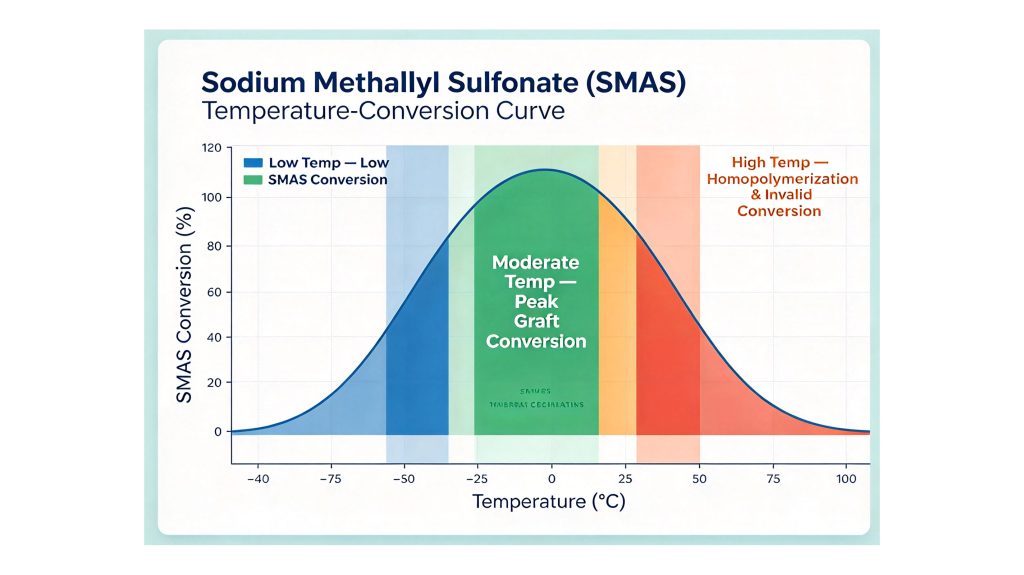
1. Low-Temperature Polymerization (20–40℃, Redox Initiator System)
Under low-temperature redox initiation, radical generation speed is slow, and the molecular activity of Sodium Methallyl Sulfonate is suppressed.
- The conversion rate of Sodium Methallyl Sulfonate maintains a moderate stable level of 78%–85%. Low radical concentration limits the collision probability between Sodium Methallyl Sulfonate and TPEG macromonomer chains, slowing the grafting reaction of Sodium Methallyl Sulfonate.
- Advantages: Slow chain transfer of Sodium Methallyl Sulfonate avoids excessive short-chain fragments; the molecular weight of copolymer is easy to control.
- Drawbacks: A large portion of unreacted Sodium Methallyl Sulfonate stays in the mother liquor after synthesis, raising wastewater COD and raw material waste. To lift the conversion rate of Sodium Methallyl Sulfonate at low temperature, extend the heat preservation time after dropwise feeding and slightly increase the initiator dosage.
2. Moderate Optimal Temperature Range (45–70℃, Balanced Conversion of Sodium Methallyl Sulfonate)
This temperature window is the standard production condition for Sodium Methallyl Sulfonate and TPEG copolymerization.
- The conversion rate of Sodium Methallyl Sulfonate peaks at 88%–96%. Moderate heat accelerates radical movement, enabling sufficient contact between Sodium Methallyl Sulfonate and main monomers. Most Sodium Methallyl Sulfonate molecules successfully graft onto polyether backbones instead of undergoing independent homopolymerization.
- Stable chain transfer effect of Sodium Methallyl Sulfonate forms uniform polymer chains with evenly distributed sulfonate groups, delivering balanced water reduction and slump retention.
- Temperature fluctuation must be controlled within ±1℃. Even a small temperature drop will immediately lower the conversion rate of Sodium Methallyl Sulfonate and generate more free residual SMAS.
3. Excessively High Polymerization Temperature (Above 75℃, Sharp Drop in Effective Conversion of Sodium Methallyl Sulfonate)
When the reaction temperature exceeds 75℃, the conversion rate of Sodium Methallyl Sulfonate splits into two contradictory trends, and the effective graft conversion declines severely.
- Rapid self-homopolymerization of Sodium Methallyl Sulfonate High temperature drastically boosts the self-polymerization activity of Sodium Methallyl Sulfonate. Most Sodium Methallyl Sulfonate monomers polymerize with each other to form insoluble microgels instead of grafting with TPEG. Although the total consumption of Sodium Methallyl Sulfonate seems high, the effective graft conversion rate drops below 70%. These SMAS homopolymer gels contribute zero dispersion performance to PCE.
- Thermal decomposition of Sodium Methallyl Sulfonate Sustained high heat breaks the sulfonate side chain of Sodium Methallyl Sulfonate, producing sulfite small molecules that lose copolymerization activity. Decomposed Sodium Methallyl Sulfonate cannot participate in grafting at all, further reducing usable conversion.
- Side effects triggered by low effective SMAS conversion Massive invalid Sodium Methallyl Sulfonate homopolymer blocks reactors and filter screens; residual decomposed SMAS raises wastewater treatment costs; finished PCE suffers poor anti-clay capacity due to insufficient grafted sulfonate groups from Sodium Methallyl Sulfonate.
4. Temperature Fluctuation Damage to Sodium Methallyl Sulfonate Conversion Consistency
Frequent temperature spikes and drops during feeding cause uneven conversion of Sodium Methallyl Sulfonate batch by batch.
- Local overheating inside the reactor forms high-SMAS-concentration hot zones where Sodium Methallyl Sulfonate homopolymerizes massively.
- Sudden temperature cooling stalls the graft reaction of Sodium Methallyl Sulfonate halfway, leaving large amounts of unreacted Sodium Methallyl Sulfonate.
- Batch-to-batch fluctuation of Sodium Methallyl Sulfonate conversion leads to unstable PCE molecular weight and inconsistent concrete performance.
5. Practical Adjustment Rules to Stabilize Sodium Methallyl Sulfonate Conversion Rate
- Fix polymerization temperature at 55–65℃ to maintain the highest effective conversion of Sodium Methallyl Sulfonate.
- For low-temperature redox processes, prolong holding time to improve Sodium Methallyl Sulfonate graft conversion.
- Strictly prohibit reaction temperature over 75℃ to avoid invalid Sodium Methallyl Sulfonate homopolymerization and decomposition.
- Install real-time temperature probes to eliminate hot spots and keep stable conversion of Sodium Methallyl Sulfonate throughout the whole reaction.