1. Core Functions in Acid Nickel Plating Bath
ALS is a primary auxiliary brightener & carrier softener, exclusively supplied as 35% aqueous liquid for plating workshops:
- Boost throwing power (covering power): Eliminate dark, thin nickel layers on low-current-density recessed parts
- Improve coating ductility & flexibility: Reduce internal stress, avoid cracking during bending/post-forming
- Suppress pinholes & pitting: Strengthen uniform metal deposition
- Cut consumption of expensive secondary brighteners (alkynol, BSI, ATPN)
- Deliver semi-bright white nickel base for decorative & functional nickel plating
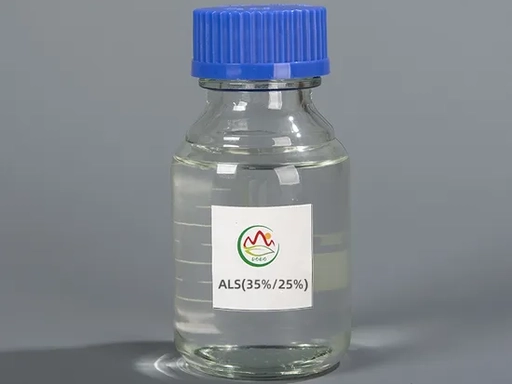
35% ALS Liquid Sample
ALS Reagent Bottle
2. Standard Dosage Reference (35% Liquid ALS, Mainstream Baths)
2.1 Decorative Bright Acid Nickel (Most Common)
- Target effective ALS content in bath: 0.5–2 g/L pure ALS
- 35% liquid dosing: 1.4–5.7 mL per liter plating solution
- Optimal range: 2–4 mL/L liquid (pure ALS 0.7–1.4 g/L)
- Consumption rate: 100–180 g pure ALS / 1000 Ampere-Hour (KAH)
2.2 Matte / Semi-Bright Nickel Plating
- Pure ALS target: 0.1–0.2 g/L
- 35% liquid dosage: 0.3–0.6 mL/L
2.3 Ni-Fe / Ni-Co Alloy Plating
- Pure ALS target: 1–3 g/L; liquid addition: 3–8.5 mL/L bath
Overdose & Underdose Consequences
- Too low: Poor throwing power, dull coating, heavy secondary brightener consumption
- Too high: Coating turns yellow/grey, hazy surface, high tensile stress; remedy: Activated carbon filtration or low-current electrolysis treatment
3. Standard Acid Nickel Bath Base Formulation (Matching ALS)
| Raw Material | Concentration |
|---|---|
| Nickel Sulfate Hexahydrate | 220–280 g/L |
| Nickel Chloride Hexahydrate | 30–50 g/L |
| Boric Acid | 35–45 g/L |
| 35% ALS Liquid | 2–5 mL/L |
| Secondary Brightener (Butynediol/BSI) | 0.1–0.3 mL/L |
4. Recommended Plating Operating Parameters
- pH: 4.0–4.8 (adjust with dilute H₂SO₄ / nickel carbonate)
- Temperature: 50–60 ℃
- Cathode current density: 2–8 A/dm²
- Agitation: Mild air stirring or cathode movement
- Filtration: Continuous 5μm filter to remove organic decomposition sludge
5. Step-by-Step Adding Operation
- Fill tank with half deionized water, heat to working temperature
- Dissolve nickel salt and boric acid completely in sequence
- Dilute required ALS liquid with warm bath water before slow stirring addition (prevent local high concentration)
- Add secondary brighteners, adjust pH, top up to full volume
- Perform dummy plating at low current (0.5 A/dm²) for 2–4 hours before mass production
6. Bath Daily Maintenance Rules
- Track ampere-hour output; replenish ALS per 120 g/KAH consumption
- Weekly bath analysis to calibrate ALS concentration
- Every 2–4 weeks: Activated carbon treatment to remove degraded ALS organics
- Avoid overheating bath above 65℃, prevents ALS self-polymerization & bath gelation
7. Product Grade Selection Note
- Plating factory preferred: 35% low-chloride liquid ALS (direct dosing, no dust)
- 99% solid powder ALS: Rare for plating; only for custom concentrated bath preparation, needs dissolving tank
8. Storage & Handling for 35% ALS Liquid
- Pack: 25kg HDPE plastic drum / 1000L IBC tank
- Store cool, shaded, anti-freeze (crystallization below 0℃ blocks pipelines)
- Shelf life: 18 months sealed; avoid long-term UV exposure