1. Basic Properties and Functional Position of Sodium Methallyl Sulfonate (SMAS, CAS NO.:1561-92-8)
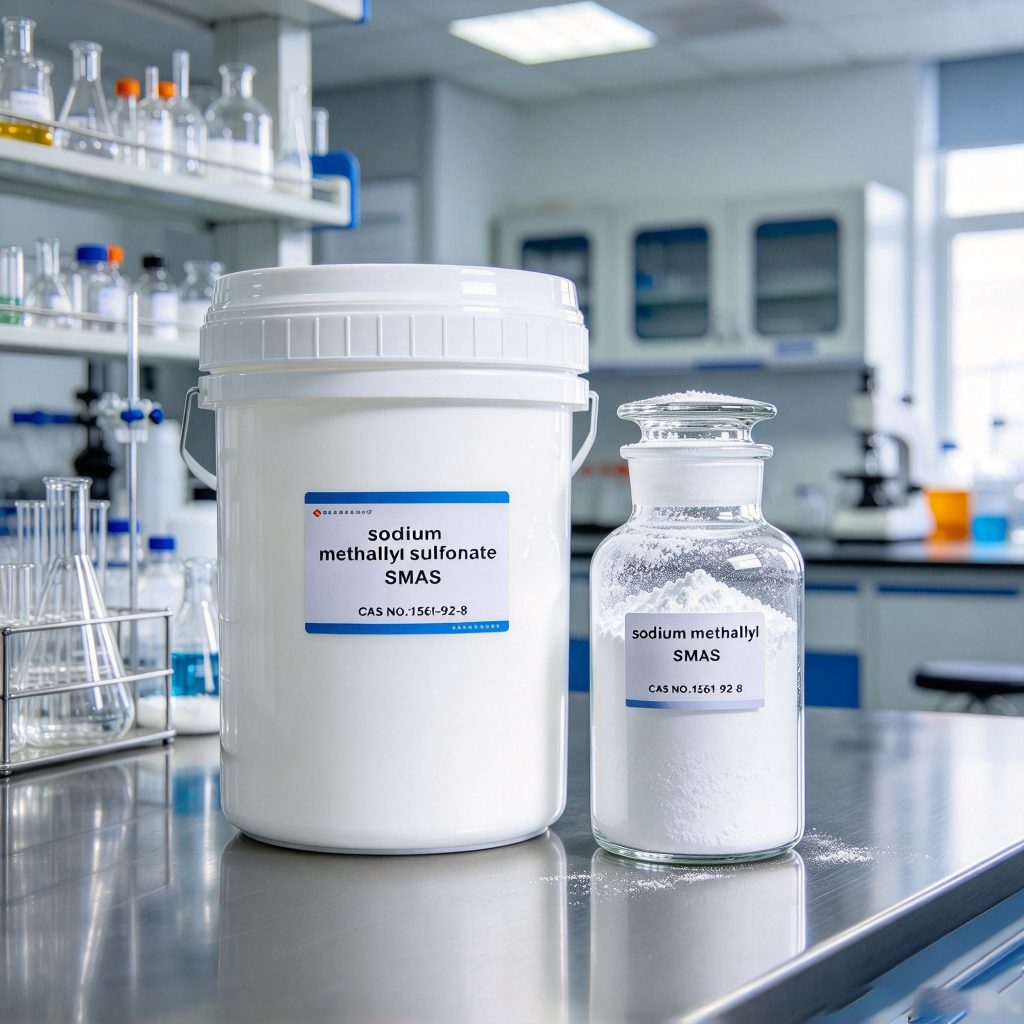
Sodium methallyl sulfonate, abbreviated as SMAS, CAS NO.:1561-92-8, is a common anionic sulfonate functional monomer widely adopted in the synthesis of polycarboxylate superplasticizers. SMAS carries stable sulfonate groups and polymerizable carbon-carbon double bonds, which are introduced into polymer molecular chains to provide electrostatic repulsion, improve water solubility, enhance dispersion retention and adjust molecular weight distribution of water-reducing admixtures. Different from finished superplasticizer products, sodium methallyl sulfonate itself is a synthesis monomer rather than a ready-to-use water reducer. This core property determines its compatibility logic when matched with aliphatic admixtures and aminosulfonate admixtures. Aliphatic superplasticizers and aminosulfonate superplasticizers are two mature condensation-type water-reducing admixtures with independent molecular structures, charge characteristics and dispersion mechanisms.
2. Compatibility Principle: Difference Between Direct Physical Compounding and Copolymerization Incorporation of SMAS
It is necessary to distinguish two application scenarios for sodium methallyl sulfonate (SMAS, CAS NO.:1561-92-8). The first scenario is direct physical compounding: mixing finished aliphatic admixture, finished aminosulfonate admixture and raw SMAS monomer solution together at normal temperature for concrete application. The second scenario is copolymerization incorporation: adding SMAS as a reaction monomer into the synthesis system of aliphatic or aminosulfonate polymers during the condensation polymerization stage. For direct physical compounding: sodium methallyl sulfonate monomer can be physically mixed with aliphatic admixtures and aminosulfonate admixtures in most cases, but the compounded system faces obvious performance risks and limitations. SMAS monomer will not chemically react rapidly with the main molecules of aliphatic and aminosulfonate admixtures under normal temperature neutral or weakly alkaline environment, so violent precipitation or gel coagulation will not occur immediately. However, this simple blending rarely brings positive synergistic dispersion effect, and may induce stability problems of the admixture solution. For copolymerization incorporation: SMAS cannot be arbitrarily added into aliphatic or aminosulfonate condensation reaction systems. Aliphatic and aminosulfonate admixtures are synthesized via polycondensation of formaldehyde, sulfonated monomers and active aromatics, whose reaction mechanism and temperature window differ greatly from the free-radical polymerization pathway of sodium methallyl sulfonate. Random feeding of SMAS into their condensation reaction will disrupt the polymerization process.
3. Performance Risks of Direct Physical Compounding of SMAS with Aliphatic and Aminosulfonate Admixtures
Although sodium methallyl sulfonate, SMAS, CAS NO.:1561-92-8, will not trigger instant chemical deterioration when directly compounded with aliphatic and aminosulfonate admixtures, multiple hidden risks restrict this operation. First, inconsistent adsorption competition on cement particles. Aliphatic admixtures and aminosulfonate admixtures adsorb on cement surface through sulfonate groups to realize dispersion. Free SMAS monomer also contains sulfonate anions and participates in competitive adsorption. Excess free SMAS occupies adsorption sites, weakening the dispersion capacity of the main admixture and reducing initial water reduction rate of concrete. Second, solution storage stability declines. Aliphatic and aminosulfonate admixtures usually have a high salt ion background. Adding sodium methallyl sulfonate increases total ionic strength of the mixed system. High ion concentration compresses the electric double layer, which may cause slow stratification, turbidity and crystal precipitation during long-term storage of compounded admixture liquid. Third, adverse effect on slump retention. Free SMAS monomer has weak sustained-release dispersion ability compared with modified polycarboxylate segments. Direct blending often leads to unstable slump loss; sometimes accelerated slump loss appears under high temperature cement condition. Fourth, interference with retardation and setting time. The combined anionic system may change the hydration induction period of cement paste, resulting in abnormal prolongation or fluctuation of concrete setting time.
4. Recommended Application Method: Incorporate SMAS in Polycarboxylate Synthesis Instead of Direct Blending
The mainstream industrial application of sodium methallyl sulfonate (SMAS, CAS NO.:1561-92-8) is to copolymerize SMAS with acrylic acid, polyethylene glycol macromonomers and other monomers to prepare modified polycarboxylate superplasticizer. The synthesized SMAS-modified polycarboxylate product can be reasonably compounded with aliphatic admixtures or aminosulfonate admixtures according to formula requirements. This route separates SMAS polymerization and admixture compounding. After SMAS is built into polycarboxylate molecular backbone, its sulfonate groups are fixed in long polymer chains, avoiding the adverse competitive adsorption brought by free SMAS monomer. The finished polycarboxylate containing SMAS structural units has better compatibility when mixed with aliphatic or aminosulfonate water reducers. Formulators can adjust mixing proportion to balance water reduction, slump retention, adaptability to different cement and clay tolerance. When mixing the finished modified polycarboxylate, aliphatic admixture and aminosulfonate admixture, pre-compatibility tests are still required, including liquid storage stability test, paste fluidity test and concrete trial mixing.
5. Key Test Items If Direct Compounding of SMAS with Aliphatic / Aminosulfonate Admixtures Is Unavoidable
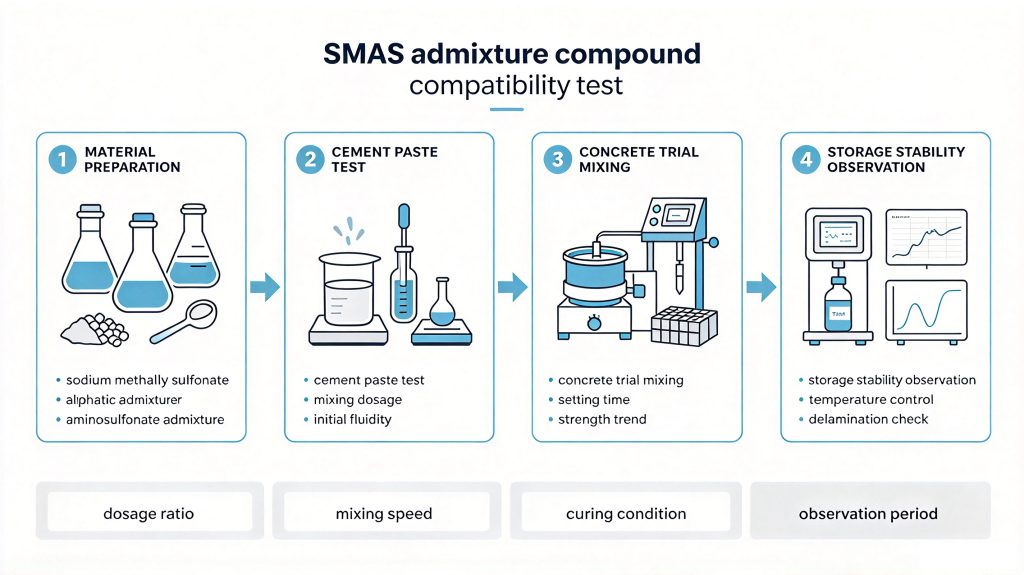
If production conditions require direct mixing of sodium methallyl sulfonate monomer with aliphatic and aminosulfonate admixtures, a full set of lab compatibility tests must be completed before formal mass production.
- Appearance and storage stability test: seal the mixed solution and observe turbidity, precipitation and stratification under 5 ℃, 25 ℃ and 40 ℃ for 7–28 days.
- Cement paste fluidity test: test initial fluidity and fluidity loss at 30 min, 60 min to judge dispersion performance.
- Concrete performance test: test slump, slump loss, setting time, compressive strength at 3d and 28d.
- Adaptability test with local cement, fly ash and mineral powder, especially for low-quality cement and high-clay aggregate.
- Compatibility with defoamer and retarder, to avoid abnormal air content. If precipitation, sharp slump loss or serious setting delay occurs in the test, the direct compounding formula must be abandoned.
6. Summary of Matching Rules for Sodium Methallyl Sulfonate and Traditional Sulfonated Admixtures
In short, sodium methallyl sulfonate (SMAS, CAS NO.:1561-92-8) monomer can be physically mixed directly with aliphatic admixtures and aminosulfonate admixtures from the perspective of simple chemical stability without immediate destructive reaction, but this method is not recommended in normal admixture formulation design. Direct compounding of free SMAS monomer usually brings unstable dispersion, poor storage performance and unpredictable concrete hydration behavior. The correct industrial idea is to use SMAS as a copolymerization monomer for polycarboxylate superplasticizer synthesis, and then compound the obtained finished polycarboxylate product with aliphatic admixture or aminosulfonate admixture. This scheme gives full play to the modification advantage of SMAS and reduces compatibility risks.
FAQ
Q1: Will direct mixing of sodium methallyl sulfonate (SMAS, CAS NO.:1561-92-8) with aliphatic admixture cause gel precipitation immediately?
A1: Normally no immediate gel or precipitation occurs at room temperature. SMAS monomer does not undergo fast cross-linking or condensation reaction with aliphatic admixture molecules. But high ion strength of the mixed system may lead to delayed precipitation after several days of storage.
Q2: Can I use SMAS monomer together with aminosulfonate admixture to improve slump retention directly?
A2: Direct addition of free SMAS monomer rarely improves slump retention stably. Free SMAS mainly competes for cement adsorption sites and often accelerates slump loss. Good retention effect is realized only when SMAS is copolymerized into polycarboxylate molecular chains.
Q3: What is the difference between aliphatic admixture, aminosulfonate admixture and SMAS-modified polycarboxylate?
A3: Aliphatic and aminosulfonate admixtures are formaldehyde-based condensation superplasticizers. Sodium methallyl sulfonate (SMAS, CAS NO.:1561-92-8) is a monomer; after free-radical copolymerization, it forms SMAS-modified polycarboxylate, which has different molecular structure, dispersion mechanism and cement adaptability.
Q4: Can SMAS be added into the synthesis reactor of aminosulfonate superplasticizer during condensation?
A4: Not recommended. Aminosulfonate admixture follows condensation reaction mechanism, while SMAS participates in free radical polymerization. Mixing them in one condensation system will disturb the reaction, lead to uncontrollable molecular weight and poor finished admixture performance.
Q5: When the SMAS-containing polycarboxylate is compounded with aliphatic admixture, what index should be focused on first?
A5: The first focus is cement paste fluidity and slump loss, followed by concrete setting time and storage stability of mixed liquid. Different cement types will greatly change the compounding effect.
Q6: What dosage range of SMAS is commonly used in polycarboxylate synthesis?
A6: In polycarboxylate superplasticizer synthesis, the mass dosage of sodium methallyl sulfonate (SMAS, CAS NO.:1561-92-8) generally accounts for 1.5%–5% of total monomers. The specific proportion is adjusted according to target water reduction, retention requirement and raw material quality.
References
[1] Zhang M, Wu H. Study on compatibility of polycarboxylate superplasticizer modified by sodium methallyl sulfonate with traditional sulfonated water reducers. Journal of Building Materials, 2021, 24(3): 478–484.
[2] Li S. Synthesis and application of aliphatic and aminosulfonate series concrete admixtures. Concrete Admixture Technology Manual, China Architecture & Building Press, 2020.
[3] SDS Document, Sodium methallyl sulfonate (SMAS, CAS NO.:1561-92-8). Fine chemical manufacturer safety data sheet, 2024.
[4] Wang Y, Liu J. Competitive adsorption behavior of sulfonate monomers and polyanionic admixtures on cement mineral surface. Cement and Concrete Research, 2022, 157: 106872.