
Sodium Methallyl Sulfonate, shortened as SMAS, is a dual-functional monomer essential for manufacturing low slump-loss PCE superplasticizers. Sodium Methallyl Sulfonate supplies negatively charged sulfonate anchoring groups and serves as a mild chain transfer agent. The dosage of Sodium Methallyl Sulfonate directly governs sulfonate group density on copolymer chains, molecular weight distribution, adsorption durability on cement particles, and the final slump retention effect of finished PCE. Insufficient SMAS dosage leads to rapid slump loss, while excessive Sodium Methallyl Sulfonate triggers ultra-short polymer chains, poor initial water reduction and increased production cost. This article elaborates systematic dosage adjustment strategies of Sodium Methallyl Sulfonate (SMAS) tailored to low slump-loss polycarboxylate synthesis, with natural keyword layout of Sodium Methallyl Sulfonate and SMAS throughout all paragraphs.
1. Standard Benchmark Dosage Window of Sodium Methallyl Sulfonate for Low Slump-Loss PCE
For conventional TPEG-2400 polyether macromonomer ternary copolymer system (TPEG + AA + Sodium Methallyl Sulfonate), the baseline molar ratio of SMAS to TPEG is fixed at 0.20:1 ~ 0.26:1 for stable low slump-loss performance.
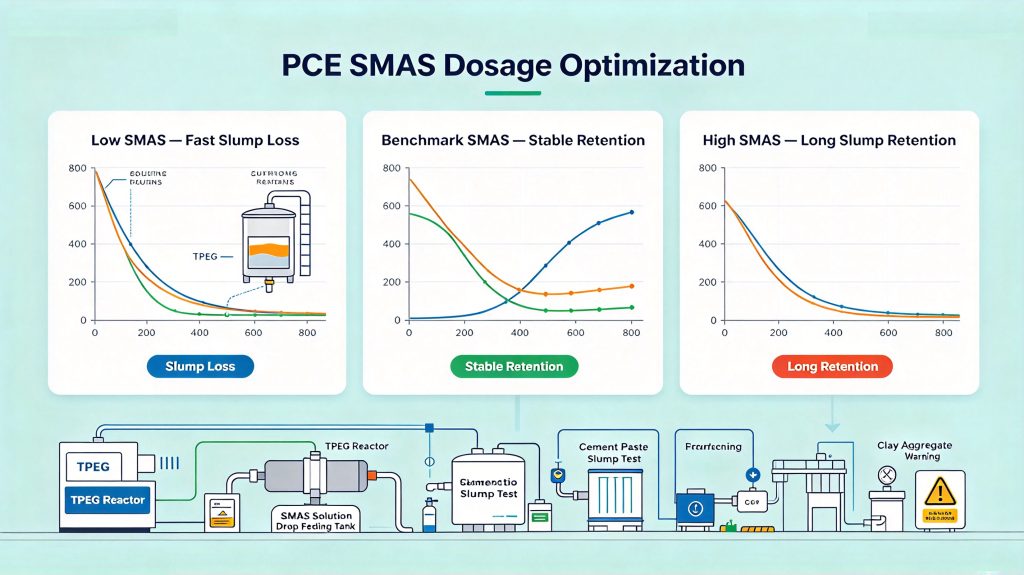
- Benchmark reference: 1 mol TPEG matches 0.23 mol Sodium Methallyl Sulfonate. This SMAS dosage balances adequate sulfonate grafting and reasonable molecular weight, achieving 2-hour slump retention without obvious loss for ordinary concrete.
- Count only effective active content when calculating Sodium Methallyl Sulfonate feeding mass; industrial SMAS contains moisture and inorganic salt impurities, which will lower actual functional dosage if uncorrected.
- When switching raw material batches of Sodium Methallyl Sulfonate, test active purity first and revise SMAS addition amount proportionally to lock stable slump retention performance.
2. Increase Sodium Methallyl Sulfonate Dosage for Severe Slump-Loss Working Conditions
Raise the molar ratio of SMAS:TPEG to 0.26:1 ~ 0.30:1 under the following scenarios to reinforce slow-release adsorption brought by Sodium Methallyl Sulfonate:
2.1 High clay content aggregate concrete
Clay minerals consume polymer carboxyl groups rapidly. Extra Sodium Methallyl Sulfonate adds dense sulfonate sites to resist clay interference, maintaining long-term cement dispersion. Without increasing SMAS dosage, PCE will lose fluidity quickly within 30 minutes.
2.2 High-temperature construction environment (ambient temperature above 30℃)
High temperature accelerates cement hydration and polymer desorption. Higher Sodium Methallyl Sulfonate dosage provides more persistent electrostatic repulsion, slowing down slump attenuation.
2.3 Long-distance transport ready-mix concrete (transport time over 90 minutes)
Extended mixing circulation consumes effective PCE components. Boosting SMAS dosage enhances the slow-release effect of sulfonate groups from Sodium Methallyl Sulfonate to keep stable paste fluidity.
Key Reminder for Over-Dosage Ceiling
Do not exceed SMAS:TPEG 0.30:1. Excess Sodium Methallyl Sulfonate causes over-intense chain transfer, generates massive short-chain fragments, reduces initial water reducing rate, and raises free Sodium Methallyl Sulfonate residue leading to concrete foaming.
3. Reduce Sodium Methallyl Sulfonate Dosage for Mild Slump Retention Requirements
Cut SMAS molar ratio down to 0.15:1 ~ 0.20:1 for these low-demand production scenarios:
3.1 Low-temperature winter production (reaction temperature below 25℃ redox process)
Low radical activity naturally extends polymer chain length. Less Sodium Methallyl Sulfonate is needed for chain transfer control; high SMAS dosage will over-shorten molecular chains and weaken initial dispersion.
3.2 Low-viscosity self-compacting concrete with short construction window
On-site pouring finishes within 30 minutes without long retention demand. Lower Sodium Methallyl Sulfonate dosage ensures high initial water reduction without unnecessary extra sulfonate groups.
3.3 Low-salinity clean aggregate concrete free of montmorillonite
No clay cation interference reduces reliance on sulfonate functional groups from Sodium Methallyl Sulfonate; appropriate SMAS reduction cuts raw material cost while meeting basic slump standards.
4. Matching Adjustment Rules Between Sodium Methallyl Sulfonate and Other Co-Monomers
Modifications to acrylic acid or initiator dosage must be accompanied by synchronous fine-tuning of Sodium Methallyl Sulfonate to avoid slump fluctuation:
- If acrylic acid molar ratio rises, slightly increase SMAS dosage. More carboxyl groups consume free radicals, requiring extra Sodium Methallyl Sulfonate to maintain balanced chain transfer and sulfonate density.
- When raising initiator addition amount, lower Sodium Methallyl Sulfonate moderately. Higher radical concentration accelerates chain termination; redundant SMAS will produce too many low-molecular-weight polymers.
- For high-molecular-weight TPEG-4000 macromonomer, reduce Sodium Methallyl Sulfonate by 15%–20%. Long polyether side chains provide sufficient steric hindrance, decreasing demand for SMAS sulfonate groups.
5. Trial Batch Calibration Method to Fine-Tune Sodium Methallyl Sulfonate Dosage
- Fix all other raw material ratios unchanged, set 3 gradient SMAS dosages (lower limit, benchmark, upper limit of Sodium Methallyl Sulfonate) for small pilot polymerization separately.
- Test paste fluidity, 1h / 2h slump loss rate and solution viscosity of each trial PCE sample.
- Select the Sodium Methallyl Sulfonate dosage with slump loss ≤30mm within 2 hours and stable initial fluidity as the formal production standard.
- If trial products show slow initial dispersion but good retention, increase acrylic acid and keep SMAS dosage stable; if initial fluidity is high but slump drops sharply, raise Sodium Methallyl Sulfonate dosage appropriately.
6. Operation Restrictions When Adjusting SMAS Dosage for Low Slump-Loss PCE
- Adjust Sodium Methallyl Sulfonate feeding speed synchronously with acrylic acid during co-dropwise feeding; uneven SMAS dripping leads to local high-concentration Sodium Methallyl Sulfonate homopolymerization and inconsistent slump retention between batches.
- Stabilize reaction temperature within ±1℃ after changing SMAS dosage; temperature drift will alter the chain transfer efficiency of Sodium Methallyl Sulfonate and offset dosage adjustment effects.
- Avoid frequent large-range jumps of Sodium Methallyl Sulfonate molar ratio; gradual 0.02 interval adjustment ensures stable continuous production quality.