
Sodium Allyl Sulfonate is a core anionic sulfonated monomer used to synthesize salt-resistant filtration control polymers for water-based drilling mud. The negatively charged sulfonate groups carried by Sodium Allyl Sulfonate can counteract cation shielding effects under high-salinity formation water, stabilizing rheology and reducing fluid loss. Improper addition amount or wrong operation of Sodium Allyl Sulfonate will cause mud foaming, viscosity collapse, polymer gel precipitation and failure of anti-salt performance. This article sorts out the optimal matching dosage and strict usage taboos of Sodium Allyl Sulfonate aiming at high-salinity drilling mud systems.
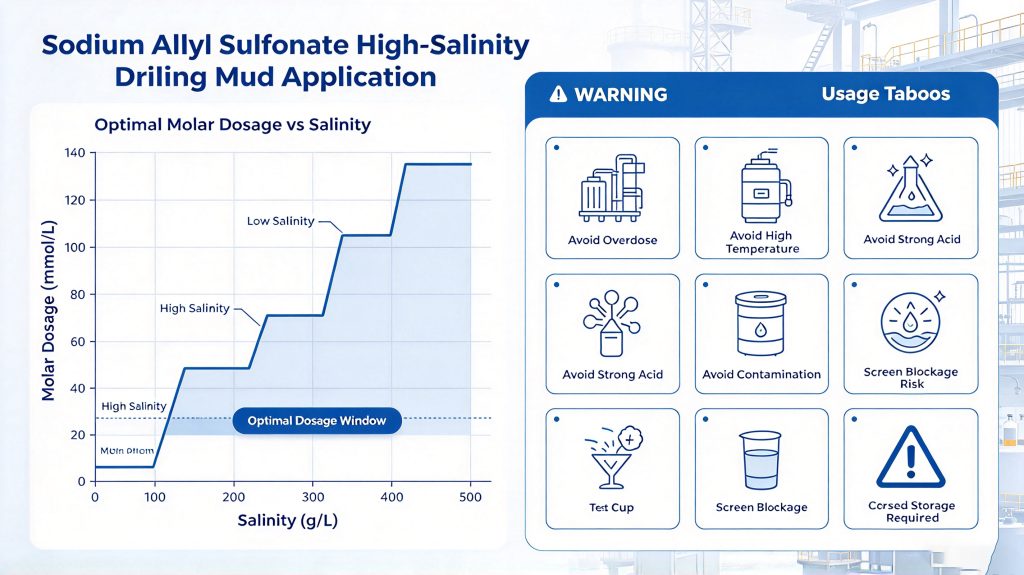
1. Optimal Dosage Range of Sodium Allyl Sulfonate for Different High-Salinity Mud Systems
The reasonable dosage of Sodium Allyl Sulfonate is calculated by molar ratio with acrylamide and acrylic acid main monomers, and matched according to salinity and calcium ion concentration in mud.
1.1 Moderate high-salinity mud (5%–15% NaCl, low Ca²⁺)
The optimal molar ratio of Sodium Allyl Sulfonate to total main monomers is 0.08–0.15:1, accounting for 1.0%–1.5% of copolymer solid mass. This dosage ensures uniform grafting of Sodium Allyl Sulfonate on polymer chains, providing sufficient negative charge to resist sodium ion interference and maintain stable mud suspension capacity.
1.2 Ultra-high-salinity high-calcium mud (20%–30% NaCl + high Ca²⁺/Mg²⁺)
Strong cation compression of electric double layer greatly weakens the effect of Sodium Allyl Sulfonate, so the dosage needs to be increased appropriately. The molar ratio of Sodium Allyl Sulfonate rises to 0.15–0.22:1, solid mass fraction reaches 1.5%–2.0%. Extra Sodium Allyl Sulfonate supplements dense sulfonate anchoring points to avoid flocculation of bentonite particles in saturated brine.
1.3 Low-viscosity lightweight high-salinity mud
For shallow well mud requiring low shear viscosity, reduce Sodium Allyl Sulfonate to the lower limit of 0.08:1 molar ratio. Excess Sodium Allyl Sulfonate will introduce excessive hydrophilic groups, leading to over-hydration of polymer chains and sharp drop of mud cutting carrying capacity.
2. Key Usage Taboos of Sodium Allyl Sulfonate in High-Salinity Drilling Mud
2.1 Taboo 1: Over-dosage of Sodium Allyl Sulfonate
When the molar ratio of Sodium Allyl Sulfonate exceeds 0.25:1, excessive sulfonate groups bring ultra-strong electrostatic repulsion. Under high salinity, polymers stretch excessively, mud viscosity drops sharply, API filtration loss rises obviously, and residual free Sodium Allyl Sulfonate will aggravate mud foaming during on-site circulation, blocking vibrating screens and circulation pipelines.
2.2 Taboo 2: Insufficient addition of Sodium Allyl Sulfonate
If Sodium Allyl Sulfonate dosage is lower than 0.08:1, the copolymer lacks enough sulfonate functional groups to resist ion shielding. After long-term soaking in high-salt formation water, mud appears thickening, gelation and severe fluid loss out of standard; the adsorption capacity of polymer on clay surface decreases, triggering bentonite flocculation and mud system scrap.
2.3 Taboo 3: One-time bulk feeding of Sodium Allyl Sulfonate
Sodium Allyl Sulfonate has high free radical polymerization activity. One-time pouring will form local high-concentration Sodium Allyl Sulfonate area in the reactor, triggering independent homopolymerization to generate water-insoluble microgels. These gel impurities cannot improve mud performance, will block drilling mud circulation equipment, and greatly reduce the effective utilization rate of Sodium Allyl Sulfonate. Continuous dropwise feeding is the standard process.
2.4 Taboo 4: High-temperature copolymerization when adding Sodium Allyl Sulfonate
High salinity accelerates the thermal decomposition of Sodium Allyl Sulfonate. When reaction temperature exceeds 85℃, the sulfonate groups on Sodium Allyl Sulfonate break off, losing anti-salt core function; decomposed small molecular by-products turn finished additive yellow-brown, and the mud prepared subsequently fails high-temperature aging test. The safe reaction temperature range for Sodium Allyl Sulfonate is 65–75℃.
2.5 Taboo 5: Co-blending Sodium Allyl Sulfonate with cationic additives
Sodium Allyl Sulfonate belongs to strong anionic monomer. Mixing with cationic clay stabilizers, cationic flocculants or cationic surfactants will produce electrostatic neutralization precipitation, completely deactivate the salt-resistant and filtration-reducing functions provided by Sodium Allyl Sulfonate, resulting in overall failure of high-salinity mud formula.
2.6 Taboo 6: Using deliquesced impure Sodium Allyl Sulfonate
Sodium Allyl Sulfonate is highly hygroscopic. Long-term open storage causes deliquescence, agglomeration and mixing of inorganic salt impurities. The actual effective content of Sodium Allyl Sulfonate declines, leading to inconsistent copolymer molecular structure between batches, unstable anti-salt performance of finished mud additives and large fluctuation of on-site mud indexes.
3. Standard Operation Tips for Sodium Allyl Sulfonate Application
- Dissolve Sodium Allyl Sulfonate separately in room-temperature deionized water before feeding to ensure uniform dropwise addition together with acrylic acid monomer;
- Adjust Sodium Allyl Sulfonate molar dosage dynamically according to actual formation salinity and calcium content;
- Keep reactor temperature stable within 65–75℃ during the whole feeding process of Sodium Allyl Sulfonate;
- Store Sodium Allyl Sulfonate in sealed low-humidity warehouse to prevent deliquescence and purity loss;
- Isolate all cationic chemical agents during mud formula compounding to avoid reaction failure of Sodium Allyl Sulfonate.