
1. Core Chemical Taboos When Blending NaBr & CaBr2 Brines
1.1 Forbidden Coexistence with Carbonate, Sulfate Contaminants
Carbonate and sulfate ions will react with calcium ions from calcium bromide to generate insoluble calcium carbonate and calcium sulfate precipitates. Taboo behaviors: Mixing with hard well water, waste brine containing sulfate, carbonate-based scale inhibitors or soda ash treatment agents. Precipitation blocks screens, disturbs density and pollutes pay zones.
1.2 Do Not Mix High-Concentration NaBr and CaBr2 Stock Solutions Rapidly
Direct fast blending of two saturated heavy brines triggers local oversaturation. Mixed salt crystals separate out instantly and form hard lumps. Standard operation: Dilute one brine with qualified soft water first, then slowly add the second bromide brine under full circulation agitation.
1.3 Avoid Overdosing Anionic Polymer Additives
Anionic viscosifiers, filtrate reducers and anionic biocides react with calcium cations, producing flocculent precipitates that destroy the stability of mixed bromide brine system. If polymer additives are required, select cationic or nonionic oilfield additives with verified compatibility test reports.
1.4 Never Store Mixed Brine with Low pH for Long Periods
Mixed sodium-calcium bromide brine under acidic conditions accelerates severe pitting corrosion on carbon steel, 13Cr and chrome alloy downhole tubulars. Long-term storage without pH adjustment and corrosion inhibitors is strictly prohibited.
2. Critical On-Site Mixing Application Notes
2.1 Strict Water Quality Control
Only low-hardness deionized fresh water can be used for dilution. Water must pass hardness testing before mixing; remove all sulfate and carbonate impurities in advance.
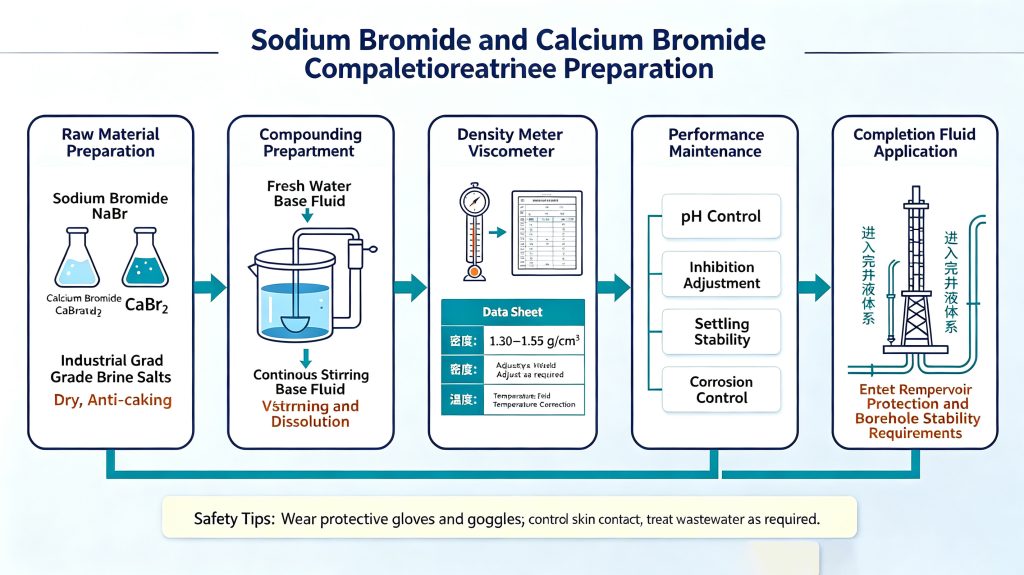
2.2 Gradual Batch Blending Sequence
- Inject qualified soft water into mixing tank;
- Turn on all circulating pumps and side-entry agitators to maintain turbulent flow;
- Add either sodium bromide or calcium bromide slowly in batches and fully dissolve;
- Introduce the second bromide component step by step after the first reaches stable target density;
- Circulate for at least 30 minutes after blending to homogenize concentration before sampling density testing.
2.3 Density & Crystallization Point Matching Design
Different NaBr/CaBr2 mixing ratios produce distinct freezing points. For offshore winter construction, calculate minimum crystallization temperature in advance to prevent pipeline blockage from salt crystal separation. Adjust blending proportion to raise anti-freezing performance.
2.4 Corrosion Control Matching Scheme
Mixed bromide brine contains high bromide and calcium ions, which boost metal corrosion risk. Configure dedicated bromide brine corrosion inhibitor and oxygen scavenger simultaneously; maintain pH value between 7.0–9.0 for the whole fluid system.
3. Construction & Storage Application Notes
- Preform compatibility lab test before large-volume onsite blending, verify no precipitation within 24h static observation;
- Avoid cross-contamination with chloride brine stock tanks; dedicated storage tanks and transfer pipelines for mixed bromide fluid;
- Seal tanks tightly for storage, adopt thermal insulation measures in low-temperature environments to reduce crystallization risk;
- Conduct regular density, pH and turbidity monitoring during long-term circulation; discharge turbid brine with sediment and re-blend fresh mixed fluid.
4. Consequences of Violating Mixing Taboos
- White insoluble precipitates block surface pipelines, downhole sand screens and perforations;
- Unstable brine density leads to well control hazards such as kick or formation fracture;
- Accelerated tubular corrosion causes equipment leakage and extra maintenance cost;
- Solid residues invade reservoir, reduce permeability and bring permanent oil and gas productivity loss.
5. Onsite Operation Summary
The primary taboos for sodium bromide & calcium bromide mixed completion brines are contact with sulfate/carbonate pollutants, rapid saturated stock liquid blending and mismatched anionic additives. Follow standardized dilution blending, water quality screening and anti-corrosion supporting processes to guarantee stable brine performance and safe wellsite operation.