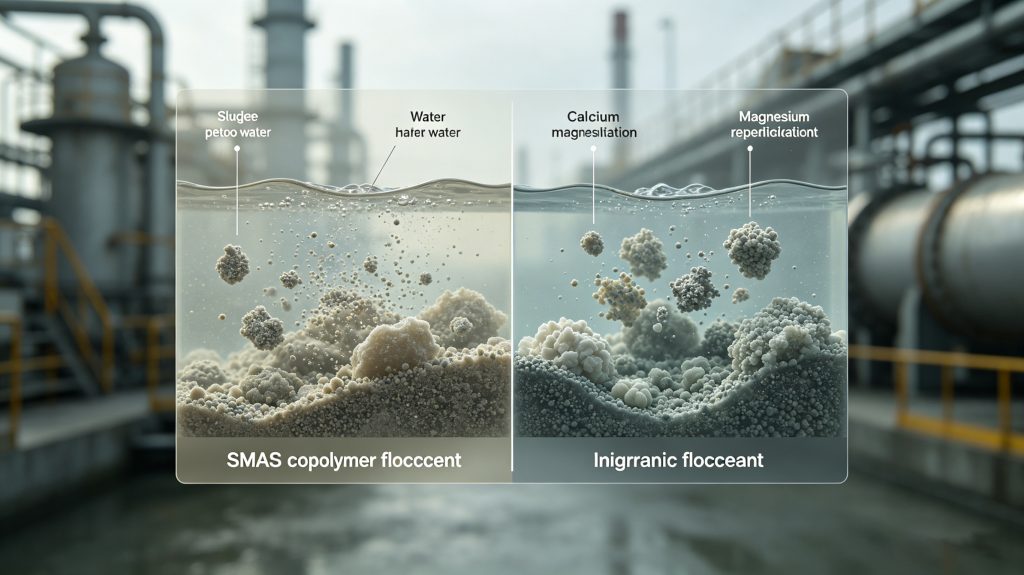
SMAS copolymers do not form insoluble precipitates with Ca²⁺ and Mg²⁺, avoiding the massive calcium‑magnesium sludge generated in the lime softening process. Its flocculation is mainly achieved through the adsorption and bridging effect of organic polymer chains, resulting in low sludge yield and good dewatering performance, which reduces the subsequent sludge disposal cost.
1. Why inorganic flocculants produce massive sludge in hard water
Inorganic flocculants such as aluminum and iron salts hydrolyze in water and react with high levels of calcium, magnesium and bicarbonate ions to form large quantities of insoluble precipitates, including metal hydroxides, calcium carbonate and magnesium carbonate.
High hardness and alkalinity greatly amplify hydrolysis and precipitation, resulting in huge sludge volume, extremely high water content and poor dewatering performance, which raises subsequent disposal difficulty and cost.
Inorganic flocculants introduce excessive metal ions, which combine with hardness ions to form dense, hardly degradable inorganic sludge.
2. Why SMAS copolymer flocculants avoid massive refractory sludge
- Organic polymer with no metal ions introducedAs an organic high-molecular copolymer, SMAS contains no aluminum, iron or other metal components. It does not hydrolyze to form metal hydroxide precipitates, fundamentally avoiding the increase of inorganic sludge.
- No insoluble sediment generated with calcium and magnesiumThe sulfonate groups on SMAS molecular chains chelate and disperse calcium and magnesium ions rather than forming precipitates. It stabilizes hardness ions and inhibits scaling and sedimentation, without producing carbonate or hydroxide sludge.
- Flocculation relies on adsorption and bridging, with low sludge yieldSMAS works mainly through molecular chain adsorption, bridging and sweeping effects to aggregate original suspended impurities only. No additional inorganic precipitates are generated, so the sludge output is far lower than that of inorganic flocculants.
- Compact flocs with low moisture content, easy dewatering and disposalSMAS forms dense organic flocs with low water content and fast settling speed. It achieves obvious sludge reduction and greatly reduces the cost of filter pressing, dewatering and subsequent transportation.
- Excellent resistance to hard water, calcium, magnesium and alkalinityWith sulfonate groups and methyl steric hindrance structure, SMAS molecular chains remain fully stretched and efficient in high-hardness and high-alkalinity water. The dosage is low and no excess chemical input increases sludge production.