
Conventional cationic flocculants easily lose efficacy under ultra-high salinity: inorganic ions shield surface charge, cause molecular chain curling and weaken electric neutralization and bridging ability.
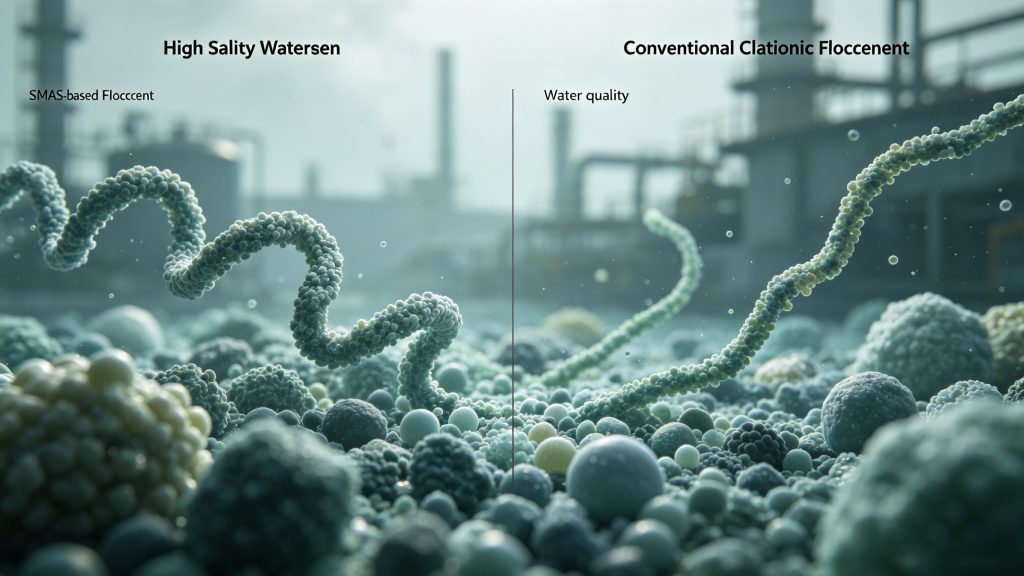
By contrast, SMAS-based flocculants remain excellent flocculation performance for these reasons:
- High-polarity sulfonate groups possess strong anti-shielding capacity, maintaining stable charge activity even at TDS over 100000 ppm.
- Methyl branched chains provide steric hindrance to keep polymer chains stretched without curling in high-salt water.
- Stable copolymer structure resists erosion of calcium, magnesium and high-concentration chloride ions, avoiding degradation and precipitation.
- It relies on multiple mechanisms including hydrogen bonding, hydrophobic association and sweeping flocculation, not only electric neutralization.
- Stable hydration film resists salting-out effect, preventing polymer separation and performance attenuation under extreme salinity.