
Why Initiator Dosage Matters So Much for ALS-Based Drilling Polymers
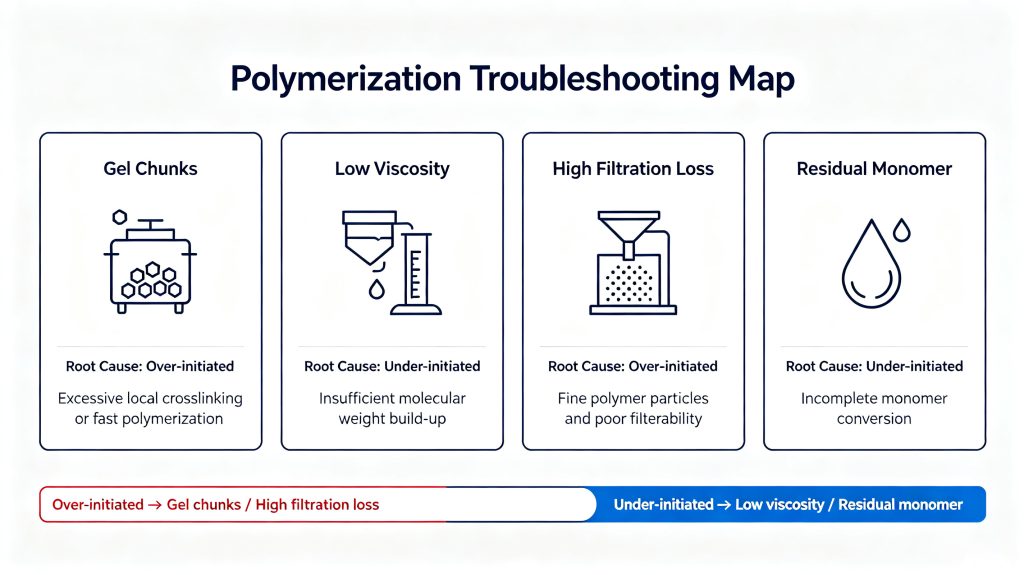
Sodium Allyl Sulfonate (ALS) is a low-reactivity allyl monomer compared with acrylamide and acrylic acid. Its allylic double bond has a strong tendency toward chain transfer and degradative chain transfer, which means the free-radical polymerization of an ALS-containing system is highly sensitive to initiator concentration. Get the initiator dosage wrong, and you either end up with low monomer conversion and a weak fluid-loss agent, or over-crosslinked, gelled chunks that ruin mud rheology.
In oilfield drilling polymers — especially anti-salt, high-temperature fluid-loss reducers and flocculants copolymerized from ALS + acrylamide (AM) + acrylic acid (AA) — the initiator is the single knob that controls molecular weight, conversion rate, and crosslinking level simultaneously.
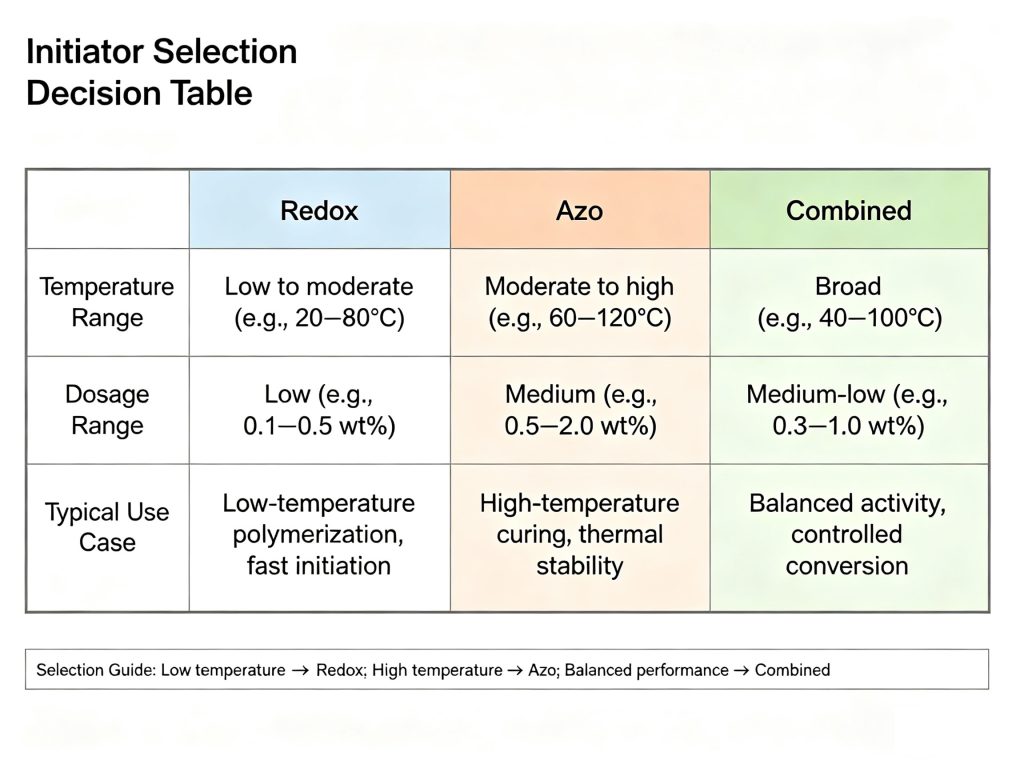
1. Match Initiator Type to the Temperature Window
Different initiator systems demand different optimal dosages:
- Redox systems (e.g., ammonium persulfate / sodium bisulfite): work at 30–55°C; typical total dosage is 0.3%–0.8% by total monomer mass. Good for low-temperature copolymerization but prone to residual monomer if underdosed.
- Thermal azo initiators (e.g., AIBA, V-50): work at 60–85°C; dosage typically 0.4%–1.0%.
- Combined redox + thermal systems: redox starts the reaction at low temp, then thermal initiator sustains chain growth; redox dosage 0.2%–0.4%, thermal dosage 0.2%–0.5%.
Do not arbitrarily raise the azo dosage just to push conversion — over-dosing accelerates chain termination and collapses molecular weight.
2. Keep Total Initiator within the 0.3%–1.2% Safe Band
For a typical ALS/AM/AA drilling fluid-loss reducer formulation (ALS 5%–15% of total monomers):
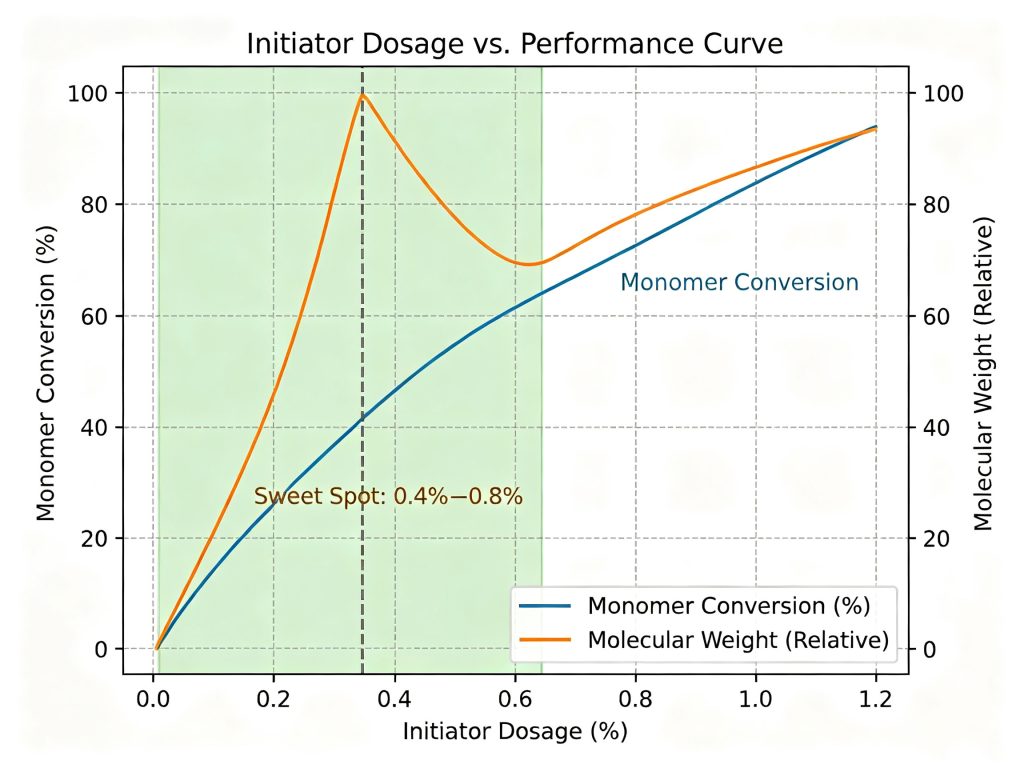
- Below 0.3%: reaction stalls, monomer conversion drops below 80%, residual ALS remains, and the product fails filtration-control tests.
- 0.4%–0.8%: the sweet spot — high conversion, balanced molecular weight, minimal crosslinking.
- Above 1.0%–1.2%: excessive radical density causes chain branching and micro-crosslinking; the polymer turns into a water-swollen gel that disperses poorly in mud.
Always scale dosage with total monomer concentration, not with reactor volume.
3. Dosage Must Scale with Solid Content
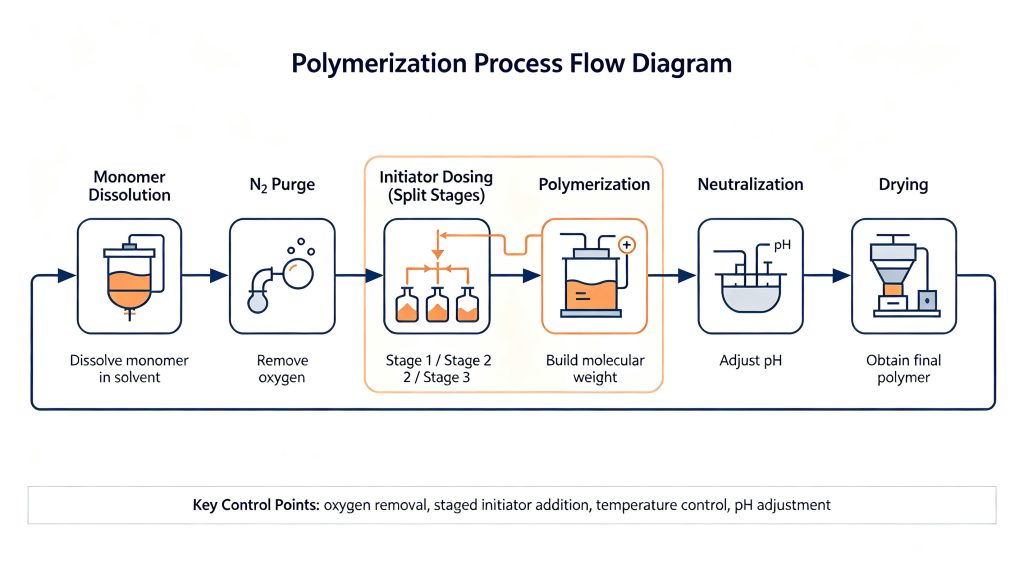
As monomer solid content rises (e.g., from 20% to 30% solids), the viscosity of the reaction medium climbs sharply and radical diffusion slows. Under these conditions:
- Reduce initiator dosage slightly (by ~10%–20%) to avoid a runaway exotherm;
- Split the initiator into two or three feed stages rather than a single one-shot addition;
- Add the second dose only after the peak exotherm subsides.
4. Control the Redox Pair Ratio
For redox initiation, the reducing agent-to-oxidizing agent ratio is usually held at 1:1 to 1.5:1 (molar). If the reductant is excessive, the system produces too many radicals too fast, leading to a sudden temperature spike and gel chunks. If insufficient, initiation is delayed and oxygen inhibition dominates.
5. Account for Water Hardness and Salt Content
Dissolved Ca²⁺, Mg²⁺, and Cl⁻ in make-up water can complex with sulfonate groups and consume free radicals indirectly. When using high-salinity brackish water as the polymerization medium, expect to raise initiator dosage by 10%–25% and extend the nitrogen purge time to compensate.
6. Avoid Initiator Over-Dosing at High ALS Fraction
When ALS fraction exceeds 15% of total monomers (formulations targeting extreme anti-salt performance), the allylic chain-transfer effect weakens effective radical efficiency. The temptation is to add more initiator — but this backfires:
- Higher initiator → more dead chain ends → lower final molecular weight → worse filtration control.
- Better strategy: keep initiator at the low end (0.3%–0.5%) and extend reaction time, or add a small amount of chain-transfer regulator.
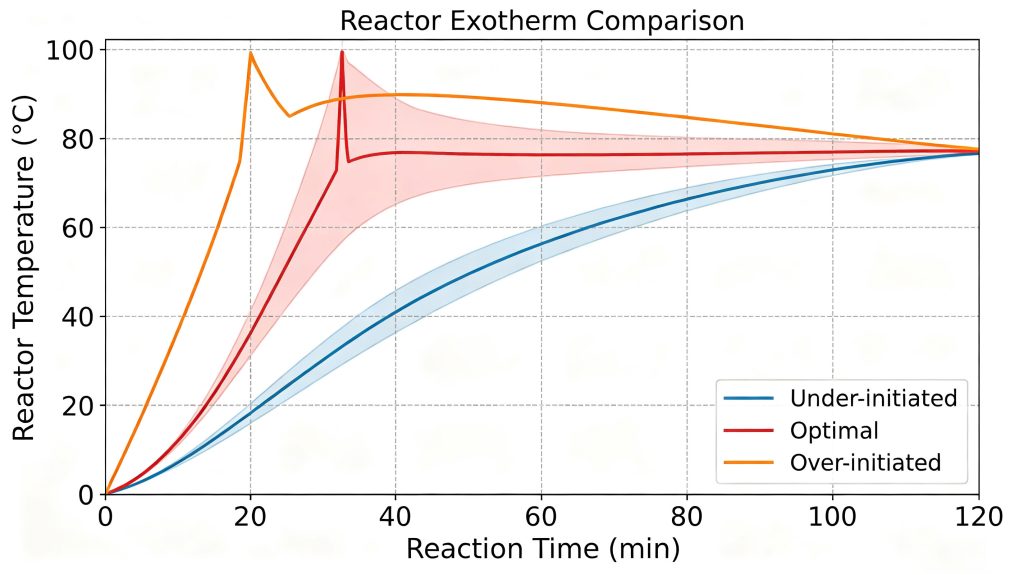
7. Monitor and Adjust by Exotherm, Not by Clock
The single best on-line control signal is the reactor temperature curve:
- A flat curve = under-initiated;
- A sharp, steep spike = over-initiated (danger of gelling);
- A smooth, sustained 5–15°C rise over 1–2 hours followed by gradual cooling = healthy initiation.
Tune dosage on the next batch based on exotherm shape, not on fixed recipe.
8. Quality Checks After Polymerization
After the reaction, verify:
- Residual monomer content (should be < 1% for ALS);
- Solution viscosity at standardized mud conditions;
- Filtration loss in bentonite mud before and after aging.
If viscosity is low but conversion is high, the initiator was over-dosed. If filtration loss is high despite good viscosity, ALS incorporation is insufficient.
Quick-Reference Summary Table
| Parameter | Recommended Range |
|---|---|
| Total initiator (redox) | 0.3%–0.8% of total monomers |
| Total initiator (thermal azo) | 0.4%–1.0% |
| Redox pair ratio (red.:ox.) | 1:1 – 1.5:1 (molar) |
| Optimal sweet-spot dosage | 0.4%–0.8% |
| Exotherm target rise | 5–15°C over 1–2 h |
| Residual ALS monomer | < 1% |