
Copolymer of Sodium Methallyl Sulfonate (SMAS) and acrylamide features rigid molecular chains, excellent shear, temperature and salt resistance. It adjusts reservoir flow profile, increases flow resistance in high-permeability zones, balances displacement front advancement, and remarkably inhibits channeling and viscous fingering in late-stage polymer flooding.
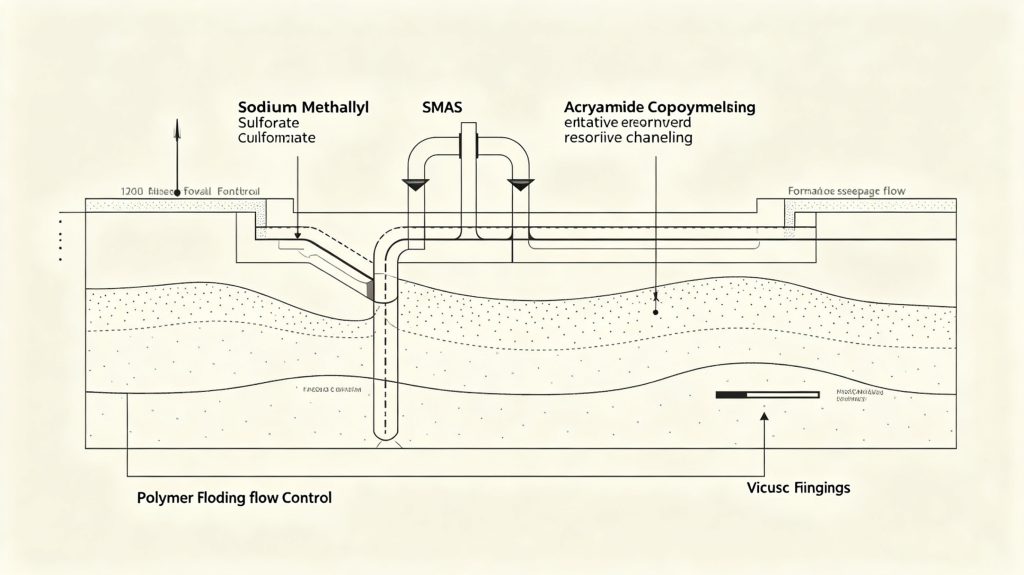
- Improved molecular chain rigidity and steric hindranceThe methyl branched structure of Sodium Methallyl Sulfonate (SMAS) enhances polymer chain rigidity and forms strong steric hindrance. It avoids chain curling and viscosity loss under high shear force, maintaining stable viscosity and flow control capacity in heterogeneous reservoirs.
- Enhanced salt and temperature resistanceIntroduced sulfonic acid groups greatly improve the adaptability in high-temperature and high-salinity formation water. The copolymer will not degrade rapidly, so it can maintain effective mobility control in long-term flooding process.
- Optimized injection profile control abilityIt has good selective plugging performance. The copolymer preferentially enters high-permeability flow channels, increases flow resistance, balances water absorption profile, restrains rapid fluid breakthrough, and slows down reservoir channeling.
- Uniform advancing front suppresses fingeringStable solution viscosity and excellent viscoelasticity make the displacement front advance evenly. It prevents local fluid rapid penetration, restrains the formation and expansion of viscous fingering, and expands the swept volume effectively.
- Strong adsorption retention in porous mediaThe copolymer adheres moderately to rock pore surfaces, forming stable flow resistance zones in dominant flow paths, further slowing down fluid shortcut migration and prolonging effective oil displacement period.